
001-200
062 | Miles Davis | Birth of the Cool | Capitol CAPS 1024 | 1957
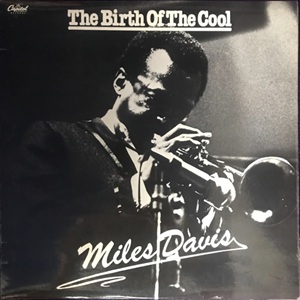
The Birth of the Cool is actually a 1957 compilation LP of recordings from the late 1940s, when Miles Davis began experimenting with a nonet format, after serving an apprenticeship with the giant of Bebop, Charlie Parker. Striving to discover a new direction in jazz, a handful of musicians worked towards this new direction by staging three sessions, which took place between 1949 and 1950, bringing together the collective talents of Gerry Mulligan, Lee Konitz and Bill Barber, who played on all the sessions, plus Kai Winding and Al Haig amongst others, each keen to explore the new orchestral sounds of what would later be referred to as ‘cool jazz’. It’s difficult to track down the original individual 10” 78s, therefore this release, which includes all the available takes, makes up for it and could be considered an essential item in any jazz collection. Birth of the Cool really paved the way for the West Coast jazz scene that was to follow shortly afterwards, with one or two of these musicians moving West for what was to become a highly productive period in jazz. Some of the compositions on the album are now considered classics, with Mulligan writing no fewer than three of the numbers, “Jeru”, “Rocker” and “Darn That Dream”, and Davis, co-writing a further three, “Budo”, in collaboration with Bud Powell, “Boplicity” with Gil Evans and “Deception” with a nod towards George Shearing’s “Conception”. Birth of the Cool could be considered a template for some of Divis’ later work in collaboration with Gil Evans, Miles Ahead, Porgy and Bess and Sketches of Spain amongst them.
061 | Jean-Luc Ponty | Enigmatic Ocean | Atlantic K 50409 | 1977
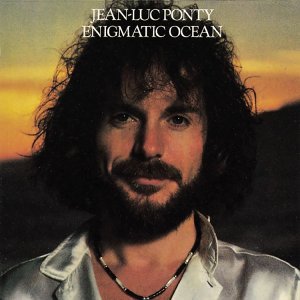
I would say that a confident musician stares back at us in from the cover of Jean-Luc Ponty’s Enigmatic Ocean, his 20th album release and his 4th on the Atlantic label. The French violinist and composer had by this time gained some attention after appearing on Frank Zappa’s Hot Rats album some eight years before, albeit on just the one composition ‘It Must be a Camel’. Around the same time, Ponty had paid tribute to Zappa by releasing an album entirely of his former boss’s compositions, King Kong. Ponty was well on his way to becoming a major league jazz fusion artist, who went on to release several more albums under his own leadership as well as being a member of the Mahavishnu Orchestra with John McLaughlin and as part of Chick Corea’s band. Enigmatic Ocean is presented in the style of a classical album, complete with an overture and two pieces divided into sections, four in the case of the title composition and three in respect of the closing piece, ‘The Struggle of the Turtle and Sea’. Having both Alan Holdsworth and Daryl Stuermer onboard brought with it its own rewards, with some highly inventive playing by both guitarists. The album did well upon its initial release in 1977, reaching the top spot on the Billboard album chart. Sadly most of my friends still mistake him for a French/Swiss New Wave film maker.
060 | John Coltrane | Coltrane | Impulse AS 21 | 1962
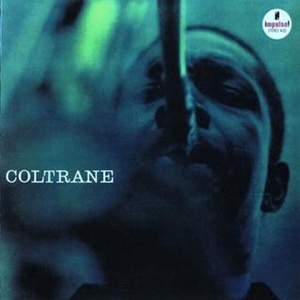
I write this on the eve of what would have been John Coltrane’s 100th birthday and have selected this 1962 LP almost randomly out of any number of landmark albums released by this gifted musical genius in his short lifetime. Always reaching beyond the bounds of current trends and styles, taking giant steps if you will, sometimes into the unknown, Coltrane could always be relied upon to take you to places you never dreamed possible. Whether as a sideman or in his own right, Coltrane could move notes from delicate melodic beauty to scorching torrents of experimentation, on either the tenor or soprano saxophone, his instruments of choice. On Coltrane, his third album released on Impulse!, not to be confused with the earlier debut on Prestige, also entitled Coltrane, the musician presents just five selections, two of his own construction and the other three carefully chosen numbers, including a couple of show tunes and one by Mal Waldren, the sublime ‘Soul Eyes’. Perhaps it’s the show stopping fourteen minute opener ‘Out of This World’ that begs initial attention, a confident piece of teamwork, based around an Arlen/Mercer tune recorded by everyone from Jo Stafford to Julie Andrews. Coltrane is joined here by the utterly reliable McCoy Tyner on piano, Jimmy Garrison on bass and Elvin Jones on drums. Like many works of genius, Coltrane was pretty much overlooked initially, probably due to the aforementioned giant steps he was taking alongside fellow musical adventurer Eric Dolphy, yet time has stamped its indelible mark on this album, which should be in any jazz collectors box.
059 | Georg Brunis | And His Rhythm Kings | Jazzology J12 | 2000
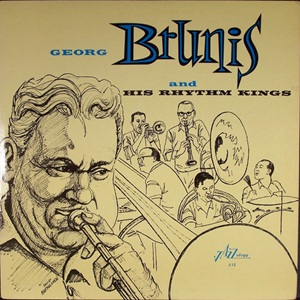
Known as the ‘King of the Tailgate Trombone’, Georg Brunis is perhaps best remembered as the trombonist for the New Orleans Rhythm Kings, a band of friends from the Cresent City, formed after he moved to Chicago in the early twenties. Playing by ear, Brunis (or to give him his real name, George Brunies), had already been performing in bands since the age of eight, steadily honing his flamboyant style. He was a showman who incorporated bizarre humour into his live performances, occasionally inviting the heaviest audience member in the room to sit on his chest while he played his instrument. Despite this strange behaviour, Brunis could also get the best out of his sidemen, much of which comes across in these nine selections. Joined by Dick Baars on cornet, Pat Patterson on clarinet, Clarence Hall on piano, Gene Mayl on both bass and tuba and Glenn Kimmel on drums, the band showcase the sound of New Orleans with some conviction, all nine selections being first takes with no mucking about with the tapes afterwards, therefore essentially, a live performance.
058 | Oregon | Out of the Woods | Elektra K 52101 | 1978
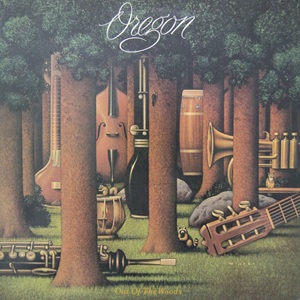
You only have to look at the sleeve design for this album to get a sense of what might be in store. David Wilcox’s array of instruments hidden in the woods, indicate that there might be jazz involved, but also classical elements and crucially, World influences, which is what we get. Having already released several albums on the Vanguard label, the quartet moved over to Elektra for the first of three albums on the label. Out of the Woods is a melting pot of styles, all of which merge into one another in a seamless flow, a showcase for the musical chops of Ralph Towner, Paul McCandless, Glen Moore and Collin Walcott, Towner and Moore friends since 1960, having met at the University of Oregon, hence the outfit’s name. If Paul McCandless’s oboe flitters between jazz and classical stylings with apparent ease, then Collin Walcott’s fluency in both the sitar and tabla ventures into Eastern territory with equal aplomb. The opening few bars of “Dance to the Morning Star”, might just as easily have been included on King Crimson’s Lark’s Tongues in Aspic record from roughly the same period, such is the spirit of adventure. Once you’ve heard Out of the Woods or indeed any of the other albums by Oregon, you tend to be assured that these musicians know what they are doing. It would be incorrect to imagine the music of Oregon to be wild and experimental, as much of it is smooth and soothing to the ear, “Vision of a Dancer” for example. Worth checking out.
057 | Herbie Mann | Mississippi Gambler | Atlantic SD 1610 | 1972
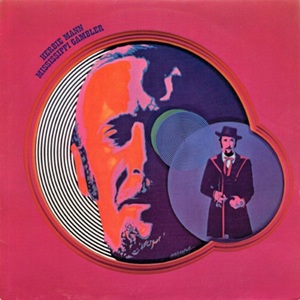
In a sea of sax and clarinet players, it’s easy to see why this New Yorker would choose to specialise in the flute and to explore the instrument’s possibilities in both jazz and what we now know as World Music. Why be a small fish in a big pond when you can make your mark on your own terms? Herbie Mann’s subsequent recorded output is vast, with the release of dozens of albums between 1954 and 2003, the year in which he left us at the age of 73. For ‘Mississippi Gambler’, Mann teams up with sax player David Newman, who also plays flute, for six selections, which includes a couple on Mann originals, including the title number, and nods to the Rolling Stones with a slow burning take on “(I Can’t Get No) Satisfaction”, together with a fairly pedestrian reading of Otis Redding’s “I’ve Been Loving You Too Long”, which doesn’t have the necessary punch that Booker T and Co gave the original, in fact here it verges on easy listening. The album is probably best remembered for its opener, a steady reading of the traditional “Swing Low Sweet Chariot”, and treats the melody to some funky soul. To cater for a full-length photograph of the musician, in a pose reminiscent of Robert Mitchum’s character in ‘The Night of the Hunter’, complete with a deck of cards in hand, the gatefold sleeve has an oddly placed pocket for the record to go, which adds to its charm.
056 | The Gerry Mulligan Quartet | What is There to Say? | Philips BBL 7320 | 1959
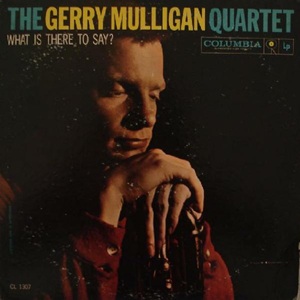
For ‘What is There to Say?’, Gerry Mulligan is joined by Art Farmer on trumpet, Bill Crow on bass and Dave Bailey on drums, an album recorded in late 1958, early 1959, and released later in the year. The four selections, a mixture of original Mulligan pieces with one or two standards, notably the Rogers and Hart chestnut “My Funny Valentine”, which here, loses none of its melancholy. The bassist Bill Crow even offers up his own “News from Blueport” to good effect. As the cover shot of Mulligan suggests, ‘What is There to Say?’ is as relaxed as his pose, contemplative, thoughtful and cool throughout, after all Mulligan was there at the birth of the cool, though the album closer “Utter Chaos” would suggest otherwise. Each time I take this down from the shelf, my aim is to listen all the way through, though I occasionally have to play “Festive Minor”, “What is There to Say” and “Just in Time”, at least a couple of times.
055 | John Coltrane | My Favourite Things | Atlantic ATL 5022 | 1961
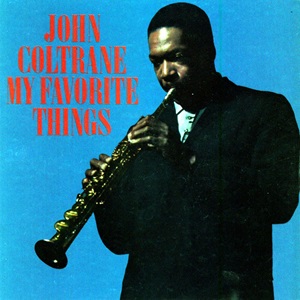
In a strange way, the title song from ‘My Favourite Things’, feels like hearing an excitable boy with a brand new toy. This is the first album to feature Coltrane’s soprano saxophone, a gift from Miles Davis, and he seemed determined to make it sing. There’s a certain amount of joy in this melody, familiar to those who had caught the latest Rogers and Hammerstein production on Broadway, and again to the millions who saw ‘the Sound of Music’ at the flicks four years later. In just a little under fourteen minutes, Coltrane manages to transform a song that was apparently created on the spot by a nun to ward off fear in the kids she was charged with looking after when she wasn’t whirling a dervish on the mountain slopes above Salzberg, to something wildly experimental, taking the song to new heights, higher than the mountains of Austria and way up into the stratosphere. Modern jazz hadn’t heard anything of the like before, as Coltrane took us on an adventurous musical journey into the very essence of the Richard Rogers melody, performed with supreme confidence. Though there are three other pieces of music on this album, it’s difficult to get past the title song, in fact had the album featured the title cut alone, it would have already done its job sufficiently well. Having said that, “Ev’ry Time We Say Goodbye”, “Summertime” and “But Not For Me”, make up a worthy support act, each a showcase not only for Coltrane, but also for his hand-picked collaborators, McCoy Tyner on piano, Steve Davis on bass and the ever reliable Elvin Jones on drums. Coltrane’s reading of this fine melody is essential listening for anyone who appreciates music, and not just jazz. Magnificent.
054 | Pat Metheny | Rejoicing | ECM 1271 | 1984
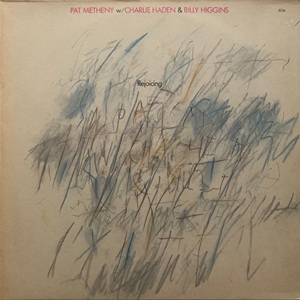
As a small and compact combo, the guitar, bass and drums triumvirate has always been something of a winner in several genres of music, certainly in the world of rock, where such bands as Cream, the Jimi Hendrix Experience, Taste and later Rush and Nirvana seemed to thrive. In the world of jazz, the same formula can occasionally create excellence, though in a markedly different way. For the American guitarist Pat Metheny, it was vitally important to approach this formula by choosing a rhythm section made up of outstanding musicians who could maintain musical empathy throughout. With Charlie Haden and Billy Higgins, Metheny traverses the dusty end of his instrument with highly melodic flair. The album includes eight pieces of music, one or two from the repertoires of others, such as Ornette Coleman, who both Hadden and Higgins had previously worked with, “Tears Inside”, “Humpty Dumpty” and the title track, whilst opening with a reading of Horace Silver’s bluesy “Lonely Woman”. The rest is pretty much made up of original material, with Hadden even paying tribute to his buddy with “Blues for Pat”, whilst delivering some fine bass strokes in the process. After settling into the album, effectively rejoicing in the sound of Metheny’s highly listenable guitar playing, “The Calling” comes along to spoil the party with the dreadful guitar synthesizer, which is about as welcome as bagpipes at a Classical harp recital.
053 | Herb Ellis & Charlie Byrd | Guitar/Guitar | CBS 62552 | 1965

It takes no time at all to settle into the Latin vibe of this album’s opener, “Se Todos Fossem Iquais A Voce” or its English translation, “If everyone were just like you”, which was pretty much in vogue at the time of its release. The jazz world seemed to be impressed with anything south of the border, all of which was considered cool during this period and both Herb Ellis and Charlie Byrd were available to exploit the style. With six strings apiece, the Texan and the Virginian both managed to blend their respective techniques and come up with almost a dozen arrangements of both jazz standards and originals, the two guitars complemented by a rhythm section of acoustic bass and drums, courtesy of Keter Betts and Buddy Deppenschmidt respectively. Stylistically, the duo occasionally borrow from others, the middle section of “St Louis Blues” for example, which is clearly a nod towards Django Reinhardt, and also the contemporary Country Blues troubadour guitarists of the period, such as Stefan Grossman and Blind Gary Davis, certainly on Harlen Howard’s “Take Care of Yourself”. The two guitarists are pretty much at home with the Bossa Nova aspect of this record, notably their reading of “Jazz ‘N’ Samba” and the aforementioned opener, both composed by Antonio Carlos Jobim. This is the sort of record you need to plonk on the turntable after a difficult shift, preferably with a nice Touriga Nacional.
052 | Sonny Stitt & Paul Gonsalves | Salt & Pepper | Jasmine JAS 26 | 1964

The two tenor sax giants Sonny Stitt and Paul Gonsalves conspire to deliver this early Sixties gem for Impulse!, later reissued on the Jasmine label. The two musicians are joined by Hank Jones on piano, Milt Hinton on bass and Osie Johnson at the drums seat. Just five numbers here, but each performed immaculately by two seasoned players. It’s pretty much tenors all the way through, though Stitt picks up the alto for the final number “Stardust”. offering that all-important contrast such a song cries out for. Stanley Dance tells us in the liner notes that the session took place early in the morning on 5 September, 1964 and waxes lyrical on the duellist metaphor for probably longer than necessary. The duelling here couldn’t be further away from honourable gentlemen ready to whack one another at dawn, but empathise warmly throughout the 35 minutes of music. With Bob Thiele at the helm, the ensemble deliver on cue, some fine performances, not least the sprawling 12 minute “Perdido”. Perhaps the strangest moment is the inclusion of the quirky “Theme from Lord of the Flies”, based on the children’s chant featured in the movie version of the Classic William Golding novel, which at just under 3 minutes, keeps the listener somewhat engaged, if only temporarily. One niggle, the cover shot could be better.
051 | Bob Brookmeyer Quintet | Traditionalism Revisited | Affinity AFF127 | 1984
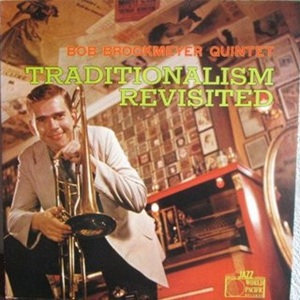
This 1984 reissue of an album first released on World Pacific in 1957 has lost little of its charm in the 27 intervening years, and then again nothing more over the last 42 years since its release, both presented with the same sleeve design, which features a clean-cut and youthful Bob Brookmeyer, looking relaxed in some unspecified jazz joint. The noted West Coast musician once again joins forces with Jimmy Giuffre and Jim Hall to conjure up some of the magic the trio managed to achieve under the leadership of Giuffre around the same period in the late 1950s. The interplay between Giuffre’s clarinet, baritone sax and tenor sax and Hall’s ever reliable guitar, are perfectly aligned to Brookmeyer’s valve trombone throughout. Here though, the trio are specifically looking back, hence the title, reimagining such standards as “Honeysuckle Rose” and “Sweet Like This”. Once again it’s worth recalling the opening sequence of the ‘Jazz on a Summer’s Day’ film, where these three core musicians, each suited and booted, herald in the new sounds of the day, each contributing that definitively ‘cool’ sound. Much of that feel is captured here on these eight selections, with the added bonus of having borrowed Gerry mulligan’s then current drummer David Bailey, plus Joe Benjamin and Ralph Pena sharing the bass duties. Nat Hentoff’s extensive liner notes praise the album’s credentials, which I couldn’t possibly add to, other than to say ‘Traditionalism Revisited’ is very much worth revisiting once again.
050 | Dave Brubeck Quartet | Time Out/Time Further Out | CBS 22120 | 1976
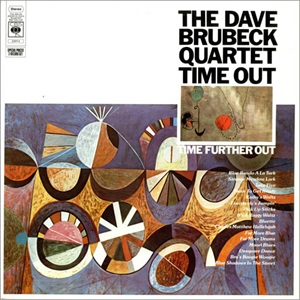
“Take Five” might well be the only familiar tune in the entire Modern Jazz catalogue to some, Paul Desmond’s composition having enjoyed much radio play in its day and continues to be a firm favourite to many still. Its quirky 5/4 time signature went on to influence a myriad of subsequent compositions, from such diverse artists as Nick Drake (“Riverman”), Radiohead (“15 Step”), Pentangle (“Light Flight”) and even the ‘Mission Impossible’ theme by the late Lalo Schifrin. Despite the edited version being released as a single in 1959 with “Blue Rondo a la Turk” on the flip side, it’s the fully realised, almost improvisational version on Brubeck’s ‘Time Out’ LP that makes its mark on the jazz world. Coming in at five and a half minutes, the arrangement features a lengthy drum solo, which because of its time signature, surprisingly keeps the customer satisfied throughout. Coupled with Brubeck’s later release ‘Time Further Out’, the two albums make perfect bedfellows with this mid-1970s release, complete with its abstract artwork courtesy of both S. Neil Fujita and Joan Miró. ‘Time Further Out’ continues to explore the 5/4 time signature with “Far More Blue” and “Far More Drums”, both composed by Brubeck, rather than Desmond, with other explorations in time being “Maori Blues” (6/4) and “Blue Shadows in the Street (9/8), with “Charles Matthew Hallelujah” settling for something as straightforward as 4/4. Essential for all jazz collections
049 | Paul Desmond | Take Ten | RCA LPM 2563 | 1963
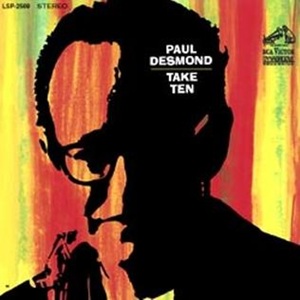
So vital was the playing of Paul Desmond to the sound of the Dave Brubeck Quartet, that one or two would be under the impression that Brubeck himself was the sax player, and some may have even thought that Brubeck’s classic number “Take Five” was from his own pen. On the contrary, the genius behind the alto sax playing and that particular composition, was in fact Paul Desmond, whose gentle tonality provided what some refer to as ‘Cool Jazz’ with one of its most recognisable sounds. The Californian musician released ‘Take Ten’ in 1963, four years after Brubeck’ landmark ‘Time Out’ album, which features the aforementioned “Take Five”. On ‘Take Ten’, the title track is loosely based around the same time signature and feel of the earlier composition, which has become something of a signature sound for the musician. Desmond is joined by the ever reliable Jim Hall on guitar and Connie Kay on drums, with three bass players contributing their parts accordingly, those being Gene Cherico, Eugene Wright and George Duvivier. Strangely, this album has something in common with both the Rolling Stones and the Velvet Underground, which could be a good pub quiz question; they each have album covers designed by the pop artist Andy Warhol, ‘Take Ten’ being Desmond’s.
048 | Louie Bellson | Cool Cool Blue | Pablo 2310 899 | 1983
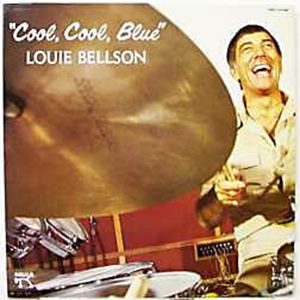
Luigi Paolino Alfredo Francesco Antonio Balassoni is not the sort of name you would normally see on a billboard, not back then and certainly not now, though the much shortened Louie Bellson was a much more usable moniker for this Illinois-born drummer. Cool Cool Blue is one of the musician’s later albums, having already released a good few dozen by the time of its release in the early 1980s. A seasoned player, Bellson had worked with both Duke Ellington and Count Basie, as well as such notables as Ella Fitzgerald and Sarah Vaughan, and even on two albums by Linda Ronstadt. For this album Bellson gathered together a handful of musicians from his much larger orchestra, namely George Duvivier on bass, Frank Strazzeri on piano and both Matt Catingub and Ted Nash on either alto, tenor or soprano sax. The bulk of the compositions were written by Bellson and Strazzeri, with the one Duvivier offering, the soothing “Wanderlust”, his bass runs prominent throughout. Produced by Alan Freeman, the British record producer and engineer and not the fluffy pop DJ, Cool Cool Blue captures the band on fine form.
047 | Bill Evans | Waltz for Debby | Riverside RLP 9399 | 1962

It was tragedy that ensured a short life for this fine trio, with the fatal accident involving the young bassist Scott LaFaro on 6 July, 1961, just ten days after this historic recording was made at the Village Vanguard in New York. The trio had already released three albums on the Riverside label leading up to this, Portrait in Jazz (1960), Explorations (1961) and Sunday at the Village Vanguard (1961), essentially the first part of this date at the venue. The six selections, recorded in the relatively quiet ambience of the famous club, showcases precisely what these three musicians could deliver on a good night, each of them providing the vital ingredients for the finished dish. The inventive bass runs in particular reveal a musician who you could well imagine being much missed after LaFaro’s tragic accident. Named for Evans’ niece, the title composition dominates the first side, sandwiched between the much shorter opener “My Foolish Heart” and the slightly longer “Detour Ahead” before we even consider flipping the record over. Once that particular chore is done, the good news continues with a fine reading of the Rogers/Hart number “My Romance” before venturing into Leonard Bernstein’s “Some Other Time”, from the earlier musical On the Town, which is so close to the slow ballads on Kind of Blue, it wouldn’t have been out of place on that landmark album. Tipping his hat to his recent collaborator and band leader Miles Davis, Evans rounds things off with a delicate rendition of “Milestones”, which loses none of the power demonstrated by Miles’ first great quintet version recorded three years earlier for the album of the same name.
046 | Lee Konitz and Red Mitchell | I Concentrate on You | SteepleChase CSC 1018 | 1974
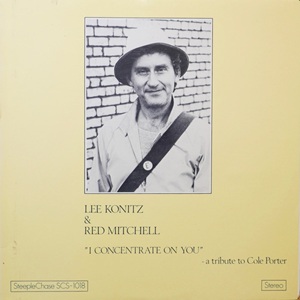
A duet album recorded in Denmark in the mid-1970s, in tribute to the great songsmith Cole Porter. Eleven songs set to the alto sax and double bass (or piano on “Night and Day”) by two musicians whose musical empathy is evident from the start of “Just One of Those Things” through to the title cut “I Concentrate on You”. Recorded at the Rosenberg Studio in Copenhagen, Denmark, I Concentrate on You finds the Chicago-born sax player in relaxed mode throughout, with the New York bassist providing complex patterns or those all-important spaces, which allow the pieces enough room to breathe. This is most evident on “It’s Alright With Me”, the popular song from Porter’s 1953 musical Can-Can. Despite the absence of the human voice, which is the usual vehicle for numbers from the so-called Great American Songbook, Konitz and Mitchell allow the melodies to be instantly recognisable, therefore giving you the listener the opportunity to sing along. Having said that, there is a moment of scat during “You’d Be Nice To Come Home To”. Despite some fine performances, the art department were having a rest day it appears, with a simple mug shot of the sax player wearing his familiar bucket hat against a brick wall, being as inviting as just the brick wall.
045 | Barney Kessel, Shelly Mann, Ray Brown | Poll Winners | Contemporary C 3535 | 1957
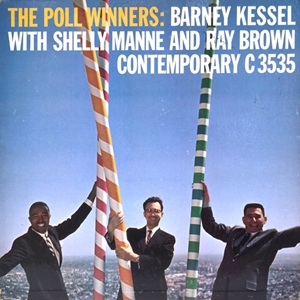
Barney Kessel, Shelly Mann and Ray Brown would go on to make five albums together, this being the first, where the trio make an exciting sound, to say there are no horns nor piano to worry about throughout, just one fine guitar player accompanied by a first rate rhythm section. As with many album cover shots at the time, one has to stand back and scratch one’s head, though I’m sure it all made perfect sense at the time. The photo does however illustrate the sun-drenched West Coast sensibility, in much the same way as the Beach Boys would do throughout the following decade with their album covers. So with sun and suits, together with swirling barber shot tubes, Kessel, Mann and Brown wade into the contemporary cool jazz scene with some confidence. The title may allude to the fact that these musicians were winning certain accolades at the time, which is unsurprising, as each of them are masters of their craft. Kessel’s guitar style is notable not only for its highly melodic flair, but also for its command over rhythm, making it all the more compatible with the fine rhythm section of Brown’s confident bass runs and Mann’s seasoned drum patterns. With some rather spiffing performances of Duke Jordan’s “Jordu”, Duke Ellington’s “Satin Doll”, and a fine arrangement of “On Green Dolphin Street”, the trio made their mark before the decade was through. The Rock generation that followed ten years later probably owes more to jazz than we tend to appreciate. What was Cream, Taste, James Gang, ZZ Top and Nirvana (to name but a few) if not a guitar, bass and drums combo? You’re Welcome.
044 | Sonny Rollins | The Best Of Sonny Rollins | Blue Note B1-93203 | 1989
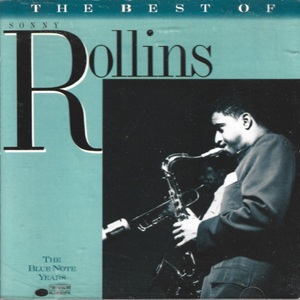
It was back in 1991, after seeing the Alan Plater play Misterioso on the telly, as part of the BBC’s Play on One series, that I felt a need to discover more about the music of Sonny Rollins. Thelonious Monk’s composition of the same name was used throughout the drama, which became an ear worm that I just couldn’t budge until I had the recording in my mit. After searching the jazz shelves at my local record shop, I came across the track in question of this fine Sonny Rollins compilation, featuring some of the musician’s finest recordings, including “Misterioso”, which first appeared on the earlier Sonny Rollins Volume 2 LP first released in 1957, both released on the Blue Note label. So began my venture into collecting Sonny Rollins albums, which has been an utterly fruitful pursuit, starting with the albums that this collection of recordings were lifted, Sonny Rollins Vol. I, (BLP 1542), Sonny Rollins Vol. II (BLP 1558), Newk’s Time (BST 84001) and A Night At The Village Vanguard (BLP 1581). I bought this album towards the end of 1991, around the time we lost Miles Davis, who Rollins once worked with during their Prestige period, and sadly 35 years later, we have to bid farewell to Sonny Rollins, who died at the age of 95 on 25 May, 2026. The Best of Sonny Rollins: The Blue Note Years is as good a place as any to start for any newbies.
043 | Miles Davis | ‘Round About Midnight | Columbia CL 949 | 1957
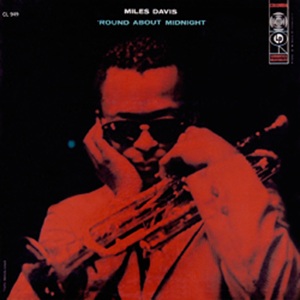
The first of a fruitful partnership with Columbia Records, ‘Round About Midnight is a vehicle for the musician’s first great quintet, which features alongside Miles Davis on trumpet, John Coltrane on tenor saxophone, Red Garland on piano, Paul Chambers on double bass and Philly Joe Jones on drums. It takes just six numbers to demonstrate the unique talents of this quintet, with each member of the band on fine form throughout. Setting out their stall with compositions ranging from Cole Porter and Charlie Parker, through to Tad Dameron and Thelonious Monk, whose title tune, “‘Round Midnight”, without the additional noun, opens the album on a rather melancholy note, conjuring the feel of the twilight hours. Parker’s “Ah-Leu-Cha” is actually a contrafact of the earlier “Honeysuckle Rose” and provides the album with its sincere nod to the bebop era. In the same year, Miles would release Miles Ahead, his first collaboration with noted Canadian arranger Gil Evans, followed by the release some of the most outstanding records in jazz, including Milestones, Kind of Blue and Someday My Prince Will Come. In a way, it was this album that paved the way for some landmark collaborations.
042 | Bireli Lagrene | Bireli Swing ’81 | Jazzpoint | 1981
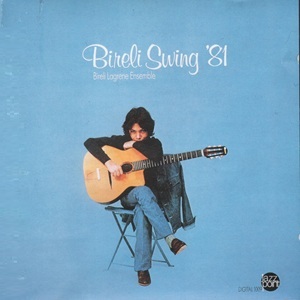
When I first heard the virtuoso playing on Bireli Swing ’81 a good few years ago, which featured a cover shot of a seated 14 year-old French guitar player, looking only slightly bigger than the guitar, I couldn’t quite connect the image with the music. This was emphasised further by the image on the back of the sleeve, with a standing Bireli Lagrene, who was clearly a toddler at the time. I later reasoned that if you pick up a guitar at the age of four and hang around the right people, you are likely to excel early. Born into a musical family, both his father and grandfather guitar players in their own right, Bireli Lagrene took to it like a duck to water and soon had Django Reinhardt tunes down to a tee. Amazingly, Bireli Swing ’81 is Lagrene’s second album, having already released his debut at the age of 13, and features a couple of Django standards, “Djangology” and “Nuages”, but also introduces us to a handful of Lagrene originals, which stand up beside those of the undisputed master of the gypsy guitar style, certainly the album opener, “B.L.” Equally at home with Reinhardt tunes as with his own compositions, Lagrene at such a young age, tackles such well worn tunes as George and Ira Gershwin’s “Lady Be Good” and Kurt Weill’s “September Song”, yet appears to bring something new to the table at the same time. Lagrene’s youthful flair and advanced dexterity makes this album essential listening.
041 | Hank Mobley | Soul Station | Jazz Images 37165 | 1960
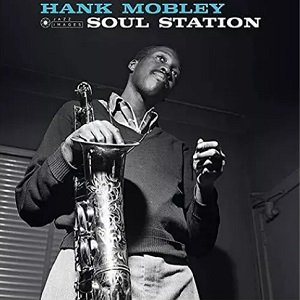
Originally released in 1960 on Blue Note, Soul Station is Hank Mobley’s twelfth album, with some of the earlier releases on either Savoy or Prestige. Joined by Wynton Kelly on piano, Paul Chambers on bass and Art Blakey on drums, Mobley allows these musicians plenty of scope for improvisation, notably on “This I Dig of You”, which could easily be Mobley’s way of showing his appreciation. Art Blakey’s drum solo alone demonstrates the fact that Mobley hangs around the right people. This re-issue on Jazz Images re-visits the same set list with the addition of a bonus track, “Three Coins in a Fountain”, with Philly Joe Jones replacing Blakey, plus an entirely different cover shot, though by the same photographer, Francis Wolff. With Alfred Lion producing and the ever dependable Rudy Van Gelder at the controls, the other six original album tracks sound as fresh as the day they were recorded, that day being 7 February, 1960, the place, Englewood Cliffs, New Jersey.
040 | John Lewis | Cool! | Fontana 683 256 JCL | 1964
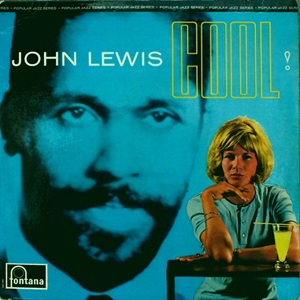
The long serving member of the Modern Jazz Quartet occasionally ventured into extracurricular activities and released several solo albums, or at least group albums under his leadership. Cool! was his second album originally released on the Pacific Jazz label in February 1965 under the title Brief Encounter, subtitled 2° East – 3° West, which refers to the mix of east and west coast musicians involved, and with a different sleeve and running order. The six selections includes just the one Lewis original “Two Degrees East, Three Degrees West”, designed to give each of the musicians a little breathing space, those musicians being Jim Hall on guitar, Bill Perkins on tenor sax, Percy Heath on bass and Chico Hamilton on drums. For those wishing to further investigate, you may inadvertently stumble upon the lingerie pages of a famous British department store during your search, which I think is fair warning. Notable tracks include the lengthy “Almost Like Being in Love”, which is promoted to opener here (though the final track on the original), and “Love Me or Leave Me” the opener on the original.
039 | The Jimmy Giuffre Trio | The Train and the River | Atlantic 590 011 | 1967
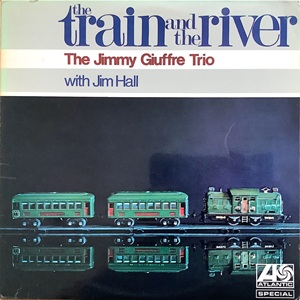
Atlantic Records produced an excellent series of fine albums in the 1960s and 1970s on their specially designed orange label, each album released in a uniform turquoise sleeve and each featuring noted jazz artists that included at one point or another, John Coltrane, Ornette Coleman, Erroll Garner, Charles Mingus and many other jazz greats. Jimmy Giuffre had already released the selections on this release ten years earlier under the title The Jimmy Giuffre 3, most notable amongst them being the title instrumental “The Train and the River”, famously featured over the title sequence of the film Jazz on a Summer’s Day. Joining several other albums in the series, The Train and the River became a fine addition and an essential classic from this or any other period in jazz. Joined by Ralph Peña on bass and Jim Hall on guitar, Jimmy Giuffre demonstrates his flair on the clarinet, tenor saxophone and baritone saxophone and sometimes all three on the same number. Recommended tracks, “The Train and the River”, “Gotta Dance” and the bluesy “Crawdad Suite”.
038 | Sonny Rollins | Way Out West | Contemporary C 3530 | 1957
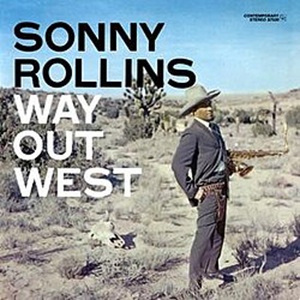
I often wondered whether Mel Brooks had the Way Out West sleeve shot in mind when he made Blazing Saddles back in 1974. I’m still not sure what Sonny Rollins was thinking when he donned the full cowboy garb for this album cover, but there again, the world was very different back in 1957. It was apparently his idea, when he asked William Caxton to take the photos, to mark the saxophonist’s first visit to California. Rollins is on good form here, despite the fact that the sessions began at the ungodly time of 3am, the only available time for these three busy musicians, the other two being Ray Brown and Shelly Mann on bass and drums respectively. No piano or guitar on this album, a first for Rollins, though in these hands, they’re not missed. Of the six selections here, three reference the West in their titles, the opener “I’m an Old Cowhand (From the Rio Grande)”, “Wagon Wheels” and the closing title cut, with further nods to Duke Ellington and Isham Jones, with fine performances of both “Solitude” and “There is No Greater Love”. These days we think of John Coltrane as the main man when it comes to the tenor sax, yet at the time of this album release, Rollins was still at the vanguard of modern jazz and was definitely the one taking giant steps.
037 | Milt Jackson | Bebop | East-West 790 991 1 | 1988
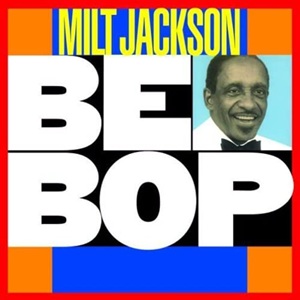
As the title suggests, Bebop takes Milt Jackson back to his roots, paying homage to the likes of Charlie Parker, Dizzy Gillespie and Tad Demeron, three of the chief architects of the highly charged jazz style of the early to mid-1940s. Jackson would’ve been an impressionable 17 year-old when Parker and Gillespie were tearing it up on the bandstand, and possibly taking notes. Of course Jackson was also a noted Bebop vibes player, and worked on those same 52nd Steet bandstands, rubbing shoulders with the best of them, including Gillespie himself. Bebop was released in 1988 when Jackson was in his mid-Sixties, though much of that original energy is very much present here in these eight favourites, including Charlie Parker’s “Au Privave”, “Now’s the Time” and “Ornithology” and Dizzy Gillespie’s playful “Salt Peanuts”. For Bebop, Jackson gathered together an empathetic group of sidemen, Jon Faddis on trumpet, whose solo on “Salt Peanuts” is staggering, JJ Johnson on trombone, Jimmy Heath on tenor sax, Cedar Walton on piano, John Clayton on bass and Mickey Roker on drums.
036 | Chico Hamilton | Quintet in Hi Fi | Pacific Jazz LAE 12045 | 1956
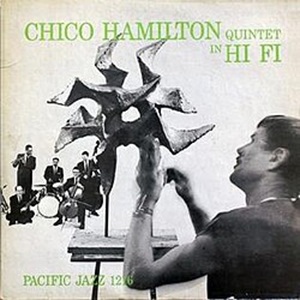
Sleepy Stein’s sleeve notes to this album declare that Chico Hamilton Quintet in Hi Fi ‘is not just a jazz album’, rather that it’s ‘an experience in the heights which our art has achieved’. The art theme is echoed in the cover shot, a sculptor at work. Perhaps it’s because Chico Hamilton is a drummer that so much can be achieved with those hand-picked musicians he chooses to work with and in the case of this quintet, some fine performances are to be found. Jim Hall’s guitar flurries take flight throughout, underpinned by a Buddy Collette’s wind arsenal of either alto or tenor sax, clarinet or flute. At times the quintet sound a little like a chamber orchestra, probably due to Fred Katz’s flamboyant cello, which the other musicians run with accordingly. “Chrissie” has a fine arrangement by Jim Hall, which sees the guitarist spar with Katz’s flute with some fluency. “The Ghost” is one of the highlights of the album, Collette’s arrangement giving each member of the band the space to explore. The band leader’s prerogative is to take his inevitable turn at some point and here it’s with the penultimate number “Drums West”, the album’s only live track, apparently recorded around the time of the album sessions, which should probably have been saved for Hamilton’s drum clinics rather than being put on the album. Five-minute drum solos are usually the drummer’s cup of tea exclusively and not really for the rest of us.
035 | Miles Davis | Filles de Kilimanjaro | Columbia PC 9750 | 1969
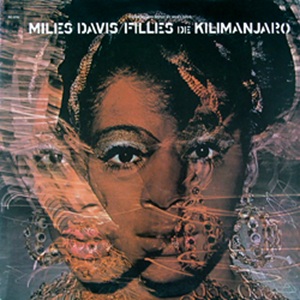
In 1969, Miles Davis would’ve been well aware of Jimi Hendrix, Cream and the progressive development of The Beatles, and would strive to take his music to similar heights. Never one to let the grass grow under his feet, Miles recorded Filles de Kilimanjaro almost immediately after Miles in the Sky with the same line-up as his previous four albums, ESP, Miles Smiles, Sorcerer and Nefertiti, and in the same year as the adventurous In a Silent Way, which would change things yet again. Where this album differs from the previous five albums, is that it features two different line-ups of his famous second quintet, Miles on trumpet, Wayne Shorter on tenor sax and Tony Williams on drums, with Herbie Hancock on piano and Ron Carter on bass on three of the tracks, being replaced on the other two tracks by Chick Corea and Dave Holland respectively. Though the first side of this album features three exceptional tracks, worthy of any jazz album of the period, it’s with the second side that the magic happens. The two lengthy pieces, “Filles de Kilimanjaro” (or “Girls of Kilimanjaro”), features five musicians who are clearly listening to one another, whilst the album closer “Mademoiselle Mabry (Miss Mabry)” showcases the intuitive connection between Corea, Holland and Williams, who were evidently well ahead of their game. Ralph Gleason in his liner notes quotes Edgard Varese, who once said “An artist is never ahead of his time but most people are far behind theirs”, which remains an astute observation, certainly when it comes to Miles.
034 | Thelonious Monk | Thelonious Alone in San Francisco | Riverside RLP 312 | 1959
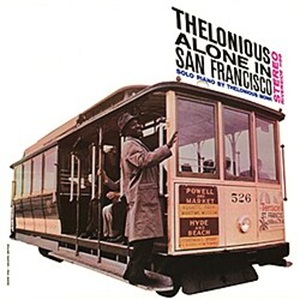
I never tire of listening to Thelonious Monk. For his third solo album, the other two being Piano Solo (1954) and Thelonious Himself (1957), Monk finds himself on stage at the Fugazi Hall in San Francisco on both the 21 and 22 October 1959, and both times he has no audience to worry about. The performances certainly have the feel of a live concert, with clearly audible grunts and mumbles throughout the ten-song set, though these recordings are uncontaminated by any audience whoopin’ and hollerin’ or indeed applause. One or two old familiars come out to play, notably “Blue Monk” and “Ruby My Dear”, the two choice openers, but there’s so much more to appreciate besides, certainly worth a mention is “There’s Danger in Your Eyes, Cherie”, which could be considered an album highlight. Monk is on form throughout the forty-odd minutes, and delivers these tunes as only he possibly could. Highly inventive, slightly quirky but always interesting, Thelonious Alone in San Francisco remains a master work.
033 | The Art Farmer Quartet | Interaction | London Atlantic SH-K 8135 | 1963
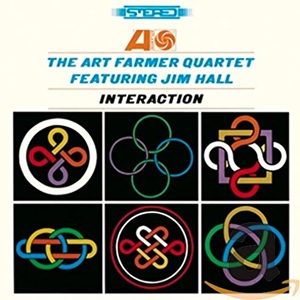
Known chiefly as a trumpet player, but also a master of the flugelhorn, and occasionally a mixture of the two, the ‘flumpet’, which was designed especially for him, Art Farmer knows his way around the valves on all three. For this album though, Farmer chooses the flugelhorn throughout, it’s gentle, almost melancholy sound, lending itself perfectly to such ballads as Henry Mancini’s “Days of Wine and Roses” and George Gershwin’s “Embraceable You”. Joined by the hugely empathetic guitar playing of Jim Hall, together with the rhythm section of Steve Swallow on bass and Walter Perkins on drums, Farmer keeps it pretty relaxed over the six selections, each of which were recorded during sessions at Atlantic Studios in New York City in the summer of 1963. As Gene Lees points out in his liner notes, Farmer turned more and more to the flugelhorn after forming this quartet with Jim Hall, whose guitar style became a perfect match for Farmer’s warm and subtle sound. Both in their mid-thirties at the time of recording, they were young enough to showcase their adventurous prowess, yet old enough to demonstrate their mutual musical wisdom at the same time.
032 | Ornette Coleman | Something Else!!!! | Contemporary C 3551 | 1958
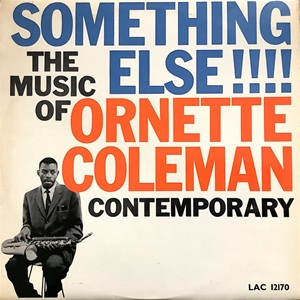
‘Roped Together’ is an old adage regarding Pablo Picasso and Georges Braque, which described their their intense collaboration as they developed the new art of Cubism. The same two words could possibly describe the collaboration between Ornette Coleman and Don Cherry as they ventured into the abstract world of Free Jazz. Ornette Coleman’s debut album Something Else!!!!, with no fewer than four exclamation marks, was recorded in the summer of 1958, when the saxophonist was still emersed in melodic jazz, the entire album being highly listenable, certainly with such numbers as “The Blessing”, “Angel Voice” and “When Will the Blues Leave?”, though there are signs of things to come. Ornette Coleman would go on to change the course of jazz, and would become a controversial figure, his foot firmly on the accelerator and his album titles suggesting a forward direction, Tomorrow is the Question!, The Shape of Jazz to Come, Change of the Century and such like. Free Jazz was certainly on its way, a style that the old guard frowned upon, my own father-in-law, a traditionalist, often sneering, with the usual throw-away comment, “oh, I see they’ve got their sheets upside down again”. Something Else!!!! features Ornette Coleman on alto sax, Don Cherry on cornet, Walter Norris on piano, Don Payne on double bass and Billy Higgins on drums.
031 | Wes Montgomery Trio | Wes Montgomery Trio | Riverside RSLP 310 | 1959
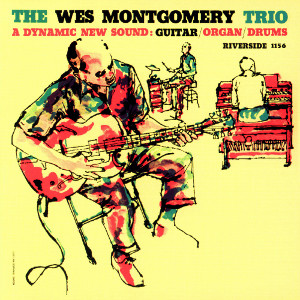
The sleeve for this late-fifties jazz album boasts ‘a dynamic new sound’, which may or may not be true, certainly if one compares it with other dynamic new sounds coming out at the time, Miles Davis’ Kind of Blue for example, or Ornette Coleman’s The Shape of Jazz to Come , or even Charles Mingus’ Mingus Ah Um, each of which brought their own particular dynamism to music in ‘59. Wes Montgomery’s new dynamic sound probably refers to his new combination of guitar, organ and drums, which probably wouldn’t keep the ‘deceptive advertising’ campaigners at bay. There’s certainly some adventurous guitar playing on these nine, mostly familiar tunes, such as Thelonious Monk’s “’Round Midnight”, Duke Ellington’ “Satin Doll” and Horace Silver’s “Ecorah”. Although Melvin Rhyne’s organ and Paul Parker’s drums make the very best effort to accompany these October 1959 recordings, all ears were perhaps on the 36 year-old guitarist’s bold playing throughout. As with a lot of jazz albums at the time, the sleeve artwork takes on a modernist approach, though in this case the guitarist featured looks more like Joe Pass than Wes Montgomery!
030 | Dexter Gordon | American Classic | Elektra Musician MUS K 52 393 | 1982
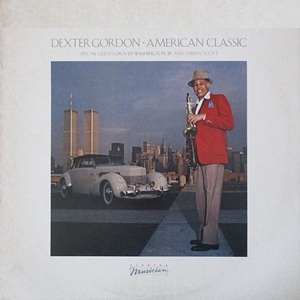
When Herman Leonard took that famous photograph of Dexter Gordon during a studio break in 1948, the saxophonist relaxing in a miasma of cigarette smoke, captured in vivid monochrome, I doubt whether the musician knew just how iconic that image would become in the following years, effectively becoming the poster that best represents the world of jazz. Three decades later and that poster boy was still appearing in striking images, even at the age of 60, as well as recording fine albums, American Classic being his penultimate release back in 1982. A snappy dresser, all six foot six of him, he seems to tower above the now sadly missed twin towers that once dominated the New York skyline behind him, while a white 1950s Cadillac Series 62 convertible waits to the side. Dexter Gordon is joined on this album by Grover Washington Jr on soprano sax, together with Shirley Scott on organ, Kirk Lightsey on piano, David Eubanks on bass and Eddie Gladden on drums. Recorded in both New York and Philadelphia over a couple of weeks in March, 1982, the five selections demonstrate that the man had still got it, especially on such numbers as the album opener, “Jumping Blue”, the sprawling closer “Skylark” and the playful “For Soul Sister”, on which Grover Washington Jr excels. The album also includes a short interview with Gordon tucked in at the end, where he talks about his early influences.
029 | Thelonious Monk & Art Blakey | Blue Monk | Atlantic 590.009 | 1962
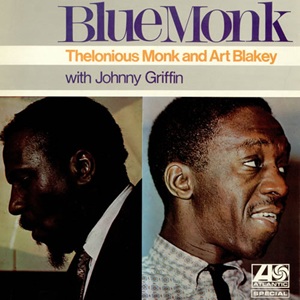
Originally released under the guise of Art Blakey’s Jazz Messengers with Thelonious Monk on the Atlantic label back in May 1958, after being recorded almost exactly a year before, Blue Monk was subsequently released as one of Atlantic’s special orange label releases, with Monk being placed first in the pecking order. The two formidable characters from the world of jazz are united for these sessions, their combined musical abilities very much on show throughout the six songs, predominantly composed by Monk. It’s difficult these days to over-estimate the importance of these two musicians, especially during this time of change. The great partnership of Monk’s compositional skills and Blakey’s sense of rhythm all shine through, especially on such compositions as “Evidence”, “I Mean You” and the title song. Added to this is the contribution of Johnny Griffin, whose tenor solos are top drawer, together with further contributions from Bill Hardman on trumpet and Spanky DeBrest on bass.
028 | Sonny Clark | Cool Struttin’ | Blue Note BST 81588 | 1958
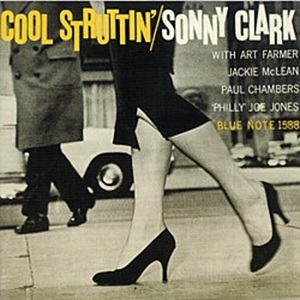
These days it’s hard to determine whether the popularity of Sonny Clark’s landmark album is due to the quality of the playing by the musicians involved, the choice of the four songs included or perhaps even the now iconic ankles of the wife of one of Blue Note’s co-founders. It has to be said that when one of those co-founders, Francis Wolff took the shot of Blue Note partner Alfred Lion’s wife, as she herself strutted along the pavement (oh go on then, sidewalk), none of them could have possibly imagined just how iconic the shot would become once Reid Miles incorporated it in the cover artwork for this classic album. Fortunately, the music matches up to the design, with four excellent performances, “Blue Minor”, “Sippin’ at Bells” and “Deep Night”, and not forgetting the memorable title opener. Joining Sonny Clark, whose piano never dominates proceedings, are Art Farmer on trumpet, Jackie Mclean on alto sax, Paul Chambers on bass and ‘Philly’ Joe Jones on drums. Essential listening.
027 | Stan Getz | Another World | CBS 35514/5 | 1978
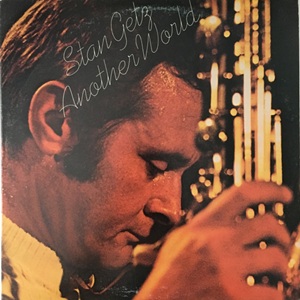
The album title gives the content away slightly, in that our man Stan does seem to meander in and out of his comfort zone and into an entirely different world to his usual ‘cool jazz’ fare. Joined by a bunch of fellow American musicians, namely Andy LaVerne on a variety of keyboard instruments, Mike Richmond on bass, Billy Hart on drums and Efrain Toro on percussion, the two LP set is a showcase for musical adventure. Despite the ‘out there’ title, Getz presents lots of flair, whilst the band provides plenty of musical empathy, especially on one or two of the album’s more challenging pieces, notably the title track, together with the galloping “Club 7 and Other World Places”, which almost ventures into Star Trek mode. Recorded in Montreux and produced by Getz along with his then wife, the late Monica Getz, Another World’s double package allows the band to pack quite a lot into its 75 minutes.
026 | Thelonious Monk | Monk’s Dream | Columbia BPG 62135 | 1963
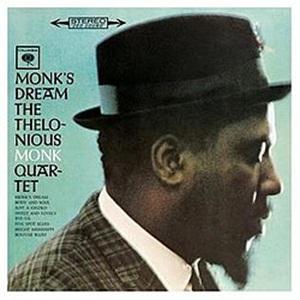
Monk’s first release on Columbia, after a brief spell with both Blue Note and Prestige, together with a highly productive thirteen-album spree with Riverside, Monk’s Dream initiated a long term relationship with a major label. Despite this, the album contained little in the way of anything new, most of the titles having already been recorded and released on other albums, notably in live settings, “Bright Mississippi” being the sole exception. Nevertheless, each of the selections here showcase Monk’s idiosyncratic style, especially on the two solo performances, “Body and Soul” and “Just a Gigolo”, but also on the remaining quartet recordings, all of which feature Charlie Rouse on tenor saxophone, John Ore on bass and Frankie Dunlop on drums. With Teo Macero at the helm, Monk’s Dream remains a memorable album even over half a century on.
025 | Gerry Mulligan | Night Lights | Wing WL 1125 | 1963
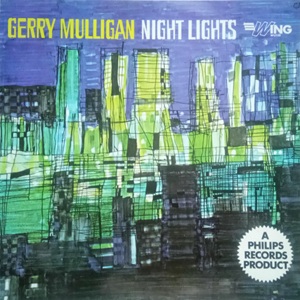
Whenever we think of the baritone saxophone, we almost always think of Gerry Mulligan, whose tall and slender frame seems to go hand in hand with the instrument. Having played with some of the biggest names in jazz, from Brubeck to Baker, Monk to Mingus and Holiday to Hampton, his instrument always takes command. Highly prolific, Mulligan released in excess of fifty albums over a career spanning five decades from 1946 to 1996 and Night Lights was around number thirty-nine (or thereabouts). Featuring a Stella cast of sidemen, Mulligan is joined by Art Farmer on flugelhorn, Bob Brookmeyer on valve trombone, Jim Hall on guitar, Bill Crow on bass and Dave Bailey on drums. With three Mulligan originals, including the rather tasty “Festival Minor”, the album also sees Mulligan venture into Classical territory, taking Chopin’s “Prelude in E Minor” for a walk in the park. Night Lights, as the title suggests, is an album for after hours and perfect with a night cap after a heavy day.
024 | Bobby Timmons Trio | Easy Does It | Riverside RLP 363 | 1961
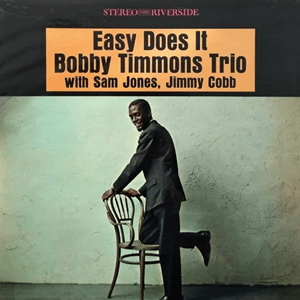
By the time his third album for Riverside came along in the Spring of 1961, Bobby Timmons had already appeared on several albums by the likes of Art Blakey, Cannonball Adderley, Nat Adderley, Pepper Adams and Chet Baker, providing each session with something both soulful and memorable. The trio he formed in 1960 with Sam Jones and Jimmy Cobb, on bass and drums respectively, first appeared on the trio’s debut album for Riverside, This Here is Bobby Timmons, which included “Moanin’”, a Timmons original probably best remembered as the title number on Art Blakey and the Jazz Messengers album of the same name, released a couple of years earlier. Easy Does It saw the return of the same trio, with pretty much more of the same, and was well received both commercially and critically at the time. With just three Timmons originals, the album concentrates on standards such as Dizzy Gillespie’s “Groovin’ High”, Harburg and Lane’s “Old Devil Moon” and Johnny Mercer’s “I Thought About you”.
023 | Kenny Burrell | Midnight Blue | Blue Note BLP 4123 | 1963
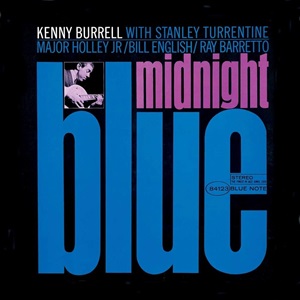
As the title suggests, Midnight Blue is imbued with a bluesy feel throughout, and possibly the kind you hear at the close of a day. Kenny Burrell’s highly distinctive guitar playing permeates the nine selections, enhanced further by the playing of Stanley Turrentine on tenor sax. The guitar/sax sparring on the album opener “Chitlins Con Carne” sets the bar high for the rest to follow. The rhythm section of Major Holley Jr. on double bass and Bill English on drums keeps the blues feel alive, especially on the slower numbers such as “Mule” and “Gee Baby, Ain’t I Good to You”, with some added percussion courtesy of Ray Barretto. The title number could perhaps be the template for Van Morrison’s “Moondance”, a groove that instantly informs the listener’s feet to move in time. Midnight Blue is certainly one of Burrell’s best known albums for Blue Note, certainly remembered for the music but also Reid Miles’ iconic sleeve design, the gatefold re-issue with no fewer than seven black and white shots of the guitarist in action. A shot of the other musicians involved wouldn’t have gone amiss. Leonard Feather’s liner notes give a good insight into the period.
022 | Jack Montrose | Blues and Vanilla | RCA LPM 1451 |1957

Is there a happier face in jazz than that of Jack Montrose on the cover of his 1957 album release Blues and Vanilla? Sharing a cover sleeve credit with vibes player Red Norvo, who also appears on the cover with the biggest ice-cream cone in California, the album was recorded in Los Angeles in the winter of 1956, the six titles ranging from the sprawling, yet sprightly, 18 and a half-minute “Concertina da Camera (Blues and Vanilla)”, to the decidedly shorter “A Dandy Line”, both sounding more whimsical than usual, the West Coast sound of the day very definitely at the fore. Largely self-penned, the album does feature the one notable standard, a bluesy reading of Duke Ellington’s “Don’t Get Around Much Anymore”, which features some fine playing by the tenor player. With over-enthusiastic sleeve notes by the record company, “This is Jack Montrose’s first album for RCA Victor. It will not be his last, nor his next to last, nor his fifth or tenth to last”, it appeared that they had faith in the musician and arranger. I think he actually made one more for RCA, but there you go. Montrose is joined by Red Norvo on vibes, Jim Hall on guitar, Max Bennett and Walter ‘Buddy’ Clark on bass, Bill Dolney and Shelly Manne on drums, with Joe Maini guesting on alto sax on the “Concertina”. As always, Jim Hall embellishes the album with some fine guitar licks.
021 | Thelonious Monk | Brilliant Corners | Riverside RLP 12 226 | 1957
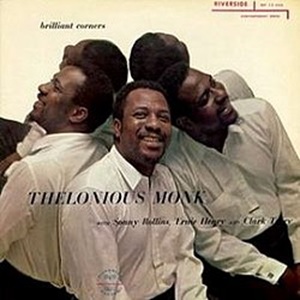
Whenever I hear the term ‘classic album’ I always approach it with caution. Is it a classic album or just a popular or bestselling album of its time? Brilliant Corners is a classic album and should be in everyone’s collection as it is a gift that keeps giving. Thelonious Monk presents five pieces, four of which are Monk originals for his third Riverside release, employing two different quintets. Monk’s idiosyncratic playing is immediately revealed on the album opener, the title composition “Brilliant Corners”, which was reportedly recorded 25 times with no successful results, the produced Orrin Keepnews having to splice together different takes in order to arrive at a finished recording, a little like George Martin’s mopping up after Beatles sessions. Sonny Rollins is on hand to provide some fine tenor sax soloing, augmented by contributions by Ernie Henry on alto sax, Clark Terry on trumpet, each of which are credited on the front cover, with Max Roach on drums and bass duties shared between Oscar Pettiford and Paul Chambers. One composition that further outlines Monk’s adventurous spirit is “Pannonica”, for which the pianist utilises the celeste alongside the piano, almost mimicking a toy piano to great effect. The album closer “Bemsha Swing” is the only original number to have been recorded prior to its appearance here, with masterful results. For new listeners to modern jazz, Brilliant Corners is a good place to start.
020 | Bob Brookmeyer | Kansas City Revisited | United Artists UAS 5008 | 1958
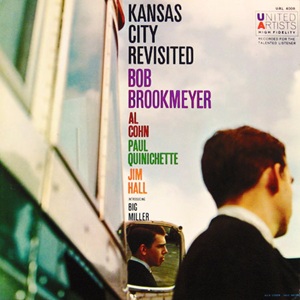
I first became aware of Bob Brookmeyer when I saw the opening credits of the film Jazz on a Summer’s Day, the trombone player providing the counterpoint to Jimmy Giuffre and Jim Hall’s interweaving melodies on “Train and the River”, as the rippling waters of Newport shimmered in the sunlight. The three suited and booted musicians appeared to be the epitome of ‘cool’, as they crossed a continent from the beaches of California to the Rhode Island harbour town. A year earlier Brookmeyer was in the studio with his own combo, consisting of himself on valve trombone, Al Cohn and Paul Quinichette on tenor sax, Nat Pierce on piano, the aforementioned Jim Hall on guitar, Addison Farmer on bass and Osie Johnson on drums. The sessions were held at Olmstead Studios in New York and though the musicians were pretty much riding the wave of the cool jazz sounds of the time, the songs and tunes on Kansas City Revisited take a new look at the music from the 1920s and 1930s era of jazz, as the title suggests. Kansas City’s Clarence Horatius Miller, otherwise known as ‘Big Miller’, provides some authentic vocals on two of the six numbers, “A Blues” and “Travlin’ Light”. Brookmeyer’s own liner notes perfectly reflect the sort of rhetoric of the time as he writes about Kansas City in earlier times, Al Capone even getting a mention. “Blue and Sentimental” is probably the album highlight.
019 | Jimmy Smith | Bucket! | Blue Note 4235 | 1966
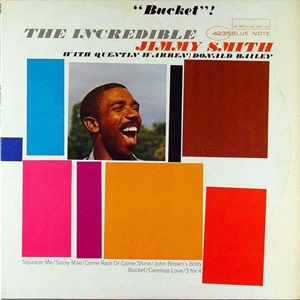
Despite many attempts to avoid the word ‘groovy’ at all costs, it appears to be the only adjective that ever springs to mind whenever I hear Jimmy Smith and his trusty Hammond B3. Bucket is the organist’s 24th album release on Blue Note, recorded in the winter of 1963 and not released until 1966. Bluesy in places, most notably on Smith’s reading of “Careless Love” and the almost swinging “3 for 4”, the seven tracks also include one or two more uptempo ‘groovers’, including the opening title track. Smith is joined here by Quentin Warren on guitar and Donald Bailey on drums, the trio offering a more stripped down sound to that of, let’s say, the unpredictable Mr Smith’s earlier Bashin’. There’s also a surprising conclusion to the album, as the trio ponder on the old Civil War anthem “John Brown’s Body”, which serves as a fine finisher. Leonard Feather’s generous liner notes point out that the trio’s original sound of ten years earlier was unprecedented at the time, though by the time of Bucket, Smith and Co had become more of an institution. Sadly, many of the ‘..and that’s jazz’ crowd, really do think that this is all it is.
018 | Jimmy Giuffre 3 | Jimmy Giuffre 3 | Atlantic 1254 | 1957

By 1957, Jimmy Giuffre had already recorded and released three albums under his own name before the release of the debut album by the Jimmy Giuffre 3, teaming up with guitarist Jim Hall and bass player Ralph Peña. Peña had in fact worked with Giuffre on his second solo album Tangents in Jazz from the previous year. Perhaps the album is best remembered for the inclusion of “The Train and the River”, based on a folk sensibility, which in effect heralded in a new sound in jazz, so much so, the complex tune was sped up and performed at the 1958 Newport Jazz Festival, captured magnificently and used during the title sequence of the filmed record of the event, Jazz on a Summer’s Day, released the following year. There’s no pianos to worry about on this album, just guitar, bass and either tenor sax, baritone sax or clarinet, and in the case of “The Train and the River”, all three, each played both tightly and loosely throughout. In the original liner notes, Giuffre is at pains to point out that the communication between the three musicians was infinitely more important than the actual instruments they each chose to play. A landmark in West Coast jazz.
017 | Nat Adderley | Sayin’ Somethin’ | Atlantic ATL 50 246 | 1976

As the younger brother of the celebrated alto sax player Julian ‘Cannonball’ Adderley, Nat Adderley would undoubtedly feel the need to have his say, and Sayin’ Somethin’ would be a case in point. Recorded in the winter of 1966 and released a little later in the year, Adderley’s twelfth album, his second on Atlantic, following the success of the precious year’s Autobiography, looked like Adderley was on a roll. This was after all, really the pinnacle of his career. Predominantly performed by Adderley’s fine quintet, comprising Joe Henderson on tenor sax, Herbie Hancock on piano, Bob Cranshaw on bass and Roy McCurdy on drums, the trumpet player was also joined by an 11-piece ensemble for four of the tracks, “Manchild”, “Call Me”, “Gospelette” and a pretty rocky reading of Duke Ellington’s “Satin Doll”. One of the highlights of the album is the band’s pretty faithful take on Herbie Hancock’s “Cantaloupe Island”, with Hancock himself delivering his timeless piano motifs. The pressing I have here in my collection is the 1976 That’s Jazz re-issue window version, again on Atlantic.
016 | Milt Jackson & John Coltrane | Bags & Trane | Atlantic SD 1368 | 1961

By the time Milt Jackson met up with John Coltrane to record the sessions that would emerge a couple of years later as Bags & Trane, Jackson had already been changing the course of jazz with the Modern Jazz Quartet for almost a decade, whilst Coltrane was just about to join Miles Davis in one of the most fruitful sessions in jazz history, which would result in the outstanding recording Kind of Blue, which we’ve probably talked enough about. Bags & Trane, the title derived from the nicknames of the two musicians concerned, was a landmark in collaboration and featured a stella cast of musicians, those being Hank Jones on piano, Paul Chambers on bass and Connie Kay on drums. The album is made up of just five numbers, yet much is packed into the 35 minutes or so, especially on their take on Dizzy Gillespie’s “Be-Bop” and the eerie title track, which wouldn’t be out of place as the soundtrack to a Hitchcock thriller. Some claim the album doesn’t quite gel in terms of collaboration, though I still find it an essential listen.
015 | Hampton Hawes Trio | Hampton Hawes Trio | Contemporary C 3505 | 1955

Hampton Hawes’ recording career spanned a little over a couple of decades, from 1952 to 1977, the year he left us after suffering a brain haemorrhage at the age of 48. During those years he enjoyed a fruitful career in music, working with some of the noted jazz musicians along the way, including Dexter Gordon, Barney Kessel, Art Pepper and Shorty Rogers amongst them. Here we see Hawes at the beginning of his career, a confident debut album that introduced us to a fine trio, consisting of Hawes on piano, Red Mitchell on bass and Chuck Thompson on drums. Hawes’ confidence as a leader shows in his playing on these ten selections, made up primarily of standards, though interspersed with one or two of his own compositions, including the inventive “Blues the Most” and the playful “Hamp’s Blues”. After serving his country in Japan between 1952 and 1954, the pianist fell into addiction and later found himself banged up, though remarkably, he managed to receive a pardon from the newly elected President Kennedy, and went on to record a string of albums during the rest of the 50s and 60s and well into the 70s.
014 | Sonny Rollins | The Bridge | RCA SF 7504 | 1962
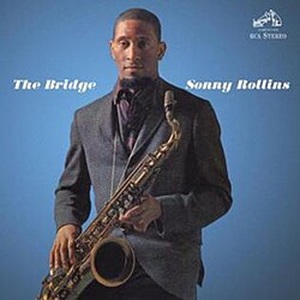
In 1991, when the BBC used to produced plays that could tell a good story in under one hour, rather than in eight twelve-part ‘seasons’, I sat down to watch Alan Plater’s Misterioso, the soundtrack of which was predominantly made up of Thelonious Monk’s compelling composition of the same name. This is when I first discovered Sonny Rollins and his unique tenor saxophone playing and I felt compelled to go out and buy anything I could find by the musician. I began with the obvious choice of the Blue Note release, The Best of Sonny Rollins, which of course featured the track in question. After the release of such notable gems as Way Out West, Sonny Rollins Vol 2, Newk’s Time and Sonny Rollins and the Contemporary Leaders, Rollins made an extraordinary decision in light of his growing fame, he threw the rag in. He quit both recording and live appearances and took to the Williamsburg Bridge, where he spent two hot summers and two cold winters in all weathers, and sometimes up to 16 hours a day, to practice alone. It has been said that leaving his Lower East Side residence to practice on a busy city bridge spanning the East River between Manhattan and Brooklyn had little to do with noise issues, though he has also stated that he was concerned about a neighbour’s newly born, who he didn’t want to disturb. It really had more to do with the freedom of practicing outdoors amongst the regular din. The Bridge was an obvious title for his first release after returning to the studio in January 1961 and the first to be released on the RCA label, where he would stay for the next few years. Unlike his previous releases, Rollins did away with the piano and instead recorded the six songs with guitarist Jim Hall, together with the rhythm section of Bob Cranshaw on bass and Ben Riley on drums. The album may not have made the same giant strides as those made by his contemporaries at the time, but it’s well worth adding to any record collection, if only for Rollins and Hall’s splendid reading of Billie Holiday’s “God Bless the Child”.
013 | Stan Getz and Joan Gilberto | Getz Gilberto | Verve SVLP 9065 | 1963

In the early 1960s, the jazz world became obsessed with Latin American music, notably Samba and Bossa Nova, chiefly through the work of guitarist Charlie Byrd, who Stan Getz collaborated with in 1962 on the celebrated album Jazz Samba. A couple of years later, Getz joined forces with an actual Brazilian guitarist, João Gilberto, and together with pianist and composer Antônio Carlos Jobim, Getz Gilberto arrived to an ecstatic reception, sweeping up the following year’s music awards, which included Grammys for the Best Album of the Year and Record of the Year for “The Girl from Ipanema”. Now here’s a thing, Astrud Gilberto, João Gilberto’s wife, had never sung professionally before, yet she delivered a highly memorable vocal performance on both “The Girl from Ipanema” and “Corcovado”, the two stand out performances on the album, effectively launching her own career in music. Sarah Vaughan was originally pencilled in for these performances, and it’s fortunate for Astrud that Miss Vaughan was busy that weekend. The the marriage between the Gilbertos hardly saw the year out, yet the album remains one of the best-selling jazz albums of all time.
012 | Art Blakey and the Jazz Messengers | Moanin’ | Blue Note 4003 | 1958

This album saw the return of Art Blakey and the Jazz Messengers to Blue Note after a series of albums released on other labels including Columbia, Atlantic and Bethlehem. Originally released simply as The Jazz Messengers, its lead composition Moanin’ became its moniker, the title replacing the catalogue number on later releases. The sleeve design also followed a new trend of featuring a full on close up of the artist in question, dutifully tinted to reflect Blue Note’s increasingly visible penchant for cool arty design. On later releases, the album opens with some studio dialogue, which gives us a glimpse into the atmosphere behind some of these fabulous late Fifties recordings sessions. Blakey is joined by a Stella cast of musicians including Lee Morgan on trumpet, effortlessly sparring with Benny Golson on tenor sax, with Bobby Timmons on piano and Jymie Merritt on bass. Blakey’s stick work was in great demand at the time, with contributions to a plethora of sessions for the likes of Sonny Rollins, Thelonious Monk, Milt Jackson, Hank Mobley, Jimmy Smith and famously the sessions that resulted in Somethin’ Else for Julian ‘Cannonball’ Adderley. Highlights, “Along Came Betty”, “Come Rain or Shine” and the title cut (of course).
011 | The Wynton Kelly Trio | Full View | Milestone MSP 9004 | 1968
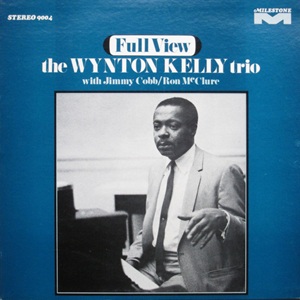
Anyone at all familiar with the landmark modal jazz album Kind of Blue, will immediately recognise the names of Miles Davis, Julian ‘Cannonball’ Adderley, John Coltrane, Bill Evans, Paul Chambers and Jimmy Cobb, and possibly to a lesser extent, Wynton Kelly, who contributed to just one track on the record, “Freddie Freeloader”, effectively standing in for Evans. From the late 1950s, Kelly was a prolific sideman for some of the biggest names in jazz, including Julian Adderley and his brother Nat, Gene Ammons, John Coltrane, Dizzy Gillespie, Blue Mitchell, Wes Montgomery and Sonny Rollins to name but a few, recording dozens of albums from 1958 to the early 1970s both as a sideman and as a leader. Full View is one of the pianist’s later albums, recorded five years before his death in 1971. With Ron McLure on bass and Jimmy Cobb on drums, the nine selections might not be necessarily considered landmarks in jazz, nor do any of the performances mark out any new territory in the progression of modern jazz, but they are highly listenable, melodic and easy on the ear, especially “Autumn Leaves” and Kelly’s own “Scufflin’”, both of which have become effortless choices for radio play, though I tend to steer clear of “I Want a Little Girl” for obvious reasons. Produced by Orrin Keepnews, who also writes the liner notes, Full View remains a firm favourite.
010 | Miles Davis | Kind of Blue | CBS BPG 62066 | 1959

There are a multitude of essays, articles and even entire books dedicated to this album, a truly iconic piece of work that really needs no further elaboration from me, though I might take a moment to reflect on how I first came upon it. Though it was recorded a couple of years after I came into the world, it would take a further 27 years for it to reach my ears, by no coincidence, the very moment I turned my attention to jazz in the mid to late 1980s, when pop and rock music offered nothing in the way of quality. I just happened to stray into the area of the jazz browsers in the audio department of my local library, after dismissing everything that the rock, folk, country and classical browsers had to offer and Kind of Blue seemed to jump out at me. Yes, I knew who Miles Davis was and I’d been used to seeing him in double denim and shades in the rock press, doing the jazz equivalent of whatever Hendrix had been doing in rock, but I never dreamed in a million years that the five tunes on this album would change my musical allegiance completely. There’s not a dull moment here, with each of the musicians performing exquisitely. Joining Davis are Julian ‘Cannonball’ Adderley on alto sax, John Coltrane on tenor sax, Bill Evans on piano, Wynton Kelly on piano, Paul Chambers on double bass and Jimmy Cobb on drums. “So What” brought me into jazz and I dare say a lot of other people too.
009 | Modern Jazz Quartet | Pyramid | Atlantic 1325 | 1960
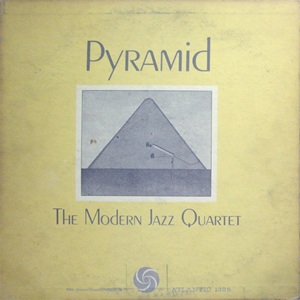
Though recorded in the latter half of 1959 and released in early 1960, the sleeve of the Modern Jazz Quartet’s Pyramid album could’ve passed as an early Prog Rock album, judging by its modernist cover, perhaps an early version of Dark Side of the Moon? The music though, once again straddles the boundaries of both jazz and classical music, with a mixture of both standards and originals, showcasing the by then familiar line-up of Milt Jackson on vibes, John Lewis on piano and that highly dependable rhythm section of Percy Heath and Connie Kay on both bass and drums respectively, each of whom receive generous bios on the back cover. The six pieces include fine re-workings of Duke Ellington’s “It Don’t Mean a Thing (If it Ain’t Got That Swing)”, the Hamilton/Lewis favourite “How High the Moon” and Jim Hall’s moody “Romaine”, though it’s with the quartet’s original compositions that the album is perhaps best remembered, not least the fine opener “Vendome”, a John Lewis number, which has lost none of its charm almost seven decades on.
008 | Coleman Hawkins | The Hawk Flies High | Riverside RLP 233 | 1957
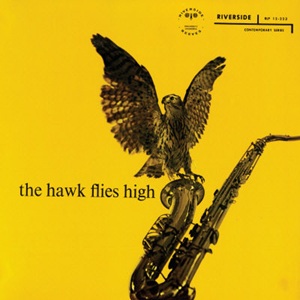
For anyone picking up a tenor saxophone to go for a jazz solo, whether their idol be John Coltrane, Sonny Rollins or Ornette Coleman, they should perhaps tip their hat to Coleman Hawkins who first brought the instrument to wide attention as a lead jazz instrument. Emerging from the Swing era and being very much around at the beginning of the Bebop period, Hawkins is pretty much the bridge between the old and the new when it comes to the saxophone heroes in jazz. The Hawk Files High was recorded in March 1957, a few months before Jack Kerouac published on the Road, and around the same time as Miles Davis was launching his first great quintet with John Coltrane with the release of ‘Round About Midnight, an important period in the evolution of jazz. Hawkins drew together a handful of contemporaries from his own particular era of bebop, namely JJ Johnson on trombone, Idrees Sulieman on trumpet, Hank Jones on piano and Oscar Pettiford on bass, together with relative new comers Barry Galbraith and Jo Jones on guitar and drums respectively. The Hawk Flies High includes the eleven minute Sulieman composition “Juicy Fruit”, which features the trumpet player’s one minute sustained note before launching into a fine solo, whilst one imagines Hawkins looking on with some measure of approval.
007 | Dexter Gordon | Go | Blue Note BLP 4112 | 1962

After a series of early album releases on such labels as Savoy, Dial, Bethlehem and Dootone, saxophonist Dexter Gordon moved on to Blue Note, releasing a string of fine albums, Go Being his fourth on the iconic label. By this time, Dexter Gordon’s reputation had been firmly established. Critics at the time praised Go for capturing the essence of a live performance, whilst not technically being a live album. Gordon’s sole composition “Cheese Cake” gives the album the desired lift from the start, a memorable performance that the album is best remembered for. The energy of the performance is matched by the striking simplicity of the sleeve artwork, the word ‘GO’ taking up most of the space and repeated, or rather picked out, in the musician’s surname. It was certainly all go for Dexter Gordon at the time, ably supported by a fine cast of musicians, Sonny Clark on piano, Butch Warren on bass and Billy Higgins on drums.
006 | Gene Ammons | Boss Tenor | Prestige 7180 | 1960
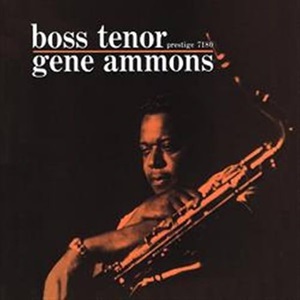
Unusually, this album opens with a lengthy slow blues, a showcase not only for Gene Ammons’ masterful tenor, but also for a finely chosen rhythm section made up of Tommy Flannigan’s confident piano, Doug Watkins’ reliable bass and Art Taylor’s seasoned drums. Released on one of the big jazz labels, Prestige, which boldly indicates its unique serial number on the cover, next to a subtle portrait of the saxophonist in what could be described as pensive mode, shrouded in a deep orange haze. There’s a good eight and a half minutes of “Hitting the Jug”, easily the longest number on the album, before Bernice Petkere’s “Close Your Eyes”, augmented by Ray Barretto’s rhythmic congas. Other album highlights include Charlie Parker’s “Confirmation” and the sublime reading of the old Rogers and Hart standard “My Romance”, which sees Ammons returning to that breathy sax playing of previous times, making Boss Tenor essential listening and a recommended item for any jazz collection.
005 | Charles Mingus | Mingus Ah Um | Columbia CS 8171 | 1959

There are some albums that any self-respecting jazz collector must have and I guess, Mingus Ah Um has to be one of them. Released in 1959, the year when jazz reached its magical year, with the release of such classics as the Miles Davis modal masterpiece Kind of Blue, John Coltrane’s landmark Giant Steps and Dave Brubeck’s cool and highly popular Time Out, Mingus Ah Um provided a moment in the spotlight for this revered composer, arranger and bassist, not that Mingus ever really stepped out of the spotlight. The album features one of Mingus’s most enduring compositions, “Goodbye Pork Pie Hat”, a reference to the late saxophonist Lester Young, who died just before the album was recorded. There’s also tributes to other jazz greats, including Duke Ellington with “Duke’s Choice” and Jelly Roll Morton with “Jelly Roll”, all of which clearly indicates that Ah Um is a nod to the musician’s forebears, though it should be pointed out that “Bird Calls” has nothing to do with Charlie Parker, but indeed the call of birds.
004 | Jimmy Giuffre | Tangents in Jazz | Capital Records T 634 | 1956

Like many of us, the first time I became aware of the music of Jimmy Giuffre was through his live version of “The Train and the River”, which was played over the opening credits of the Aram Avakian film Jazz on a Summer Day, shot at the Newport Jazz Festival in 1959. It was a perfect choice to go with the arty shots of rippling water as the plethora of big names in jazz appeared on screen, from Louis Armstrong to Chuck Berry. Three years earlier Giuffre released his second album Tangents in Jazz, which came hot on the heels of his self-titled debut, also released as Four Brothers, the year before. Joining Giuffre on Tangents are Jack Sheldon on trumpet, Ralph Pena on bass and Artie Anton. The music of Jimmy Giuffre, which would almost always be considered ‘cool jazz’, always worked best in a trio format, as exemplified in the Newport date, where he was seen with Bob Brookmeyer on trombone and Jim Hall on guitar, though it works equally well here with a fourth musician. Unlike most of his contemporaries, who would relish in long solos, Giuffre’s music was almost always collaborative as equal space would be given to each of the musicians, the instruments sparring with one another, whilst working in tangent, hence the album’s title. This is exemplified on such numbers as “Chirpin’ Time”, “Lazy Tones” and “The Leprechaun”. The album also features four short interludes under the title “Scintilla”, literally sparks of inspiration and musical genius.
003 | Ornette Coleman | Ornette on Tenor | Atlantic 1394 | 1962
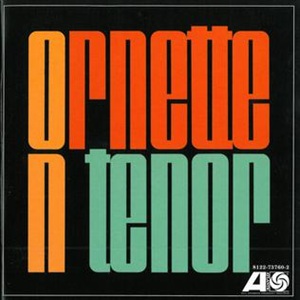
By the time Atlantic released Ornette on Tenor, jazz fans were already well aware of the giant strides this alto sax player had made, in doing for jazz, what Picasso had done for watercolours a few decades earlier. Free Jazz was by no means everyone’s cup of tea, though the further distance in time we travel, the more accessible this music really seems to be. We tend to tune into the freedom of expression with more empathy, more understanding, certainly in a time when anything and everything goes. When I listen to Coleman’s sax runs throughout the opening piece, “Cross Breeding”, I feel I could more or less hum along, whereas when I first heard the tune a good few years ago, it all seemed to be upside down and the wrong way around. Perhaps my musical sensibilities have been stretched in various directions through sheer osmosis, like a bunch of rubber bands. Ornette Coleman had released seven albums prior to this, five on Atlantic, this being his final release on the label. Joining Coleman are Don Cherry on pocket trumpet, Jimmy Garrison on bass and Ed Blackwell on drums. I suppose the album is best known for featuring Coleman on tenor rather than his usual alto sax, yet making an equally remarkable job of it too.
002 | Cannonball Adderley | Somethin’ Else | Blue Note 1595 | 1958
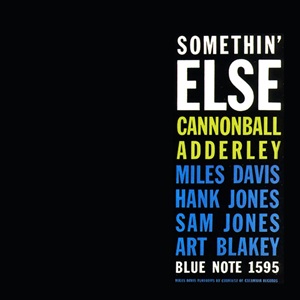
Though released the year before Kind of Blue, Somethin’ Else is often cited as a companion piece to the Miles Davis classic, due in no small part to Davis’s generous contribution as a side man, something Adderley would reciprocate the following year. The track list also resembles Kind of Blue, in that it features two lengthy tracks on one side and three on the other, with “Autumn Leaves” serving the same purpose as “So What”, both showcases of musical virtuosity. “Autumn Leaves” would remain in Davis’s own repertoire for some years to come. Adderley (alto sax) and Davis (trumpet) are joined by a fine trio of musicians, Hank Jones on piano, Sam Jones on bass and Art Blakey on drums, each demonstrating their own innovative musical chops on such numbers as Cole Porter’s “Love for Sale” and the title song written by Davis. As with many of what are now considered jazz classics from this period of time, there’s not a wasted note to be found.
001 | Sonny Rollins | Vol 2 | Blue Note 1558 | 1957
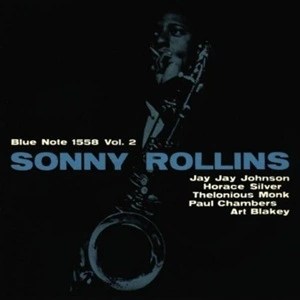
I would no doubt have been completely unaware of Sonny Rollins back in 1957, the year of my birth, and probably unaware of anyone else for that matter. It didn’t stop me from thinking that there might be some significance in the arrival of the Sonny Rollins Vol 2 LP, which was released on the Blue Note label in that very same year. Many years later I popped into Dodds Music Shop in Doncaster, specifically to purchase a gleaming tenor saxophone, after a voice told me that I could play the instrument like Sonny Rollins. The voice was wrong of course, and on so many levels, yet as I followed this fated path to its predictable conclusion, by placing the instrument back in its case and storing it away in the loft, I felt utterly bereft. I did the decent thing and returned to my LP collection and vowed never to assault the ears of family and friends ever again. These voices in the head can be fantastically irritating at times. This LP features the definitive version of the Thelonious Monk composition “Misterioso”, which is worth having if only for that, though it has to be said, the rest is equally worthy.

