
200 | Fairport Convention | Rosie | Island ILPS 9208 | 1973

Surprisingly, Rosie was the very first studio album by Fairport I bought after seeing the band at the Top Rank in Doncaster back in the early 1970s. I’d already bought the band’s double compilation set, the History of Fairport Convention, upon its release in 1972, which concluded with a set of fiddle tunes, indicating that “The Hen’s March” would be included on their forthcoming album. That album was Rosie, which I immediately bought upon its release the following year. I was slightly disappointed that there weren’t more fiddle tunes included, though the title song, written by Dave Swarbrick, who was by now the lead voice in the band, became a firm favourite. Old pals Sandy Denny and Richard Thompson contributed to the title song, as well as the future Mrs Thompson, under her maiden name Linda Peters. The album also saw the band spreading their wings slightly, moving from a quintessential English folk rock band to something slightly more international, with Australian folk singer Trevor Lucas joining their ranks together with American guitarist Jerry Donahue, whose Telecaster twang would become the new sound of the band. Rosie was also the first Fairport album without original member Simon Nicol, who had gone on to do something else with his time, which these days would be unthinkable. Produced by Lucas, with noted engineer John Wood present, Rosie remains largely ignored by Fairporters, yet it had some fun moments, notably “Hungarian Rhapsody”, a kind of “Angel Delight II”, Swarbrick’s pretty “My Girl” and Swarbrick’s nostalgic “Me with You”, featuring some of Ralph McTell’s trademark ragtime guitar accompaniment. Sometime in the early 1980s, I was fortunate enough to see Swarbrick with Nicol at the Rockingham Arms in Wentworth, who played a couple of predominantly instrumental sets to an enthusiastic full house, with one or two songs delivered by Nicol. For the encore, Swarbrick asked if there were any requests for the final number, to which the audience immediately called for him to sing. He sang “Rosie”.
199 | Steely Dan | Pretzel Logic | ABC ABCL 5045 | 1974
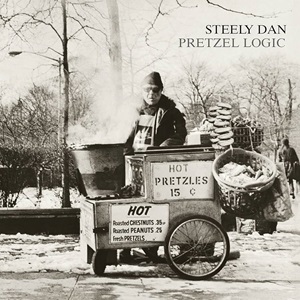
I always felt slightly pleased with myself, that I was among the first of the Steely Dan fans, in that I remember popping out to buy the band’s debut album Can’t But a Thrill, upon its release. “Reeling in the Years” and “Do It Again” were played relentlessly, not to mention “Dirty Work”, each of which can be heard by passing neighbours as I turn the volume up even today, after all these years. Pretzel Logic came a little later, it being the band’s third album, with Countdown to Ecstasy sandwiched in-between. I always used to make a point of learning the names of every member of a band that I admired and could irritatingly reel them off at the drop of a hat, though keeping up with Fairport Convention and The Mothers was always a challenge. With Steely Dan, I didn’t even bother. It was always just about Donald Fagen and Walter Becker for me, though it was always fun looking for the names of the ‘guests’ on those album sleeves. Though mainly an albums band, Steely Dan also released quite a few singles, “Rikki Don’t Lose That Number” being the no brainer release from this album, a tune that was played a zillion times on the radio at the time, which led to it being their biggest US hit, reaching number 4 on the singles chart (only 58 in the UK, mind you, it had Gary Glitter to contend with). Other standout songs included “Barrytown”, “Any Major Dude Will Tell You” and the title track, though the Duke Ellington tune “East St Louis Toodle-Oo” came as a bit of a surprise, with Becker’s over-use of the ‘talk box’ (see Peter Frampton and Joe Walsh for other examples of a guitar effect that should never have been invented). As with other Steely Dan albums, Pretzel Logic was fabulously produced, though probably not so much of a ‘new stereo system tester’ as Aja, which appeared three years later. The usual perusal of the sleeve revealed a street vendor on a snowy winter’s day near Central Park in New York City, offering the usual local snacks, roasted peanuts, roasted chestnuts and hot pretzels at just 15 cents. I still don’t know what a pretzel tastes like, though I remain partial to the other two.
198 | David Crosby | If Only I Could Remember My Name | Atlantic SD 7203 | 1971
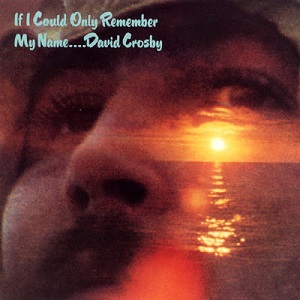
I found my copy of David Crosby’s debut solo LP If Only I Could Remember My Name languishing in a cardboard box at a garage sale just outside Tampa on Groundhog Day in 1996, an album first released in the wake of the hugely popular Déjà Vu by his then band, Crosby Stills Nash and Young. In the early 1970s those four musicians released solo albums almost simultaneously, each inviting various prominent musicians along for the ride. In Crosby’s case, Joni Mitchell was there, along with members of the Grateful Dead, Santana and Jefferson Airplane. In places the album echoes some of the sonic styling of Déjà vu, with a strong acoustic feel, yet the LP received less than favourable reviews at the time of release in 1971, which was possibly due to Crosby’s overt hippy sensibilities. I have time for David Crosby, warts and all. I know he had his faults, that he was enormously opinionated and could be unreliable, being the only person on earth who could possibly upset Graham Nash, so much so, the chummy Blackpool-born Hollie vowed never to speak to him ever again, the very man who once stood by Cros through thick and thin, which beggars the question, what on earth could he possibly have done to worry the likes of Graham Nash? Nash no longer has that problem. Crosby continued to make me smile for some reason and this album remains a favourite of the CSNY related solo albums and is still played regularly, over fifty years on. “Music is Love”, “Cowboy Movie” and “Laughing” are great songs, in fact they all are.
197 | Yes | The Yes Album | Atlantic 2400 101 | 1971
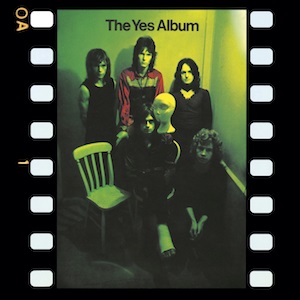
Considered the band’s breakthrough album after two reasonably received introductory efforts, their self-titled debut Yes (1969) and the superior Time and a Word (1970), The Yes Album saw the band take further steps into the world of Progressive Rock, with a rarely seen boldness. This was the first album by Yes that crossed my threshold, ready to compete with mum’s Sing Something Simple routine. The gatefold sleeve was the thing we fourteen year-olds enjoyed deciphering in those days, identifying things that were perhaps not worth deciphering in the first place. What’s this, a frame of cellulose film? What’s this green filter? What’s this head of a mannequin? Why is there a cast on Tony Kaye’s foot? Why the additional vacant chair? Silly questions, but thoroughly engaging for us early Proggers, a couple of years before kids began saying no to Yes. There could also be questions about the musical content on The Yes Album, like why include “The Clap”? It’s the only live track on the album and it’s little more than a wanky show off ragtime guitar tune from the fingers of Steve Howe, the title of which either refers to the audience’s expected reaction to the tune or the taboo hazard that comes with rock territory. Joking aside, The Yes Album was an important addition to my burgeoning collection in the early 1970s and a world away from the music that would later have so much scorn placed upon it by the next generation of music fans. “Yours is No Disgrace” and “Starship Trooper”, the two tracks that open and close the first side are perhaps the album highlights, though I also have a fondness for “I’ve Seen All Good People”.
196 | John Mayall and the Bluesbreakers | A Hard Road | Decca SKL 4853 | 1967

The first Bluesbreakers album was always destined to be a hard act to follow, not least for the fact that John Mayall’s star guitarist had somehow risen to divine status, heralded as ‘God’ on suburban London walls in pre-Banksy scrawl. If the Beatles had been bigger than Jesus, then Clapton was in fact God himself. For its follow up, A Hard Road, Mayall called upon the services of one Peter Allen Greenbaum upon Clapton’s departure, who went off to join Ginger Baker and Jack Bruce in the so-called supergroup Cream, bringing his own distinctive sound to the Bluesbreakers’ mix, under the professional name Peter Green. Once again, as with its predecessor, the album combines a mixture of originals penned by Mayall and blues standards, with a couple of Green compositions, “The Same Way” and “The Super-Natural”. Green also provides an immediately recognisable vocal on the Willie Cobbs song “You Don’t Love Me”. Some would probably argue that the album might have benefitted from more Green vocals and fewer Mayall, who wasn’t particularly known for his vocal prowess. The guitarist was given plenty of room though, for his informed playing, notably on the Freddie King workout “The Stumble”, much the same as Clapton’s on the previous album’s “Hideaway”, another King classic. Retaining the services of John McVie on bass, Mayall added Aynsley Dunbar on drums, effectively replacing the outgoing Hughie Flint, who went on to work with Alexis Korner and Savoy Brown, before joining forces with ex-Manfred Mann guitarist Tom McGuinness to form McGuinness Flint and have hits to boot. As with many of his contemporaries at the time, Mayall was also handy with a brush, and was indeed responsible for the cover painting of the moody looking quartet.
195 | Carole King | Tapestry | Ode SP 77009 | 1971

Carole King made several albums in her career, as well as penning many hits for others, yet her second solo album Tapestry always shines like a beacon in a career lasting well into six decades. I’m pretty sure that this is due to the fact that Tapestry is a fabulous album, yet it could also be attributed to the time it was released, or perhaps even to its iconic cover, which shows a very casual, almost hippie-ish writer of songs working on her needlework, while Telemachus the cat peers into the camera lens, possibly the most famous cat in the world after Tom. “It’s Too Late” was the single that first brought the album to my attention, a 45 I frequently played whenever I was looking for respite between King Crimson’s “20th Century Schizoid Man” and Black Sabbath’s “Paranoid”. Once I added the LP to my collection, it was only then that I discovered such gems as “So Far Away”, “I Feel the Earth Move” and “(You Make Me Feel Like) a Natural Woman”, a hit for Aretha Franklin, a few years earlier. Another couple on the album I was already familiar with were “Will You Love Me Tomorrow”, a song written by a much younger King along with the husband Gerry Goffin, for the Shirelles, and “You’ve Got a Friend”, which James Taylor made his own. The other reason the album still holds its place as one of the greatest albums of all time, is that it was picked out from her canon when the compact disc came along, occupying the same shelf space in record shops as Joni’s Blue, Van’s Moondance and Marvin’s What’s Going On.
194 | John Cale and Terry Riley | Church of Anthrax | CBS 64259 | 1970
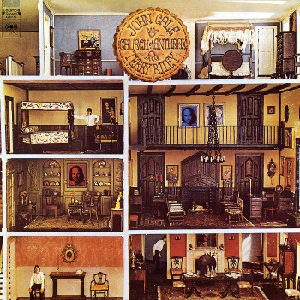
A meeting of spirits of sorts, with two prominent musical explorers, tied at the waist like Sir Edmund Hillary and Tenzing Norgay, in theory at least. There were apparently arguments, but we are talking strong characters here. Church of Anthrax saw the collaboration between these two experimental musicians after they had both enjoyed some success individually, Cale with the Velvet Underground and Riley with his memorable masterpiece A Rainbow in Curved Air, which brought his minimalist approach to electronic music to the fore. With a cover design showing Cale wandering around a doll’s house, with one or two portraits of Riley on the walls, Church of Anthrax comes over as a creative jam that brings together the best elements of Cale’s multi-instrumental credentials and Riley’s piano, organ and soprano sax flurries, most notably on the sprawling “The Hall of Mirrors in the Palace at Versailles”. Predominantly instrumental, the album does include the one vocal track, with a guest appearance by Adam Miller on “The Soul of Patrick Lee”, the album’s most accessible track. Meeting Riley in 2018 after a show in Manchester was a bucket list moment that easily trumped swimming with dolphins. He also signed my old copy of Curved Air.
193 | John Martyn | Sunday’s Child | Island ILPS 9296 | 1974

I’d just consumed enough wine as the sun set down on the fields of Cropredy back in 1988, at the moment John Martyn walked on stage with his long-time collaborator Danny Thompson by his side. The opening song could not have been more perfect for the moment, the same song that opens this 1974 album. “One Day Without You” is criminally short, but there again, it says what it needs to say, and you can always pop the needle to the start again. Whenever I hear this song, I see a sunset over Oxfordshire and taste the wine, even if I might be emptying the bins at that moment. But enough of that. Sunday’s Child was Martyn’s sixth solo album and could also be his finest. What? Finer than the fantastically fine Solid Air? I’m not going to roll me sleeves up about it. The jazzy feel on the title song, evokes some of the improvisational magic that could be seen on stage, whilst the traditional “Spencer the Rover” takes the troubadour right back to the start, with a first rate performance of a song than mentions the next town to me, Rotherham. Not many do. There’s no Yorkshire towns mentioned in either “The Message” or “Satisfied Mind”, the former borrowing from a Scots wedding song and the latter, an old spiritual that could be one of Martyn’s most soulful and smouldering vocal performances. If “May You Never” stood out on Solid Air, then “You Can Discover” does the same for Sunday’s Child, till the cows come home. Mrs Martyn makes an appearance on “My Baby Girl”, which could relate to the sprog pictured on the back of the sleeve, a photo that also sees our rough necked hero in parental mode; you couldn’t imagine this bloke punching a clock let alone someone’s jaw.
192 | Simon and Garfunkel | Sounds of Silence | CBS 62690 | 1965

I first heard the sound of Simon and Garfunkel in my English class, when the teacher brought in the duo’s second LP for us to listen to and forensically dissect, notably the lyrics of “Richard Cory”. I immediately considered the exercise not only useful, but thoroughly enjoyable. I don’t think it was the harmonies that these two New Yorkers made that first sprang to my attention, but the fact that people with acoustic guitars could write good songs. I hadn’t yet discovered Dylan and was really still spinning “I’m a Believer” on the Dansette. I would grow to love the sound of Paul and Artie and never shied away from the ridicule thrown my way by some of the skinhead variety in class. People had a certain scornful way of annunciating those two names, almost as if they’d swallowed a wasp. I love these two and many of their songs. Even today if I’m sitting in a folk club and someone sings “Kathy’s Song”, it’s usually met with some measure of approval. Another oft-played tune around the time of this release was Davy Graham’s “Anji”, which was taken to be the test tune for all budding troubadours. If you can play “Anji” you can join our gang. The “Anji” theme is repeated throughout the album, certainly the intro to “Somewhere They Can’t Find Me” and again later on “We’ve Got a Groovy Thing Goin’”, a song included ‘just for fun’ according to the sleeve notes. Speaking of the sleeve, the cover shot was something of a contradiction, two college types, complete with university scarves, yet both sporting ultra-trendy Beatle boots. The neck and feet warmers continue on the back, with the addition of Chesterfields poking nonchalantly through their awkwardly posed fingers. Good album, reminds me of school.
191 | Byrds | Younger Than Yesterday | CBS S 62 998 | 1968

I always thought it a little audacious to set out the rules for becoming a rock and roll star in the lyrics of the opening song on the fourth album by the Byrds, but there again this band was always quite an audacious band. The experimentation continues pretty much where it left off on the previous Fifth Dimension album from the year before, with more jazz meandering, special effects, backward tapes and so on, certainly on the wild and enthusiastic “CTA 102” and “Thoughts and Words”, but also on the relatively straightforward folksiness of “Renaissance Fair”, which wouldn’t have been out of place on The Mothers’ We’re Only in it for the Money album. Chris Hillman attempts to keep the folk and country elements at the fore while the rest of the band drift further into psychedelia, especially on “Time Between”, whilst Crosby takes us on his usual dreamy soundscapes with the almost James Bond themed “Everybody’s Been Burned”, a forerunner to the controversial “Triad” in feel, together with the over-trippy “Mind Gardens”. Never too far from the Bard of Hibbing, the band have a crack at “My Back Pages”, from which the album’s title derives, with some success, though by album four you would’ve thought the band might’ve snipped the umbilical cord. Younger Than Yesterday is still a listenable feast, though possibly better served with a joint in one’s gob.
190 | Flying Burrito Bros | The Gilded Palace of Sin | A&M SP 4175 | 1969
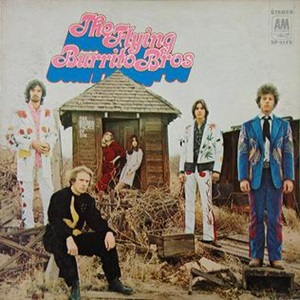
I first discovered the Flying Burrito Brothers in the early 1970s after hearing a live album, The Last of the Red Hot Burritos, which was performed by quite a different band from the four-piece pictured on this, the band’s debut from 1969. There was in fact only one remaining original member at that point, Chris Hillman. Gone was Hillman, along with the band’s charismatic leader Gram Parsons, who had both left Byrds to form this band with pedal steel player ‘Sneaky’ Pete Kleinow and bassist Chris Ethridge. Continuing in the vein of what Byrds achieved with the seminal Sweetheart of the Rodeo album the year before, the Flying Burrito Bros brought together the sentimental lyricism of Country Music and the energy of Rock and Roll to create a new form of music. Having been brought up on a diet of Hank Locklin, Eddie Arnold and Jim Reeves, it took me a while to adjust to listening to anything associated with Country Music, though the music of Byrds, Poco and the Flying Burrito Brothers, was ultimately my way in, which would then inevitably lead to an enduring love of Townes Van Zandt, Guy Clark and Emmylou Harris. Crucial cuts here include “Christine’s Tune”, also known as “Devil in Disguise”, “Sin City”, “Dark End of the Street” and the gorgeous “Hot Burrito #1”, which Gene Clark chose to rename “I’m Your Toy” for his 1987 album So Rebellious a Lover with Carla Olson and even later, Elvis Costello, who had a go at it during his country period. I still listen to this, along with the follow up Burrito Deluxe, quite often.
189 | Hopkins, Cooder, Jagger, Wyman, Watts | Jamming with Edward | Rolling Stones COC 39100 | 1972
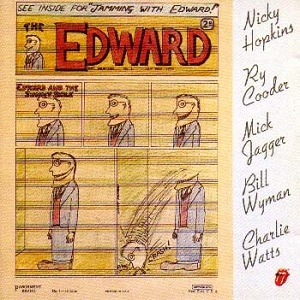
Annoyingly, the gathering of musicians who congregated to make these recordings, chose no collective moniker to go by, therefore the album is forever credited to the cumbersome Nicky Hopkins, Ry Cooder, Mick Jagger, Bill Wyman and Charlie Watts, which isn’t even in strict alphabetical order. This aside, Jamming With Edward isn’t really a Rolling Stones record at all, despite it having three members of the band included, together with the band’s regular keyboard player, Nicky Hopkins, sometimes referred to as ‘Edward’, though it was released on the band’s own record label. Hopkins is also responsible for the sleeve artwork, essentially made up of doodling on some manuscript paper. It’s essentially a jam session, featuring the American slide guitar wizard Ry Cooder, who was around at the time for the Let It Bleed, sessions. Although not released until 1972, the recordings were made in 1969 and shouldn’t be taken too seriously. The recordings were made simply while the rest of the Stones hung around for the arrival of the unreliable Keef. Though regarded by those involved as a throwaway recording (didn’t Mick refer to it as a “nice piece of bullshit?”), the album does include a rather tasty version of the Elmore James blues “It Hurts Me Too”, though “The Highland Fling” could do with binning, despite some fine finger work courtesy of Eddie.
188 | John Lennon | Imagine | Apple PAS 10004 | 1971
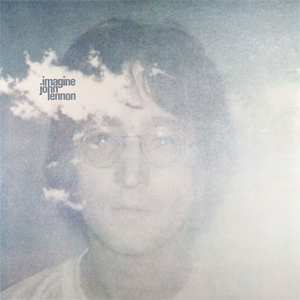
I suppose the song “Imagine” was enough in itself to ensure Lennon’s second solo album would reach the top spot in the album charts on both sides of the Atlantic, a song of peace if ever there was one. Having said that, I don’t think this album comes anywhere close to its predecessor Plastic Ono Band, though one or two of the songs cut through, almost to the bone, “Gimme Some Truth” for one, together with the scathing “How Do You Sleep”, which during rehearsals Lennon was to add “yer c***” to the already harsh lyric. Lennon’s notorious punch-up with his former songwriting partner brought all the attention in precisely the same manner as the songs on McCartney’s then latest release Ram did. As is always the case with such gifted songsmiths, one or two tender moments cut through the bitterness, with the gorgeous “Jealous Guy” shining an almost celestial light on the track list. Even the throwaway stuff is worthy of more than a few listens, “Oh Yoko” being one of them, with its jaunty rhythm and infectious refrain, whilst “Oh My Love”, could have been a White Album contender, sitting comfortably alongside “Julia”. The self-probing continues as it did on the previous album, with “How” asking all the right questions. Listening to the album now, with all that’s happened subsequently, the songs take me to an emotional place that was probably not originally intended.
187 | Dave Mason | Headkeeper | Blue Thumb ILPS 9203 | 1972

Whenever I find myself flicking through the nerdy alphabetically arranged LP shelves, I’m always pleasantly surprised at just how many Dave Masons are there, sandwiched between the John Martyns and the Ian Matthews’ records. As a founding member of Traffic, a favourite band from the late 1960s, a band that experimented with psychedelia first, then rock, then onto folk and with some ventures into jazz fusion, and remembered both for their singles and albums, Dave Mason, during his time with the band, always seemed to be living in the shadow of Steve Winwood. It was therefore as a solo artist that Mason came into his own with a string of decent albums, this being one of them. Headkeeper is Mason’s second solo effort, following on from his experimental duo LP with Cass Elliot, released a few months earlier. Originally intended as a double album, the album was to feature studio recordings together with a couple of live sides, yet in house punch-ups over contract details saw Mason making off with the tapes, leaving the label no alternative than to release an album made from back-up tapes. Mason saw that release as little more than a bootleg, though even he couldn’t really argue about how good that ‘bootleg’ actually was. The songs that eventually were released on Headkeeper are well-written, well-produced, highly melodic throughout and well-performed. Keeping to the original plan, though stripped down slightly, Headkeeper is one half studio and one half live, recorded at the Troubadour in LA. “To Be Free” is a fine piano-led opener, with some fine harmonies, delivered by Rita Coolidge, Spencer Davis, Kathi McDonald and Graham Nash. In fine voice throughout, Mason shapes an exceptionally good album, with some fine performances, notably the lilting “In My Mind”, the short but sweet “Here We Go Again” and the title track “Headkeeper”, which wouldn’t be out of place on any Traffic album.
186 | David Bowie | Hunky Dory | RCA SF 8244 | 1971
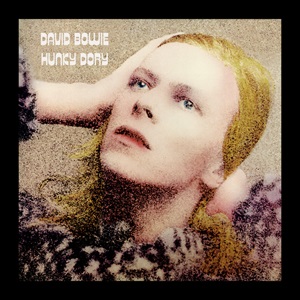
Towards the end of 1971 and the beginning of 1972, I would look forward to hanging around at a pal’s house, watching and listening to his band rehearse – he was the drummer and his older brother was the lead guitarist, who never once spoke to me. The band’s repertoire included Cream’s “Sunshine of Your Love”, the Beach Boys’ “Student Demonstration” and Joe Cocker’s version of Leon Russell’s “Delta Lady”. As the months went on, a new band member was drafted into the band’s ranks, a strange gangly blonde-haired youth, whose overtly camp affectations would soon become easily his most immediately recognisable trait. I never did know the youth’s real name but his nickname remains memorable in that it couldn’t possibly be repeated today, unless referring to a cigarette, and even for that purpose, the word is now very much redundant. Not only did he bring a new musical sensibility to the band, he also brought along a couple of David Bowie songs for the set, including “Changes”, which we all now know is the opening song to Bowie’s fourth album. It’s strange to think now, fifty years on, that Hunky Dory was famously the album that many fans returned to only after discovering The Rise and Fall of Ziggy Stardust and the Spiders from Mars six months later, having been all but ignored previously. It was all a bit too glam for me back then. I was still getting my head around Yes, whose Fragile album was released around the same time. Bizarrely, Rick Wakeman played on both. Nevertheless, Hunky Dory remains my favourite Bowie album to this day, not least for such outstanding songs as “Life on Mars”, “Oh You Pretty Things”, the Velvet Underground inspired “Queen Bitch” and “Kooks”.
185 | Todd Rundgren | Something/Anything | Bearsville K 65501 | 1972

Like Phil Spector and Brian Wilson before him, Todd Rundgren made the studio his playground and soon became known more for his knob twiddling than his actual musicianship. With a trio of albums by his first band Nazz, immediately followed by a couple of solo albums under the name Runt, Todd Rundgren revealed himself as a wizard and true star with his first album under his own name in February 1972. Something/Anything? is a double album that features a wide range of styles from straight rock, through Motown to the purely experimental, much of it with Laura Nyro in mind. The album kicks off the stand out song “I Saw the Light”, which also became a top twenty hit single in the States, though it only managed to reach number 36 in the UK, despite it becoming such a well-known and much-loved song. There’s lots of playful stuff on this album, notably “Intro”, where Rundgren invites the listener to get their headphones out and ‘cranked up’, to play a game called ‘Sounds of the Studio’, the object being to locate recording errors such as hiss, hum and bad editing etc. It’s playful yes, and probably a result of an abundance of weed around the three studios the album was recorded, in both New York and Los Angeles and also in Woodstock. It comes as little surprise to find that all of the instruments on the first three sides are played by Rundgren alone, with the final side made up of tracks recorded live in the studio with session musicians, including Rick Derringer and Billy Mundi. Like a lot of double albums at the time, the Beatles’ White Album in particular, Something/Anything? would probably have benefited from being a single album with all the nonsense edited out. However, the album kick started a highly prolific career career for Rundgren with many albums to follow both as a solo artist, a member of Utopia and a string of high profile records as a producer, notably by Grand Funk Railroad, New York Dolls and Meatloaf.
184 | Allman Brothers Band | Eat a Peach | Capricorn 2CP 0102 | 1972

Pedantically, I like to keep my live albums and studio albums separate, and never the twain shall meet, though in the case of Eat a Peach I might have to make an exception. The Allman Brothers Band’s fourth album is a double album containing one and a half sides of studio cuts and two and a half sides of live material, recorded at the Fillmore East, presumably left overs from their hugely successful previous release, At Fillmore East, a live album some claim to be the best in rock music. My initial introduction to the band came by way of two memorable sampler LPs from the early 1970s, two records released on two different labels, “Black Hearted Woman” on Atlantic’s Age of Atlantic and “Stand Back” on the Warner Bros release, Fruity, released on one of the few ill-conceived and highly impractical circular sleeves (they roll off the shelf). The latter song is included on this album, together with other notable tracks “Melissa”, “Blue Sky” and “Ain’t Wastin’ Time No More”. Probably the cutest little tune on the album is “Little Martha”, a duet featuring both Duane Allman and Dickie Betts on acoustic guitars. Three months prior to the release of this album, Duane Allman was killed in a motorcycle accident, which is probably why the bulk of the album has been taken from live recordings. The two extended “Mountain Jams” which take up two full sides, are loose jams built around Donovan’s “There is a Mountain”, a hit for the singer in 1967. Some of the instrumental tracks included here show a clear sign of the direction the band was to take on their next album Brothers and Sisters, notably the Dickie Betts tune “Les Brers in A Minor”. Eat a Peach, which features an illustration of a giant peach on the back of a truck, is dedicated to the memory of the late guitarist, who was apparently quoted as saying “every time I’m in Georgia, I eat a peach for peace”.
183 | Neil Young | Harvest | Reprise KMS 2277 | 1972
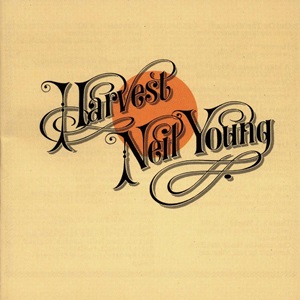
“Heart of Gold” was certainly one of the most often played songs on the radio back in 1972, an almost Dylan-like harmonica sound drawing many new ears to the songs of Neil Young, despite the singer having already released a couple of solo albums, not to mention a further two with Buffalo Springfield, one with Crosby Stills and Nash and a combined effort with Crazy Horse. Young was no newcomer to the music scene, yet it felt as if his music was only just coming to our attention by the time “Heart of Gold” reached number ten in the British singles charts and number one in the US charts in the spring of 1972. I bought the double soundtrack LP Journey Through the Past around the same time as Harvest, which contained some of the studio rehearsals for the Harvest sessions, providing a glimpse into the world of Neil Young, notably the song “Alabama”, one of the key Harvest tracks. Not only does the album feature guest appearances by James Taylor, Linda Ronstadt and Crosby Stills Nash, it also features the London Symphony Orchestra on a couple of tracks, which always felt out of place in an otherwise country-inflected rock album. As I listen to the album today, the thing that jumps out immediately is the bass sound, a bass played as a bass should be played, to provide the bottom end. Just listen to the opener “Out on the Weekend” and you’ll know what I mean.
182 | Joe Walsh | The Smoker You Drink, the Player You Get | ABC Records ABCL5033 | 1973

I first became aware of the guitarist Joe Walsh during his stint with the James Gang between 1968 and 1971, particularly “Funk #49”, a frequent visitor to the turntable, possibly via the 1970 Probe sampler LP Handle With Care. Once Walsh began his solo career after leaving the band, the albums came quick and fast, The Smoker You Drink, the Player You Get, being the follow up to the Barnstorm LP, released the previous year. The opening track, “Rocky Mountain Way”, ensured that the album received some attention, a track with some fine guitar playing, together with some highly irritating ‘talkbox’ shenanigans, a device favoured at the time by Walsh and other guitarists, notably Peter Frampton (“Show Me the Way”) and Walter Becker of Steely Dan (“Haitian Divorce”). Walsh is joined on the album by multi-instrumentalist Joe Vitale, Kenny Passarelli on bass and Rocke Grace on keyboards, who between them cover much musical ground as they explore the world of blues, jazz, folk and pop, which would go on to open certain doors such as his long-time stint with the Eagles. The LP is also remembered for Jimmy Wachtel’s album design, which features a painting of a British Sopwith Snipe fighter plane in full flight.
181 | Eric Burdon and War | The Black Man’s Burdon | Liberty LDS 84003 | 1970
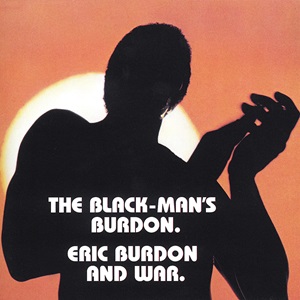
In D. A. Pennebaker’s wonderful Monterey Pop film, Eric Burdon can be seen performing the Rolling Stones hit “Paint it Black”, along with his latest version of The Animals. It was a memorable performance, complete with manic violin and psychedelic bubbling dyes behind, placing Burdon right there in the middle of the so-called Summer of Love. Three years later, Burdon revisits the song as part of a medley which opens the second album by Eric Burdon and War, his new venture after the demise of The Animals. It’s an adventurous start to the band’s second album release, a double album that meanders through a vista of psycho-babble, heavy drum solos, flute flurries and unsavoury, if somewhat comical spoken dialogue. Much of its four sides is taken up with extended jams, the band stretching out in all directions, which in all fairness could’ve been edited down into one quite good single album that reflected the times just as well. Further into the album, Burdon and co tackle Justin Hayward’s “Nights in White Satin”, giving the song an unsuitable alternative structure, which initially grates, though doesn’t improve much on further listening. The song is part of a sprawling suite that returns to the main theme after three connecting pieces by the band. The sleeve is of its time, certainly the centre spread, which shows two naked blondes laying in the grass as the shirtless band looks on, while lord knows what’s going on on the back. There’s nothing on here that comes anywhere close to “Spill the Wine”, a track included on the band’s debut album released earlier in the year.
180 | Strawbs | Grave New World | A&M 68078 | 1972
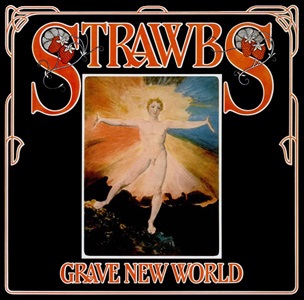
If they’d played “Benedictus” to us in assembly during my final days at school, the experience would’ve been infinitely more tolerable. In February 1972, I was pondering what on earth I was going to do with myself once this dreary experience was over. “No more pencils, no more books, no more teachers, dirty looks” as Alice Cooper put it in the then current big hit of the year. The soundtrack to that significant period was indeed provided by Vince and co, but also “Lay Down”, a single released by Strawbs to coincide with my departure from the classroom, an earworm like none other. The band’s latest album, Grave New World, didn’t actually include the single, though “Benedictus” shared some of its chord structure, hinting at what was to come a few months later. Finally shedding their folk roots, Strawbs, led by founder Dave Cousins, ventured into Prog territory, oddly enough after the departure of Rick Wakeman, who would go on to become Prog’s poster boy, his place at the keyboards being taken by Amen Corner’s Blue Weaver. A stand out song for my money is John Ford’s “Heavy Disguise”, a cross between a Jethro Tull and Roy Harper song, confirming Ford’s place as a fine songwriter. Shame that he went on to co-pen “Nice Legs, Shame About the Face” for the dreadful Monks once Punk came along. With a cover image borrowed from William Blake, the album fit right in with the growing Prog trend.
179 | Allman Brothers Band | Idlewild South ATCO 2400032 | 1970
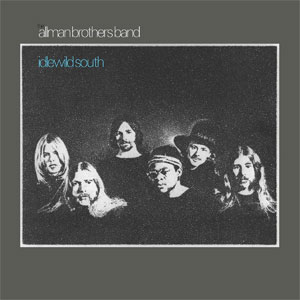
When I first heard the second album by the Allman Brothers Band, I’d already discovered several of the band’s other records, notably the later Brothers and Sisters, Eat a Peach and the live album from the Fillmore East. I was by this time pretty much familiar with the Allman’s highly distinctive guitar-led sound. Brother Duane was still around at the time of its release back in September 1970, though the album didn’t reach my ears until the late 1970s. One of the album’s most memorable tracks, Brother Gregg’s “Midnight Rider” was already on my radar via a reggae version performed by the Jamaican singer Paul Davidson, which became a top ten hit in 1976, a recording that begins with a police siren for some reason. The Allman’s version is much more visceral and soulful, which is probably why it’s still considered one of the band’s best songs to this day. The other notable track on this album is the instrumental “In Memory of Elizabeth Reed”, written by guitarist Dickie Betts, the name replacing the actual name of a woman associated with Boz Scaggs at the time, the track sounding more like something Isaac Hayes would come up with than the Allmans. The name of the album is along the same lines as The Band’s Big Pink, in that it was the name of a lakeside house the band rented in Macon, Georgia. This isn’t the Allmans’ best record, but it’s still essential listening. All their stuff is.
178 | Various Artists | Heads and Tales | TRA/SAD 18/19 | 1970

One thing you could always guarantee with those Transatlantic sampler LPs back in the day was they would always feature the cream of the British finger-picking wizards that traversed both their fretboards and the motorways of their native lands as well as further afield. Heads and Tales was no exception and on these two discs, released back in 1970, such acoustic guitar gods as Bert Jansch, John Renbourn, Ralph McTell and John James rubbed shoulders with their American contemporaries, such as Stefan Grossman, either tackling traditional arrangements or their own compositions. It wasn’t all guitars though as the label also featured bands such as The Johnstons and Mr Fox, not to mention the rock outfit Stray, whose contribution here, “Time Machine” takes us into rock territory. The blues is also represented courtesy of Duffy Power, with a track lifted from his Innovations album from around the same time, as well as some blistering guitar solos on “The Answer”, from Peter Bardens’ debut album of the same name before he went off to join Camel a little later. The inner gatefold picture is a sort of Sgt Pepper gathering of each of the respective artists included, put together collage-like in monochrome, with an unfeasible amount of folded arms. According to an ad in the 30 January, 1970 edition of Melody Maker, this double album would set you back a mere 39/8, and worth every old penny.
177 | George Harrison | All Things Must Pass | Apple STCH 1-639 | 1970

With All Things Must Pass, it was almost as if the Quiet One couldn’t wait to get some of his ideas out there, rather than the one, or at a push, two songs he could squeeze past Lennon and McCartney on all those earlier Beatles albums, hence a three disc box set. There was little time wasted as Georgie boy had all this done and dusted before the ink was dry on the band’s dissolution papers. Actually, that’s not true, all that business was done a little later, but you know what I mean. Going out to buy this box set at the time was probably a bigger ask than coughing up for either McCartney or The Plastic Ono Band, not to mention Sentimental Journey (doh! I mentioned it didn’t I?) Harrison had already proved his credentials as a fine songwriter even during the Beatle years; there ain’t now’t wrong with “Taxman”, “While My Guitar Gently Weeps” or “If I Needed Someone”, and let’s not forget the first song that pops up on Alexa when you ask for Beatles songs is always “Here Comes the Sun”. Added to this is the fact that Lennon and McCartney’s dream was for Sinatra to record one of their songs, yet the first Beatles related song ‘Ol Blue Eyes recorded was Harrison’s “Something”. Ironic or what? Anyway, this aside, All Things Must Pass is a fabulous album and features such memorable songs as “Beware of Darkness”, “Isn’t It a Pity”, “What is Life”, “Wah Wah” and the number one smash hit “My Sweet Lord”, which got him in a little deep water for having the audacity to use three chords in a similar manner to someone else. As a team player, Harrison called upon some of his pals to help deliver this now iconic album, Ringo Starr, Klaus Voorman, Gary Wright, Billy Preston and Dave Mason among them.
176 | Van Morrison | His Band and the Street Choir | Warner Brothers WB 86009 | 1970

By the time I got to see Van Morrison at the City Hall in Sheffield sometime in the early 1990s, some of the magic I first heard on the double live album It’s Too Late to Stop Now, had pretty much gone. What I witnessed that night was a cabaret act, with the annoying Georgie Fame acting as both musical director and compere, choreographing the exits and entrances for multiple encores from mid concert through to the end, by which time my interest had all but evaporated. How many times can one stand “let’s hear it again for Mister Van Morrison” before it becomes insincere? Before this show, I was the biggest Morrison devotee, largely due to the two oft played albums, Astral Weeks and Moondance, both of which hold a permanent place in any of my top albums of all time lists; and they change frequently. His Band and the Street Choir was the next one after Moondance and to be honest, it was almost as hard an act to follow as its predecessor had been. Hearing “Domino” for the first time confirmed that Morrison still had it, whatever it was, his inimitable voice filling the room once again, though this time, the lyrical content was slightly less mystical and a little more pedestrian. At the time of its release, there was the whole controversy of the record label changing the album’s original title from Morrison’s intended Virgo’s Fool, Street Choir, to His Band and the Street Choir, a reference to one of the songs on the album, “Virgo Clowns”. If “I’ve Been Working” suggests that Morrison had been listening to James Brown around this time, then “Gypsy Queen” probably does the same in regards to either Curtis Mayfield or Al Green. The songs are as soulful as they come, each delivered in Morrison’s unique style, with his influences pretty much worn on his sleeve. I could’ve done without the irritating sax solo on “Crazy Face”, but hey.
175 | Randy Newman | 12 Songs | Reprise REP 44084 | 1970
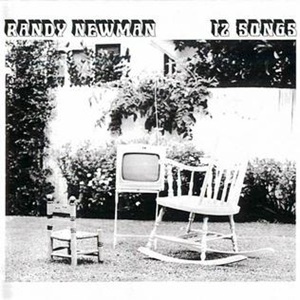
Like a good few of my generation, I first became aware of Randy Newman when I saw him perform “Political Science” on the Old Grey Whistle Test back in the early 1970s, a song like no other at the time. Unaware, I’d actually heard one or two of Newman’s songs before that, notably Three Dog Night’s hit version of “Mama Told Me Not To Come” and the Alan Price Set’s joyful “Simon Smith and the Amazing Dancing Bear”, a hit for him a couple of years earlier. I’m sure there were others. This was songwriting like none other before, almost trumping Dylan in just how uncompromisingly scathing a songwriter could be when he/she puts his/her mind to it. In the record shop, a quick scan at the musician credits would have me heading towards the counter, Ry Cooder and Clarence White alone would do the trick. As the title indicates, this LP is made up of twelve Newman originals covering a wealth of subjects from racism, violence and the generation gap, delivering each lyric with an element of wry humour and clever wit. Although a very good album, 12 Songs has been trumped for quality in later albums, certainly Sail Away and Land of Dreams, a personal favourite, before the lure of Toy Story 1/2/3 and 4, together with dozens of other film scores changed things around a bit.
174 | Fairport Convention | What We Did on Our Holidays | Island ILPS 9092 | 1969

One or two of the songs on Fairport Convention’s second studio album, released in January 1969, were also included on the later compilation The History of Fairport Convention, which was the first Fairport album I bought after seeing the band at the Top Rank in Doncaster in one of their many interim line-ups. I seem to remember Swarbrick and Peggy, but little else. I was an under-age boozer, though devoid of what my grandma would refer to as ‘a good constitution’; in other words, I was too pissed to remember. The four songs I was therefore already familiar with on What We Did On Our Holidays, were coincidentally the first three songs on side one, the utterly gorgeous “Fotheringay”, the almost throw away bluesy number “Mr Lacey” and the smoothly delivered “Book Song”, which features a joint vocal effort by both Sandy Denny and Ian Matthews. The fourth song on both the History album and Holidays is the anthemic “Meet on the Ledge”, tucked away on the second side, curiously not the album closer; the song has since closed a million shows. Fairport was one of the bands in receipt of acetates from over the pond, courtesy of Joe Boyd and therefore managed to get their hands on material not readily available to others, plundering the repertoires of the emerging singer songwriters, in this case Joni Mitchell with “Eastern Rain” and Bob Dylan of course, with a take on his “I’ll Keep It With Mine”. Despite the band’s later albums Unhalfbricking and Liege and Lief, claiming the beginning of what we now know as British Folk Rock, a forerunner must surely be Sandy’s reading of “She Moves Through the Fair”, an album highlight here. Interestingly, the cover artwork is of a blackboard doodle, created by Sandy Denny and the band’s original drummer Martin Lamble, in a classroom at the University of Essex, where the band were relaxing before a show. After doing the show and leaving the venue, the members of the band began considering possibilities for their next album’s cover artwork and remembering the blackboard, immediately contacted the school to see if the doodle was still there. It was.
173 | Creedence Clearwater Revival | Bayou Country | Liberty LBS 83261 | 1969
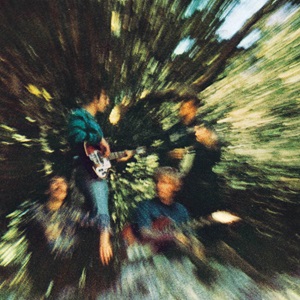
This second album by Creedence Clearwater Revival is all but done and dusted by just over thirty minutes, yet the LP is packed with goodies from the start, not least the swampy “Born on the Bayou”, as good a vehicle for John Fogerty’s inimitable vocal as any. I was at the time in competition with the boy up the street, to see who could collect the most singles by this band and more importantly, who could be first to the post. He was winning at this point, and even more disappointingly, his brother already had the two LPs. “Proud Mary” is probably the album’s high point, a song covered by Elvis and Ike and Tina, together with over a million club bands throughout the 1970s, a song that sat alongside “Yellow River”, “Sweet Caroline” and the obligatory “Johnny B Goode” in workingmen’s clubs from Formby to Filey and everywhere in-between. Creedence would have a busy year ahead, releasing a couple more albums before the clocks went back, Green River in August and Willie and the Poor Boys in October. I still remember bombing up and down the back alleys of Barnstone Street trying to whistle some of the tunes on this album, with varying degrees of success. Like other bands of the era that I admired, such as Pink Floyd and Wishbone Ash, I became disappointed that they would break up, largely due to one of their number being a bit of a twat.
172 | Fleetwood Mac | Pious Bird of Good Omen | Blue Horizon S7-63215 | 1969
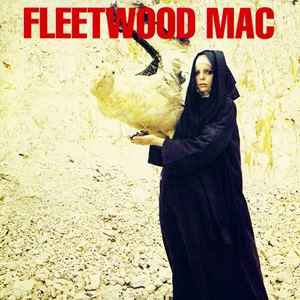
There are one or two LPs in my own collection that I don’t consider to be compilations, despite the fact that they are. Fleetwood Mac’s Pious Bird of Good Omen is one such album. Had they called it The Best of Fleetwood Mac and popped a picture of the hairy band on the cover, then that might’ve been a different story. Pious Bird is a Best Of So Far album for sure, though I consider it a stand-alone album by one of the best loved of all British blues bands. The album is actually made up of the band’s first four singles together with their relative b sides, together with one or two tracks that had already appeared on the band’s first couple of studio albums Fleetwood Mac and Mr Wonderful. The tell-tale sign that this might be a compilation album is probably the photo on the back, which shows the band’s two previous albums discarded in a patch of grass. The album opens with possibly the definitive version of Little Willie John’s blues standard “Need Your Love So Bad”, one of the band’s greatest recordings, whilst side two opens with the band’s much loved instrumental “Albatross”, which makes great use of the band’s three guitar arsenal, Peter Green, Jeremy Spencer and Danny Kirwen, whilst John McVie and Mick Fleetwood keep the wings of the bird in flight. For those who just can’t be bothered with singles anymore, Pious Bird of Good Omen is an essential record to pop alongside your early British Blues LPs.
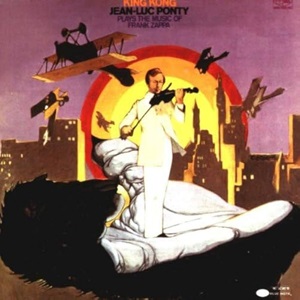
171 | Jean-Luc Ponty | King Kong | Liberty LBS 83375 | 1970
As a life-long Zappa enthusiast (well almost), paired with the fact that I belong to the breed of music animal who tends to read every single word on album sleeves and accompanying labels, the name Jean Luc Ponty appeared to me for the first time on the sleeve of Zappa’s Hot Rats LP back in the early 1970s. Ponty’s violin can be heard on just the one track, “It Must Be a Camel” and not the track mostly associated with a violin, “Willie the Pimp”, which was in fact Sugarcane Harris on that occasion. Shortly after first hearing Ponty’s contribution to the Zappa album, I sought out more from the musician, firstly his Enigmatic Ocean LP released in 1977, simply because I liked the sleeve, a close-up of the smiling musician. Later I discovered this gem of an album, made up almost entirely of Zappa compositions, some of which had already been recorded by The Mothers, such as “Idiot Bastard Son” and “America Drinks and Goes Home”, together with the exhilarating title cut “King Kong”. Subtitled ‘Jean-Luc Ponty Plays the Music of Frank Zappa’, King Kong includes a lengthy piece entitled “Music for Electric Violin and Low-Budget Orchestra”, which provides the musician with plenty of scope to stretch out, working with a small orchestra on the piece. Ponty himself provides one composition, “How Would You Like To Have a Head Like That”, which features Zappa on guitar. It’s interesting to see how this short-haired clean-cut French musician in a white suit, as seen on the cover of King Kong, soon developed into the heavily hirsute individual featured on the cover of Enigmatic Ocean. Zappa’s influence no doubt stretched further than just the music.
170 | Osibisa | Woyaya | MCA MDKS 8005 | 1971
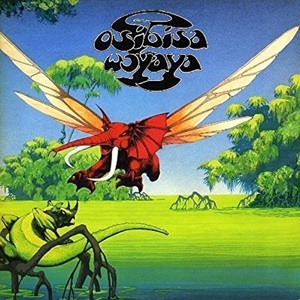
Speaking of sleeve designs, another name that pops up in regard to all things Prog, is that of Roger Dean, the artist responsible for all those wonderful Yes covers, from Fragile onwards. Though chiefly remembered for his work on those sleeves, Dean regularly branched out in other areas, no doubt a respite from trying to work out how to interpret in design, the baffling lyrics of Jon Anderson. Amongst the Uriah Heeps, Babe Ruths and Gentle Giants, Dean was also responsible for the album sleeves of the multi-cultural combo Osibisa, whose second album Woyaya was treated to a lavish and highly colourful landscape, featuring a flying elephant, which wasn’t Dumbo, or any of his relations to my knowledge. If the visuals were created by Roger Dean, then the music within was provided by the musical prowess of three Ghanaians, a bassist from Grenada, a lead guitarist from Antigua, a keyboard player from Trinidad and a sax player from Nigeria. Starting in precisely the same manner as Black Sabbath’s debut album, with the sound of rain and thunder, there was something immediately tropical about the sounds that followed. A newcomer to Osibisa might have mistaken the band’s overall sound for that of Santana, due in no small part to the band’s heavy reliance on percussion, with some informed guitar flurries thrown in at regular intervals, courtesy of Wendell Richardson. I dare say a few ‘Proggers’ were turned onto the music of Osibisa because of the sleeve, and having collected all their early LPs up to 1975’s Welcome Home, I include myself among that number.
169 | Audience | Lunch | Charisma CAS 1054 | 1972

Whenever I browsed through the rock LP boxes in Foxes Records in the early 1970s, it was more often than not that an album sleeve created by those wonderfully cookie Hipgnosis people would catch my eye. I often questioned myself about what I was doing with my burgeoning LP collection, gathering the music I loved or curating an art exhibition in my bedroom. These sleeves would be scattered around the room like Picassos in Rose’s boudoir on the Titanic. Audience released three albums on Tony Stratton Smith’s Charisma label, two of which were wrapped in Hipgnosis-designed sleeves, this and the band’s previous album The House on the Hill. Not easy to categorise at the time, Audience was slightly different from its contemporaries as the band’s music was made up mainly of guitar and sax interplay, a left over from the band’s previous incarnation as a soul band, Lloyd Alexander Real Estate. The band also had Howard Werth and his idiosyncratic, almost sneering vocal, which lent credence to the band’s overall Prog-ish sound. Lunch, the band’s final album, probably indicates a band running out of steam, though it still has some interesting songs, such as the opener “Stand by the Door”, which wouldn’t be out of place on a Mott the Hoople or David Bowie album. Staring at the album cover, a double portrait of two refined seated ladies, presumably from the 1920s, I ask myself, why Lunch? But there again, this is Hipgnosis, where questions like this have already been asked previously. Why a cow?
168 | America | America | Warner Bros K46093 | 1971

Perhaps it’s an easy choice to name one’s band after a city or state; Boston, Chicago, Alabama, Texas and the like, but who would have the audacity to claim the entire country as a moniker? Dewey Bunnell, Gerry Beckley and Dan Peek, that’s who. America was formed in London by a Brit and two Americans, military brats having not much better to do at the beginning of the 1970s. Although not actually included on their self-titled debut LP, “Horse With No Name” was the song just about everybody associated the band with at the time, the song being played relentlessly on daytime radio throughout 1972 and becoming a massive hit in the process. Subsequent releases of the album have always included the song, an unexpected hit at the time, with its Neil Young-like acoustic sound, completely at odds with the then current run of Glam hits by the likes of T Rex, Slade and all that glitters. For those enchanted by the two chord groove that permeates “Horse”, there was more to discover on America, such as “Sandman”, another key track to the album. Notable contributions on the album include Dave Atwood’s drums, Ray Cooper’s percussion and David Lindley’s steel guitar. I always admired the cover shot of the three musicians sitting before a huge mural depicting Native Americans, Indians, First Nations (choose your own term according to current trends). Looking back at those times in the early 1970s, it’s easy to see how such bands as Eagles and associated solo artists Jackson Browne, Dan Fogelberg and JD Souther emerged to step into the limelight and reign over the next decade.
167 | Barclay James Harvest | And Other Short Stories | Harvest SHVL 794 | 1971

I’d already been somewhat entranced by the music of the Oldham-based Prog Rock outfit Barclay James Harvest after first hearing “Mocking Bird”, a track from their previous album Once Again, released in early 1971 and was perhaps ready for another installment, which came later in the same year. Barclay James Harvest and Other Short Stories once again sees the band exploring what would become known as Symphonic Rock, for want of a better moniker, with John Lees, Les Holroyd, Stuart Wolstenholme and Mel Pritchard having already dabbled in this style of music in some passages on Once Again. By the time of the band’s third album though, it became obvious that this was the direction they wanted to take, in much the same way that the Moody Blues had adopted their particular Classical influences. There’s nothing quite as immediately appealing on Short Stories as “Mocking Bird”, though after a few runs through, the nine compositions begin to gel. Those orchestral influences kick in immediately as the determined cellos herald in the album’s opening track “Medicine Man” and continue pretty much to the end. Interestingly, a Crosby, Stills, Nash approach is adopted for Holroyd’s “Little Lapwing”, one of the sweetest songs, not only on this album, but all BJH records, though the same could perhaps be said of “Song With No Mening” as well, another fine Holroyd composition. Recorded at both Abbey Road and Maida Vale studios in London, the album was produced by the band along with Wally Allen, and remains a much played LP in our house, though I tend to skip “Harry’s Song” for some reason.
166 | The Mahavishnu Orchestra with John McLaughlin | The Inner Mounting Flame | Columbia KC31067 | 1971

If there was ever a case for noodling, the debut album by The Mahavishnu Orchestra might well qualify. From the opening piece, “Meetings of the Spirit”, The Inner Mounting Flame took jazz rock to new heights upon its release, with John McLaughlin’s guitar very much to the fore. Did I say that McLaughlin was born a couple of miles from my doorstep? By the time of the album’s release, the Doncaster-born guitarist had already notched up some credible collaborations, playing alongside the likes of Alexis Korner, Georgie Fame, Graham Bond, Brian Auger and even Jimi Hendrix before working with Miles Davis on his seminal jazz fusion albums In a Silent Way and Bitches Brew, the latter which included a number entitled “John McLaughlin”. If McLaughlin dazzled audiences with his sheer dexterity as a formidable guitar player, then much the same could be said of Billy Cobham, whose skills as a first rate jazz drummer were indeed very much the focus for some. Add to this the remarkable playing of Jan Hammer on piano, Jerry Goodman on violin and Rick Laird on bass, The Mahavishnu Orchestra were something very much to write home about.
165 | Captain Beefheart | The Spotlight Kid | Reprise K44162 | 1972

Back in school, when I was completely besotted with all things Edgar Broughton, I heard whispers that Wilko’s favourite band was just a rip-off of the Captain, therefore, I sought out all I could on Beefheart so that I could make up my own mind on the matter. After buying the band’s second album, Strictly Personal, based on hearing a track on John Peel’s late night show the previous week, I found that it wasn’t long before I’d caught up with them all up to that point, and my opinion was immediate, resolute and unwavering; that no one was anything like the Captain at all. Released in January 1972, Captain Beefheart’s sixth studio album was the first to be credited solely to Captain Beefheart, completely avoiding any mention of the Magic Band, who was obviously still very much present on this album. Returning to a more blues-based music, the songs on The Spotlight Kid appear to utilise much simpler arrangements to those on his two previous records, Trout Mask Replica and Lick My Decals Off, Baby, therefore the album was generally thought of as his most accessible to date. Joined by Bill Harkleroad and Elliot Ingber on guitars, Mark Boston on bass, John French on drums and Art Tripp on marimba, the Captain allegedly resorted to the same sort of bullying tactics he utilised on the Trout Mask sessions, with a particular resentment towards Bill Harkleroad, who was at one point thrown into a dustbin. Though the music was largely blues-based, the inclusion of the marimba provided a unique angle as exemplified on “Blabber and Smoke”. The funky guitar intro to “I’m Gonna Booglarize You Baby” took the band in a very different direction, much more accessible and dare I say, almost radio friendly. Well, almost.
164 | Ry Cooder | Into the Purple Valley | Warner K44142 | 1972
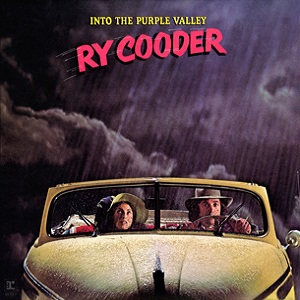
When I first saw Ry Cooder on the Old Grey Whistle Test back in 1972, I became totally obsessed with his music and in particular his bottleneck guitar playing style, which led to me seeking out other such players, including Lowell George, Duane Allman and Bonnie Raitt. At the time, I didn’t know “Vigilante Man” was a Woody Guthrie song, I didn’t even know who Woody Guthrie was. Neither did I know who Ry Cooder was, although his name had been cropping up in the music press and I had one of his tracks on the Warner Bros Fruity sampler LP, the one with the circular sleeve to match the record. Here was an extraordinary guitar player making an appearance on the telly in a darkened studio, wearing a piece of cloth on his head and a shirt, which looked for all intents and purposes, as if someone had vomited over it, while running the chopped off neck of a beer bottle up and down a very attractive guitar. I couldn’t even decide whether he was singing in tune or not, all I knew for sure was that it was worlds away from Sweet’s “Little Willy”, a song that was playing relentlessly on Britain’s only other music show. After seeing this very ordinary looking dude, who looked like he had a glass eye (he had), sitting next to Bob Harris on my then favourite TV show, I went out and bought this album, mainly for “Vigilante Man”, but then to discover such gems as “Billy the Kid”, “Denomination Blues” and “Teardrops Will Fall”. I only ever got to see Ry Cooder once, on stage with David Lindley at the Manchester Apollo sometime in the 1990s. Cooder remains one of greatest sources of musical eclecticism to this day. It’s the only American Songbook I’m interested in really.
163 | Clifford T Ward | Home Thoughts | Charisma CAS1066 | 1973
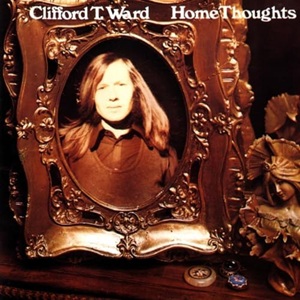
We seem to think of Clifford T Ward as a tragic figure, perhaps due to his untimely death in 2001 at the age of 57, after been diagnosed with multiple sclerosis 14 years earlier. Perhaps best known for his song “Gaye”, a million-selling hit in the summer of 1973, the opening song from his second album Home Thoughts released in the same year, the slightly more commercial single “Wherewithal” failed to chart. With a title taken from Robert Browning’s poem Home Thoughts from Abroad, which is also the title of the song that opens side two, the songwriter alludes to his love of poetry, with a further nod to the poet in the song’s lyric, as well as John Keats and William Wordsworth, together with his home county of Worcestershire. Ward actually released his debut album Singer-Songwriter a few months earlier on John Peel’s Dandelion label. If the title of Ward’s debut indicates precisely which musical category he is forced to reside, then Home Thoughts seals the deal.
162 | Bridget St John | Thank You For… | Dandelion 2310-193 | 1972

I picked up this LP in a record shop in Cornwall from a box labelled ‘collectables’. Bridget St John’s third album and her last for John Peel’s Dandelion Records label, sees the husky-voiced British singer songwriter mixing her own originals with one or two covers, notably Bob Dylan’s “Love Minus Zero/No Limit” and Buddy Holly’s “Every Day”. Joined by members of the rock outfit Quiver, who would later join forces with the Sutherland Brothers, together with such pals as John Martyn, Rick Kemp and Dave Mattacks among others, Bridget delivers what could be described as her first folk rock album, yet maintains some of the pastoral feel exemplified in the songs on her previous two records Ask Me No Questions and Songs for the Gentle Man, all three now difficult to find, unless you have a large wad of that there folding money in your back pocket. I would’ve thought in light of Nick Drake’s later popularity amongst the young, when everyone with a guitar was rushing out to learn every single note the doomed songwriter played on those three LPs, that they would equally seek out everything by this contemporary of his. Perhaps you have to be dead to count. Thank You For… is a fine album with some nice moments, certainly the almost whimsical opener, “Nice” the title song “Thank You For…” that follows, together with the haunting “Fly High”. Other notable songs include a reading of the traditional “Lazarus” and the gorgeous “Silver Coin”, penned by Hunter Muskett’s Terry Hiscock. When I met up with Bridget in 2018, she gave me a little box set of all her early albums, which I thought was very nice of her. Lovely woman.
161 | Black Sabbath | Black Sabbath | Vertigo VO 6 | 1970

One of the bleakest openings to any rock album, as rain pours, lightning strikes and thunder erupts, with the church bell striking the death toll; Black Sabbath make an entrance. The self-title debut from this Birmingham outfit was probably the start of what we now know as Heavy Metal, largely created by Tony Iommi’s idiosyncratic guitar riffing, a unique sound as the result of having to play with thimbles after losing his finger ends in an accident at the sheet metal works where he was employed. One of the curious aspects of this album is the sleeve, a fabulous sleeve make no mistake, photographed at Mapledurham Watermill in Oxfordshire, yet who is the mystery woman? Apparently no one knew until recently who it was, though it has been revealed that the woman in black is Louisa Livingstone, a model who subsequently claimed it was ‘freezing cold’ on that particular shoot. For heavy rock nuts, Black Sabbath meets all the criteria; some fine guitar riffs, a suitable rhythm section and a vibrant vocal performance from Ozzy Osbourne. This was one of the LPs almost constantly on the turntable at my school chum Gary’s house most Saturday nights, as we pretended to study for our end of term exams, our large crucifixes dangling over the text books, while reciting the lyrics to “N.I.B.” Oh yeah.
160 | Ian Matthews | Matthews’ Southern Comfort | UNI UNLS 108 | 1970

Best known perhaps for his number one hit, a country-inflected version of Joni Mitchell’s getting back to the garden anthem “Woodstock”, Ian Matthews released his debut solo album in 1970, shortly after leaving Fairport Convention. Matthews’ Southern Comfort was recorded with the help of some of his former bandmates, though the album title would provide his next band with its name. For Fairport fans bewildered as to why Matthews should want to leave their beloved band, the material on this debut revealed the singer’s desire to lean more towards a country rock sound than the British folk rock angle Fairport were currently taking. The bulk of the songs on this album are originals from either Matthews himself or his co-producers Ken Howard and Alan Blaikley, who chose to go under the moniker of ‘Steve Barlby’ for this production, perhaps to separate their new venture from their established pop songwriter roots. The album also featured Richard Thompson’s “A Commercial Proposition”, a poignant reflective song in the wake of Fairport’s tragic accident the year before. Though there’s one or two nods towards Matthews’ rock and roll roots, notably “Dream Song”, there persists a lightness of touch throughout the album, with frequent pedal steel flurries courtesy of Gordon Huntley, giving the overall sound a country flavour, without being overly Nashville. Then there’s the utterly depressing “The Watch”, which provides the listener with weeping and sobbing throughout, or it might be just the engineer who accidentally left the console mic on. Although a fine debut, there was nothing here to suggest a long career to come with dozens of subsequent albums, most of them I have collected, though, as biographer Ian Clayton once told me, nowhere near ‘em all!
159 | Canned Heat | Future Blues | Liberty LBS 83364 | 1970
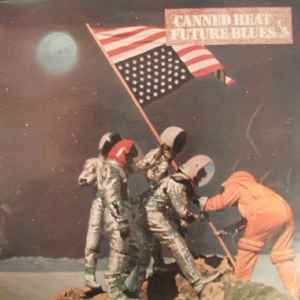
I first became aware of Canned Heat when I heard my older sister singing “Let’s Work Together” in the bathroom, which I could never get into (the bathroom, not the song). I couldn’t wait to get my hands on the single and remember being delighted that the band were on the same label as Creedence Clearwater Revival, another favourite band at the time. The song appears on this the band’s fifth album, released in the summer of 1970, though the single came out a few months earlier. Future Blues sees the band on good form, with some urgently delivered blues numbers, such as the Eddie Shuler song “Sugar Bee”, given some heavily amplified, almost distorted, wailing Little Walter-styled blues harp. The album was released just before the death of singer/guitarist Al Wilson, whose distinctive voice can be heard on such songs as Charlie Patton’s “Shake it and Break it” and the fabulous “Skat”, which sees the band in playful mood; once heard never forgotten. With a memorable cover shot of the band planting the stars and stripes on the moon, a then current craze, the inner sleeve shows the band amongst the giant redwoods, with an impassioned plea from the band’s shortly to be no more guitarist, for fans to help save the planet, to effectively “prevent future blues”. Not sure anyone was listening.
158 | Syd Barrett | The Madcap Laughs | Harvest SHVL 765 | 1970

In the mid-1970s, I had a girlfriend, though she strongly objected to the term, a friend then, pretty much obsessed with Syd Barrett, who I only really knew as the former guitarist with Pink Floyd, and who had by this time, pretty much vacated his body. She didn’t have any of his solo albums, but played her beloved Piper at the Gates of Dawn and A Saucerful of Secrets LPs relentlessly. I felt duty bound to introduce into her mum’s front room, where we spent many hours, Syd’s The Madcap Laughs, where we would listen in particular to the second side, often on repeat, whilst reading The Hobbit. Recorded between May 1968 and August 1969, just after he parted company with his band, due in part to some increasingly bizarre and peculiar behaviour, The Madcap Laughs is Syd Barrett’s debut solo LP. The cover itself, designed by Storm Thorgerson and Aubrey Powell of Hipgnosis, shows some of these worrying signs; a sparse flat, actually Syd’s bedroom at his home at Wetherby Mansions, painted floorboards, no furniture, wilting flowers, a barefooted crouching Syd looking not quite right. The gate fold sleeve also shows an acquaintance, known as Iggy the Eskimo, posing nude on a wooden stool, the two seemingly unaware of one another’s presence. I became aware of the album in 1973, around the same time I discovered Kevin Coyne and like Coyne, I was initially puzzled by some of the songs, almost accusing the pair of not even trying. The false start on “If it’s in You” should’ve perhaps been left on the cutting room floor. Of course it later became apparent that Syd’s psychological state was pretty much worse than first thought and in that context, the songs perhaps mirror what was going on in Syd’s head. I don’t know what Coyne’s excuse was though. Side two of this album, from “Octopus” through to “Late Night”, is a journey into the unknown and was perhaps not the most suitable soundtrack for my mid-teens angst, in fact it was positively harmful. Reciting the lyrics of “Terrapin” to Janet, that early girlfriend (or whatever), was invariably unrewarding, even on a good day. She preferred ‘And the sea isn’t green, and I love the queen, and what exactly is a dream, and what exactly is a joke’ from an earlier song. Where are you now Janet?
157 | The Who | Tommy | Track 2657 002 | 1969

With a life-long aversion to all things ‘musical’ related, which includes opera, operetta, stage musicals, book musicals, jukebox musicals, films of stage musicals and any other such productions that feature unlikely characters bursting into song at any given moment, it comes as little surprise that it took a while for me to get around to Tommy, allegedly the first rock opera, though the Pretty Things claim their S.F. Sorrow pipped them to the post by a few months. A few decades on, The Who’s masterpiece had been turned into an all-star stage show and a musical film directed by the esteemed Ken Russell and it surprises me still, that it hasn’t yet been turned into a Netflix series. As an album though, with four sides to go at, the story of this deaf, dumb and blind kid who just happens to be a whiz on the pinball machine, stands up as a highly listenable record, with a handful of memorable tunes, not least “Pinball Wizard”, “1921”, “Amazing Journey” and “The Acid Queen”. On the 16 August 1969, the band presented just about all of this double album before half a million sleepy hippies just outside Bethel, upstate New York, when I’m sure all that they really wanted to hear was the hits. Listening to Tommy all these years on, I’m still impressed with the “Overture”, despite John Entwistle’s corny French Horn fanfare.
156 | Isaac Hayes | Hot Buttered Soul | Stax 2325 011 | 1969
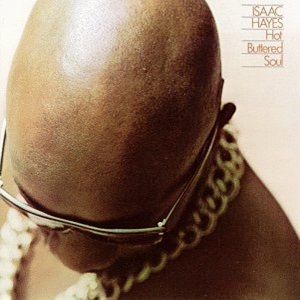
It was first hearing a version of the Jerry and Billy Butler song “I Stand Accused”, with its engaging sultry spoken intro, that first attracted to me to the music of Issac Hayes, an artist unafraid of transforming a simple song into an eleven-minute epic. That 1970 album, The Isaac Hayes Movement, which I picked up from a record shop bargain bin in the early 1970s, led me to other albums by this towering figure of orchestrated soul music, such as the double Shaft soundtrack set and his earlier second album Hot Buttered Soul. It was all a little strange at the time as I was an almost dyed-in-the-wool Progger, with little time for soul music, but there was something in these arrangements that appealed to me. If I was tempted by a twelve-minute reading of “I Stand Accused”, then how about an eighteen-minute “By the Time I Get to Phoenix” or a twelve-minute rendition of the Dionne Warwick hit “Walk on By”? It wasn’t only the lengthy arrangements that caught my eye, it may also have had something to do with the audacity of allotting one song a thirty-four letter title “Hyperbolicsyllabicsesquedalymistic”, a bluesy number with funky guitar licks throughout. In a way, I saw the success of “Theme From Shaft” coming along a little later, though in my wildest imagination I didn’t see Mr Hayes becoming the chef in South Park.
155 | Led Zeppelin | Led Zeppelin | Atlantic K40031 | 1969

I was first drawn to Led Zeppelin not so much by the racket they made, but by the way they looked, especially after seeing a Pace poster of the band in action on the wall of a shoe shop near the market place in Doncaster. As I waited patiently with my mother in the bustling shop, the smell of leather mingling with the morning’s fish deliveries over the road, I couldn’t seem to take my eyes off the chap in the flared denims and what could only be described as half a shirt, with long flowing golden hair that I would’ve willingly offered my right hand for. Led Zeppelin had entered my life and would stick around for a short while. The band’s self-titled debut passed me by without fanfare, though by the time of their second release, I was right in there hook, line and sinker. Once again the Age of Atlantic sampler opened my ears first, with its inclusion of “Communication Breakdown”, which eventually led to the purchase of this album, though not until I’d already added the other three ‘numbered’ LPs to my steadily growing collection. “Good Times Bad Times” is not quite as good an opener as the later “Whole Lotta Love” nor indeed the even later “Black Dog”, but as a starting point, it managed to draw me in nonetheless. I suppose the album’s high point is the moody “Dazed and Confused”, a number left over from the repertoire of Jimmy Page’s former outfit The Yardbirds. Having already heard Bert Jansch’s “Blackwaterside”, I couldn’t help listening to the instrumental “Black Mountain Side” with a raised eyebrow. To this day I see this album in second hand record shops going for astronomical prices, simply due to the title being printed in blue rather than the usual orange, and likewise, to this day I have no desire to spend three figures on a Pantone change, I’ll stick to the orange.
154 | John McLaughlin | Extrapolation | Polydor PD 5510 | 1972

During my tunnel-visioned lost weekend of jazz worship, a condition that led me to deliver a weekly jazz show on local hospital radio (poor buggers), the 1980s moved swiftly into the 1990s and I would find myself listening to other radio shows for inspiration, notably Humphrey Lyttelton’s Best of Jazz programme on BBC Radio 2. It was during one of these shows, sometime in the late 1980s, when I first heard “Binky’s Beam”, one of the tracks on John McLaughlin’s debut solo album Extrapolation. I felt an affinity with the guitarist, having been born in the very same town, albeit fifteen years later. “Binky’s Beam”, a tune dedicated to the jazz bassist Binky McKenzie, led me to go out and buy the Giorgio Gomelsky-produced album, which uncovered other gems, such as the Zappa-like opening title track, the smooth “Argen’s Bag”, perhaps a companion piece to “Binky’s”, also written for a bassist, in this case the Dutch musician Arjen Gorter, and “Pete the Poet”, written for the ‘amazing poet from London’ Pete Brown. Extrapolation features John Surman on saxes, Brian Odgers (Odges in the credits) on bass and Tony Oxley on drums. Not McLaughlin’s best album, but certainly an early sign to what was to come.
153 | Bert Jansch | Birthday Blues | Transatlantic TRA 179 | 1969

Bert Jansch had already made four solo albums before Birthday Blues, the guitarist’s final 1960s album. The so-called poster boy of the folk world, Bert always made it look and sound easy, though I dare say it was far from it. Birthday Blues incorporated the sort of acoustic folk blues he was noted for, together with some of the more jazzy leanings of that produced by his band Pentangle, the band’s rhythm section of Danny Thompson and Terry Cox being on hand to help out here. Opening with a song with a slightly pretentious twenty word title, “Come Sing Me a Happy Song to Prove We All Can Get Along the Lumpy, Bumpy, Long and Dusty Road”, Jansch freely exhibits his more whimsical side, though the darkness follows shortly after with “Poison”, a song that would remain in his live repertoire for some years to come. Adding to the bluesy feel, Duffy Power provides some tasty harmonica in places, notably on the aforementioned “Poison” and “I’ve Got a Woman”. Pretty much written entirely by Jansch, the songs straddle the styles previously explored on his earlier albums as well as the overall feel of the Pentangle material, a sort of bridge between the Les Cousins folk troubadour era and the country rock of the early to mid-1970s. Birthday Blues also has the best canine cover in popular music. Cute.
152 | Judy Collins | Who Knows Where the Time Goes | Elektra EKS 74033 | 1968

Judy Collins traverses a deep well of songwriting talent on this her seventh album, released in late 1968, once again borrowing songs from her friends and peers, notably a couple of Leonard Cohen staples, “Story of Isaac” and “Bird on a Wire”, leaving her indelible mark on both. Alice Cooper may have had a hit with the Rolf Kempf song “Hello, Hooray”, but here Miss Collins recorded it first, a good five years ahead of Mr Furnier. If you’re going to have a couple of Cohens then you might as well snaffle a Dylan and here Judy puts a country slant on “I Pity the Poor Immigrant”, complete with weeping pedal steel courtesy of Buddy Emmons. The songwriting genius of the Incredible String band’s Robin Williamson is also tapped into, with a gender changed “First Boy I Loved”, one of the album highlights. Judy’s beau Stephen Stills is on hand to handle guitars throughout, with appearances by James Burton, Van Dyke Parks and Jim Gordon amongst others. Though the title song is treated with respect, with Judy delivering a pitch perfect rendition of “Who Knows Where the Time Goes”, and having heard the Fairport take on Sandy Denny’s timeless song countless times, I still know which version will be played at my funeral.
151 | Yes | Yes | Atlantic K40034 | 1969
Although the Yes Album was the first album by this band to reach my shelves, it was a track from their self-titled debut that first brought the band to my attention, whilst still a scrawny teenager at school. The track in question, “Survival”, a mini-ecological epic, appeared on the first Age of Atlantic sampler, which saw the band rub shoulders with such American acts as the Allman Brothers Band, Buffalo Springfield, Vanilla Fudge, Iron Butterfly and Dr John as well as fellow Brits Led Zeppelin and Dada, shortly to become Vinegar Joe. Hearing “Survival” on this sampler LP, eventually led me to searching out more material from Yes, which included other songs on the band’s self-titled debut, as well as its follow-up Time and a Word and eventually their breakthrough LP The Yes Album, which revealed the band’s potential as a first tear Progressive Rock outfit. Known for their explorative cover adaptations, such as the Beatles’ “Every Little Thing” and the Byrds “I See You”, Yes had also achieved some degree of success with their own original material, notably “Beyond and Before”, written by Chris Squire and former Mabel Greer’s Toyshop guitarist Clive Bailey. The jazz elements filtered through, certainly in regard to Peter Banks’ Wes Montgomery-styled guitar playing, exhibited chiefly on the middle section of the Byrds’ cover. With all the heavy duty Prog excessiveness on later albums, notably the sprawling Tales From Topographic Oceans, this debut is a showcase for a new band’s musical ingenuity without it being too grand or overblown.
150 | Rolling Stones | Let It Bleed | Decca SKL 5025 | 1969
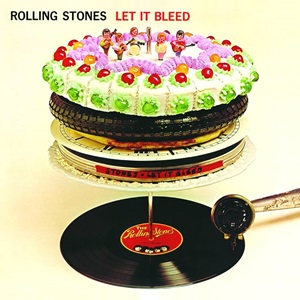
Beggar’s Banquet was really a hard act to follow, as the Rolling Stones began to show signs of fragmentation, Brian Jones becoming something of a loose cannon in the wake of the so-called Summer of Love. Let it Bleed was perhaps the album Stones fans were waiting for, the album opening with a track that continues to top best of lists to this day. “Gimme Shelter” is a perfect opener, which not only sees the band on top form, but includes some of the most soulful back-up singing in recorded history, in fact I’d go as far as to say it’s that vocal that makes this performance so good. Merry Clayton isn’t the only important contributor to this most excellent album, credits also include Ry Cooder, Leon Russell and Al Kooper, not to mention Madeline Bell and Doris Troy, who join the London Bach Choir on the opening chorus of the stunning “You Can’t Always Get What You Want”, which closes the album. The Stones return to their blues roots for their swampy interpretation of Robert Johnson’s “Love in Vain”, featuring Ry Cooder’s inimitable mandolin. The album is probably best remembered as being Brian’s last, having been replaced by Mick Taylor during the sessions, Jones having merely contributed a bit of autoharp on “You Got the Silver” and some congas on the sprawling “Midnight Rambler”. Strangely, the Stones big hit at the time, “Honky Tonk Woman”, is presented on this album as an almost throwaway “Country Honk”, featuring some country-flavoured fiddle courtesy of Byron Berline. Curiously, Robert Brownjohn’s carefully constructed sculpture that appears on the cover is often credited to Delia Smith, the then unknown TV cook, who actually only baked the cake on top. Looks delicious though.
149 | Pentangle | Basket of Light | Transatlantic TRA 205 | 1969
I don’t think it was quite as far back as 1969, it was more like a couple of years later, when a young and relatively hip youth leader and his equally young, though infinitely more attractive wife it has to be said, introduced me to this LP by Pentangle. Although I hesitate to refer to myself as the Youth Club DJ, I was nevertheless the kid responsible for spinning 45s on his crummy Dansette, an irritation to many of the female members, as I wilfully chose to play singles by Creedence Clearwater Revival, the Move, the Kinks, Humble Pie and the Beatles, rather than “Love Grows Where My Rosemary Goes”, “Sugar Sugar” or the obligatory “Chirpy Chirpy Cheep Cheep”. On one occasion, this club leader suggested a compromise, and brought in something slightly more ‘pastoral’, handing over this LP, which was even further from the sort of dance music the girls required at the time. “Light Flight” was probably the sweetest thing I’d heard up to this point and I was instantly hooked. I didn’t have any interest whatsoever in what could loosely be considered folk music, but Basket of Light worked its wonders on me for some inexplicable reason and I couldn’t take it off the turntable. The group leader was so pleased with my reaction, that he gave it to me to keep, as if he’d just put me on the path to salvation. I’d been saved! When I later studied the gatefold sleeve, I realised that the band had in its ranks one Bert Jansch, a musician my art teacher had already introduced me to a little earlier, when he played Bert’s debut solo LP in art class. Basket of Light opened up a world of music that continues to thrill me to this day. Getting the opportunity to see the original line-up of Pentangle at the Royal Festival Hall in 2011 was one of those completely unexpected events, which left an indelible mark on me. This is the album I would recommend to any potential Pentangle converts, no question.
148 | McGuinness Flint | McGuinness Flint | Capitol EA-ST 22625 | 1970
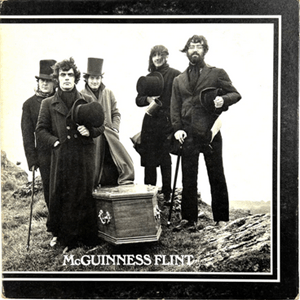
A little like Fleetwood Mac before it, this band was named for its rhythm section, in this case Tom McGuinness and Hughie Flint, whose background was steeped in blues, Manfred Mann and John Mayall respectively, the two musicians then joining forces with songsters Benny Gallagher and Graham Lyle, adding Dennis Coulson on keyboards to create a brand new rock outfit. Like most of us, the sound of McGuinness Flint came to me via the radio in the form of two hit singles “When I’m Dead and Gone” and “Malt and Barley Blues”, the former apparently influenced by story of the great bluesman Robert Johnson and it also being one of the first successful singles to feature the mandolin as a lead instrument. The sleeve of band’s debut LP from which this single comes, echoes the infamous Kinks promo film for “Dead End Street”, again shot in black and white with solemn looking Dickensian undertakers carrying a coffin in utter bleakness, the flip side perhaps of the psychedelia of the Summer of Love. McGuinness Flint has a lightness of touch, with plenty of acoustic strings, occasional brass and fine harmony vocals, certainly on such songs as “Let it Ride” and the fine opener “Lazy Afternoon” and the McCartney-like “Heritage”. The band was short-lived, a result of the usual tensions and disagreements, with Gallagher and Lyle going on to have a fruitful pop career under their own name.
147 | Loudon Wainwright III | Loudon Wainwright III | Atlantic K40107 | 1970

This is one of those albums that I eagerly sought out after hearing the singer’s second album, released a year later. Loudon’s Second Album was such a revelation to me, a record I wore out in the first month of buying it, that it was a no brainer to seek out its predecessor. Loudon Wainwright III once again featured a straight-faced stoic looking individual on the front cover, a simple flash-lit snap before a brick wall, suggesting simplicity at its core, yet the songs are anything but. “School Days” indicates who we are dealing with from the start, a romantic individual versed in Keats and Blake, and yet also perhaps a movie star wannabe who idolises Brando and Dean. This was confessional songwriting at its best, presented in a simply strummed acoustic guitar and a straight forward no nonsense vocal delivery. Having devoured four sides of original songs, and still fortunately unaware of the man’s tortured contorted facial expressions during each performance, I was able to investigate each song on its own merit. Despite the cover shot suggesting a 1930s back street gangster, Wainwright’s irreverent wit and colourful personality was yet to reveal itself, together with his and Kate McGarrigle’s talented offspring, Rufus and Martha. Now, having seen the man on stage many times, these two early LPs seem a lifetime away.
146 | Robin and Barry Dransfield | The Rout of the Blues | Trailer LER 2011 | 1970
Presumably released in a time when people who produced LP records couldn’t really be bothered to type up the track list on the label, leaving instead a gaping space of nothingness, between the brand, the album title and the artist’s name(s), although the esteemed scribe Karl Dallas does a fine job with the sleeve notes. The Rout of the Blues is the debut LP by the popular folk siblings from Harrogate, Robin and Barry Dransfield, who are pictured on the sleeve, apparently disorientated in a snowy forest, giving absolutely nothing away as to what to expect on the record itself. Robin wears an Arthur Daley sheepskin coat while Barry sports the sort of sideburns popular at the time with the Thames Valley Police. Although comprising a fine guitar player and fiddler respectively, the duo, who incidentally don’t have a brother called Maurice to my knowledge, are noted for their sibling harmonies and inventive ‘part singing’, both explored throughout this album more so than their playing chops. The duo had called it a day by the time I first came to their music, which was in the early 1980s, and so having missed them in their heyday, I had the brass nerve to seek out Robin’s contact details to plead with him to get back together with his brother for a show, but to no avail. This was before I’d become acquainted with folk etiquette and was still in a state of brazen youthful forwardness. He was lovely on the phone however, but I sensed the impossibility of the request. Strangely, I was never been tempted to ring either Noel or Liam with a similar suggestion. “The Trees They Do Grow High” is probably my favourite track.
145 | Curved Air | Airconditioning | Warner Bros WSX3012 | 1970

I distinctly remember standing by my pal’s hi-fi system as he handed me the first picture disc I’d ever seen and me being mightily impressed with it, that was until he put it on the turntable and lowered the stylus onto the grooves. Famous at the time for being an early example of a picture disc, Airconditioning suffered from the technological difficulties such a disc encountered, certainly the initial 10,000 limited edition copies. This debut album by the Progressive Rock outfit Curved Air, named after the experimental album A Rainbow in Curved Air released a year earlier by the American composer Terry Riley, saw a mixture of folk and classical elements, together with the band’s experimental rock music which resulted in the idiosyncratic ‘Curved Air’ sound, a sound that unfortunately suffered, either by poor production, or the heavy-handed manufacture of those initial copies. The LP however, also came out in the usual black vinyl, which was devoid of the irritating hiss found on the picture disc. The first side of the album begins with its most accessible song “It Happened Today”, with a confident vocal by Sonja Kristina and closes with the sprawling “Vivaldi”, Darryl Way’s frantic violin epic, which would be reprised at the end of the second side, this time with 1812 Overture-like canons. Perhaps the most pop oriented song on the album is Daryl Way and Rob Martin’s “Blind Man”, which features an unusual vocal courtesy of Kristina, who admits it was based around a similar vocal style created by Donovan for his 1968 hit “Hurdy Gurdy Man”.
144 | Captain Beefheart and the Magic Band | Lick My Decals Off Baby | Straight STS 1063 | 1970
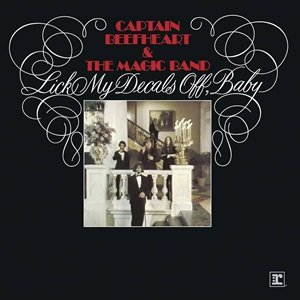
This was the only occasion when I was actually relieved that I didn’t have to ask the young lady at the counter for the record. Going into a record shop and asking for Lick My Decals Off Baby was a daunting prospect even in Doncaster, which conjured up every conceivable scenario, from a simple slap across the cheek, to being marched off to the nearest constabulary in cuffs. Fortunately the LP was right there in the browser and I was saved from any further embarrassment. I first heard Captain Beefheart on the John Peel show, a track from his second album Strictly Personal, “Son of Mirror Man – Mere Man”, which had an enormous effect on me. Decals came later, when I’d already managed to absorb most of the challenging Trout Mask Replica. Standing in the record shop reading the credits while considering whether to buy this or save my hard earned bread for several pints of Carlsberg in the Yorkist later that night, I was immediately drawn to such song titles as “Woe-is-uh-Me-Bop”, “I Love You Big Dummy” and “I Wanna Find a Woman That’ll Hold My Big Toe Till I Have To Go”, which I couldn’t imagine the Everly Brothers ever singing. I took the sleeve to the counter, thankful that the title was written in a fine, almost unreadable script, and took the thing home to delight my dad, who clearly thought I was ready for the army.
143 | Ry Cooder | Ry Cooder | Reprise K44093 | 1970
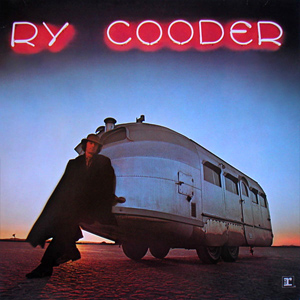
By the time Ry Cooder saw the release of his debut solo album at the end of 1970, the guitarist had already served time with both Taj Mahal in The Rising Sons and Captain Beefheart in his Magic Band, contributing to the Captain’s debut album Safe As Milk in 1967, as well as serving as a much sought after session player, even working with the Rolling Stones, appearing on their Let it Bleed album in 1968. There was little doubt as to the standard of talent Ry Cooder possessed, especially with his handling of the bottleneck guitar styles and open tunings. When his self-titled debut arrived, there was little to suggest that Cooder had his head in the sand as far as eclecticism was concerned. A wide variety of styles were utilised, from Leadbelly’s “Pigmeat”, Woody Guthrie’s “Do Re Mi” through to the more contemporary “My Old Kentucky Home (Turpentine and Dandelion Wine)”, courtesy of Randy Newman. Like many of my generation of listeners, I first became aware of Cooder when he appeared on the Old Grey Whistle Test, seated with an acoustic guitar and actual bottleneck, wearing a bandana and a shirt which looked like it had just been vomited on by Bob Harris, playing Woody’s “Vigilante Man” and the old Sleepy John Estes blues “Goin’ to Brownsville”, which also appears on this album. This was the start of a good run of solo albums before the guitarist got involved in film score work and other projects.
142 | Vashti Bunyan | Just Another Diamond Day | Philips 6308 019 | 1970

Just Another Diamond Day was until relatively recently, one of those ignored LPs that used to clutter up the browsers in your local record shop, getting in the way of your Budgies and Buffalo Springfields, yet an original copy fifty years on is more likely to be found in a locked safe at the back of the record shop and would perhaps require a second mortgage. Such items are rare simply because they were, by and large, unwanted back in their time and therefore the presses stopped churning them out in order to make way for something that might be more popular among the record buying public. Vashti Bunyan, like Nick Drake before her, has become interesting again and this album is very much back on the shelves. Is it a good album or is it a novelty, made up of songs that could easily be considered children’s songs? “Lily Pond” is actually sung to the tune of “Twinkle Twinkle Little Star”. There’s a certain naivety about the songs on this album that makes it all the more appealing in an age when young acoustic artists are returning to the woods. Though Vashti can occasionally be seen on stage again, new fans needn’t bother searching for the cottage shown on the front cover, as it was created exclusively with paint on paper by her pal John James. Produced by Joe Boyd, Just Another Diamond Day features contributions by Robin Williamson, Dave Swarbrick, Simon Nicol and one or two string arrangements courtesy of Robert Kirby, he of Nick Drake fame.
141 | Laura Nyro | New York Tendaberry | CBS KCS 9737 | 1969

Crikey, where do you start with Laura Nyro? New York Tendaberry was this New York singer songwriter’s third album, released on the CBS label, and therefore a familiar name to anyone obsessed with those early sampler albums such as The Rock Machine I Love You and Fill Your Head With Rock, her name appearing on some of them and in a way, my first introduction to her songs. Described as ‘intense and stark’, New York Tendaberry, which follows hot on the heels of More Than a New Discovery (1967) and Eli and the Thirteenth Confession (1968), finds Nyro on fine form, her unmistakable three-octave mezzo-soprano vocals dominating proceedings throughout, accompanied by her own piano, band and orchestra. Some find Nyro a little ‘too intense’, not unlike a sort of depressive Barbra Streisand after a few gins, but there’s a distinct beauty in just about everything Laura Nyro does. There’s a sense of pure determination in each note she delivers, which however dramatic and theatrical, comes over as sincere, honest and with no small measure of artistic ingenuity. Whilst “Gibsom Street” and “Captain Saint Lucifer” appear to bring out some highly emotive performances, “Save the Country” reminds us at just how entertaining Laura Nyro could be. Laura died in 1996 and is very much missed.
140 | Fairport Convention | Liege and Lief | Island ILPS 9115 | 1969
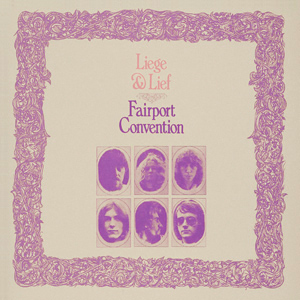
I would’ve been a little too young to witness the beginnings of what we now know as British Folk Rock by just a couple of years, climbing on board the Fairport Convention bus at album number seven, with the band’s bold venture into the realms of concept album territory with the folk opera Babbacombe Lee, which the band was touring at the time, back in 1971. Two years earlier, the band released what is generally accepted as the very first British Folk Rock album Liege and Lief, though there had already been signs of this new development a little earlier on the album Unhalfbricking, released earlier in the same year. After discovering the album, it wouldn’t be long before I was fully immersed in the sheer inventiveness of transforming old and battered English folk songs into rock classics. Among the old though, there was one or two brand new contemporary songs, such as the haunting “Crazy Man Michael”, written by key members Richard Thompson and Dave Swarbrick, with the ethereal delivery of singer Sandy Denny, who brings the song to life. Landmark songs also include “Matty Groves”, “The Deserter” and the sprawling “Tam Lin”. You know those irritating people who go on about the Stevie Nicks Lindsay Buckingham Fleetwood Mac not being the real Fleetwood Mac, that particular honour belonging to Peter Green and his gang? I’m a bit like that with Fairport. Everything important was done in the first ten years, everything after, forget it.
139 | Third Ear Band | Third Ear Band | Harvest SHVL 773 | 1970

The first time I heard the Third Ear Band I thought the person who played it to me had gone completely mad. The LP was sandwiched between his Deep Purple, Edgar Broughton Band and Led Zeppelin records and well away from his dad’s Jim Reeves and Eddie Arnolds. It should’ve perhaps been on a different shelf altogether, or perhaps in a different room, despite the small print on the inner gatefold suggesting it be filed under POPULAR: Pop Groups! It was completely different from anything else I’d heard previously, yet it was on the highly reliable Harvest label. I listened again, in fact I kept listening for the next half century. This is extraordinary music, created by people who plunge themselves right into the heart of it, giving it a feel of exploration, improvisation and trance-like meditation. It’s certainly weirder than anything you’d find on The Wicker Man soundtrack. The four instrumental tracks are named for the elements, “Air”, “Earth”, “Fire” and “Water” and in that order. Just three instruments can be heard on the band’s self-titled album, sometimes referred to simply as The Elements; the oboe, the cello, the violin (or viola) and some percussion, yet the sound seems slightly more musically overwhelming, especially when the tempo lifts in places. Whenever the sounds of the Third Ear Band would come drifting out of my bedroom back in my youth, the silence around the dinner table later that evening would be almost guaranteed. “Why can’t you just play Slade like everybody else Allan?”
138 | Jethro Tull | Stand Up | Island ILPS 9103 | 1969
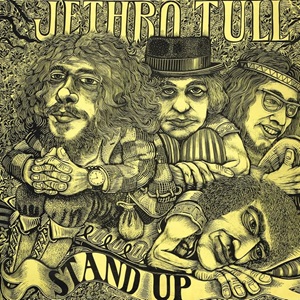
By the time Jethro Tull got around to their second album, the band had evidently become more explorative both in their music and in their artwork. The gatefold sleeve includes pop-up caricatures of the band, literally standing up as the title suggests. This wasn’t my first Jethro Tull LP by any means, the later Aqualung, Thick as a Brick, A Passion Play and Living in the Past had already found their place on my shelves. Once I’d established myself as a curious fan though, I went back to the beginning and bought the others pretty much in the order of their original release. The blues-based rock that could be heard on the first album is still quite strong here, especially on the riff-laden opener “A New Day Yesterday”, complete with a wild flute solo, something the band, or at least their leader (Ian Anderson), would maintain as its obvious trademark. The codpiece and tights were still to come, as the scruffy four-piece still hung onto their great coats. Classical elements popped up here and there, notably on “Bouree”, an instrumental based on a tune written by Johann Sebastian Bach, as well as Eastern influences on the thankfully short “Fat Man”, whilst a mellow acoustic flavour appeared on “We Used to Know”, complete with some fine electric guitar soloing courtesy of Martin Barre, a sound that could be seen as a forerunner of what would come later on Aqualung. “Nothing is Easy” is probably Stand Up’s stand out track. Lester Bangs and John Peel would become critical of later Tull, but this stuff still matters.
137 | Bob Dylan | Nashville Skyline | CBS 63601 | 1969
I can’t imagine what it must’ve been like to have been an early Dylan enthusiast, hearing one album after the other, featuring roughly the same voice, then by the ninth to be introduced to a completely different one, and a highly irritating one at that. Nashville Skyline introduced us to this new Bob Dylan voice, the one I like to refer to as the “Lay Lady Lay” voice. Never in recorded history has there been such a miss-match as Johnny Cash’s assured growl and the new Dylan voice, as the pair revisit the once gorgeous “Girl From the North Country”, effectively destroying the song with some determination. Off key, harmonies out of whack, pretty dreary really, but enough with the negativity already. The album has its moments, though to follow the disappointing opener with a throw-away instrumental was probably also ill-advised. “To Be Alone With You” with its now highly quotable spoken intro, “is it rolling Bob?”, gets us back on track momentarily, aided by the strength of the Nashville session musicians, who step up to deliver. As with just about any Dylan album up to this point, the magic appears sooner or later and on Nashville Skyline it’s probably “I Threw It All Away”, a fabulous song, even when delivered in the “Lay Lady Lay” voice. I would hate to conclude by saying that this album’s only redeeming factor is its iconic cover, which may or may not be true, so instead I’ll remind myself that the album concludes with “Tonight I’ll Be Staying Here With You”, which is a good enough song and probably the reason the LP is still on my shelf and not in the bin.
136 | Fairport Convention | Babbacombe Lee | Island ILPS 9176 | 1971
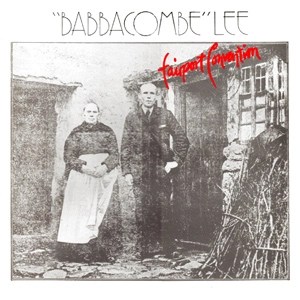
Babbacombe Lee rarely comes tops in any Fairport Convention ‘best album’ lists, most fans favouring Liege and Lief or Full House or indeed anything with Richard Thompson or Sandy Denny involved. Can’t moan at that really. But Babbacombe Lee has a very special place in my memory of this band’s early days, an album created by the four-piece that seems to be sadly ignored. This Fairport was made up of Dave Swarbrick, Dave Pegg, Dave Mattacks and Simon Nicol, which though perhaps ‘Dave’ heavy, was in fact highly competent in the musicianship stakes. I first became aware of the album by chance, when I was on a teenage trip with my local youth club, a week in the mountains of North Wales, when a local hippy was heard to say “here he is, the man they couldn’t hang” when I appeared at the dorm door, which brought about many a guffaw at my expense. Once I discovered that the phrase was connected with the story of John Lee of Babbacombe, who cheated death at the gallows no less than three times, my intrigue grew. Fairport tell the story in song and despite my life-long aversion to the ‘musical’ or ‘opera’ format, I was quite taken by this one. Handsomely packaged, with an eight-page booklet taken from Lloyds’s Weekly News, in which Lee tells his own story, the album features the British folk singer Bert Lloyd, who adds some of the narration to the songs predominantly written by the band, with Lloyd contributing “The Sailor’s Alphabet”. Frustratingly, none of the songs are given titles on either the sleeve or the label, instead a simple run down of the events the songs relate to. Even the lyric sheet fails to mention the titles of each set of words. Fairport also took part in a film chronicling these events, which is now difficult to find. Anyone?
135 | Ramatam | Ramatam | Atlantic SD 7236 | 1972

Ramatam was the short-lived five-piece band Mitch Mitchell formed after his stint with the Jimi Hendrix Experience. One might ask where a drummer, who had just spent the best part of four years with Hendrix, might go, the answer of which seemed to be a no-brainer, to work with a female lead guitar player. A good move perhaps, though it has to be said, it was widely rumoured that she was in fact transgender. Either way, April Lawton took care of that particular role with some panache, with Mike Pinera on second guitar, Russ Smith on bass and Tommy Sullivan on keyboards and reed instruments, flutes etc., a bunch of musicians known for their previous work in such outfits as Iron Butterfly and Big Brother and the Holding Company, Janis’s old mob. The band only recorded a couple of albums, this being their first, before the usual problems crept in, which resulted in the band calling it a day. The overall feel is not unlike the supercharged brassy sounds of such early 1970s bands as Chicago, Blood Sweat and Tears and the like, though Ramatam was able to make such a racket with just the one reed man involved, presumably double-tracked all over the shop. The band are chiefly remembered due to Mitch Mitchell’s involvement, but it has to be said, April’s Jeff Beck-like guitar playing is very much worth a mention. Not bad for a Bradley’s cheap bin purchase back in the early 1970s.
134 | Electric Light Orchestra | Electric Light Orchestra | Harvest SHVL 797 | 1971

Just prior to my apparent obsession with the LP record, it was exclusively 45s for me, mostly ex-jukebox records that I picked up from a stall on Doncaster Market in the late 1960s. I would’ve been 11 or 12, something like that. One of the bands that stood out amongst my burgeoning singles collection at the time was The Move, a bunch of hairies from Birmingham led by one Roy Wood, the hairiest of ‘em all. After grooving relentlessly to such gems as “Blackberry Way”, “Fire Brigade”, “Brontosaurus” and even “Curly”, it was on to “Tonight” and “Chinatown”, two singles released on the Harvest label, which fell right into the sphere of music I was then currently exploring. Then unexpectedly, the band somehow morphed into a new orchestral project, the Electric Light Orchestra, with sawing cellos, French horns and the like. This wasn’t at all unusual in pop music at the time, as “A Day in the Life” would testify to, but still, I wasn’t sure at first, though my ‘Roy Wood is a Genius’ antennae was always alert and ready for me to add some support. Okay, that antennae wilted slightly when I later heard “See My Baby Jive” but that’s another story. So, like a good little hairy Roy Wood fan, I toddled off to Foxes Records and picked up this album, which was wrapped in a wonderfully quirky Hipgnosis creation, which provided little in the way of disappointment. The album kicks off with “10538 Overture”, which was simultaneously released as the band’s first single, a song that kind of straddles between the familiar Move sound and the new explorative orchestral sound. In some ways I wish this album, which I always saw as a bridge between The Move’s Message From the Country and the symphonic stadium rock that followed, might have been better off under a different moniker altogether, to give it its own identity. I see it neither as a Move LP or an ELO album, but something in between. It’s all a bit adventurous from start to finish, with one or two Classical references included, even at one point borrowing from the earlier Mason Williams tune “Classical Gas” on “1st Movement (Jumping Biz)”. I suppose the earliest sign of what was yet to come with the later ELO success, was “Mr Radio”, which showcased the now familiar Jeff Lynne sound, though for my money, “Queen of the Hours” is the album’s high point, but that’s possibly due to it sounding very much like The Move. I was fortunate to catch the band on the revolving stage at the Top Rank in Doncaster in the early 1970s, doing songs from this album just prior to the outfit’s world domination. I often wonder what might’ve happened had Roy Wood stayed with the band, but there again, we would probably have been bereft of that jingly snowy playground anthem that comes on the box every Christmas.
133 | Frank Zappa | 200 Motels | United Artists 14C 162 92854 | 1971

Frank Zappa states in the liner notes that the track listing is not in the same order on this double LP set as it is in the film, in fact he goes on to point out that some of the music on the album isn’t in the film and visa-versa. It makes no odds, it’s all a bit too bizarre to even matter. Putting the film aside for a moment, a film that includes cameos by both Ringo Starr and Keith Moon, dressed as Zappa and a nun respectively, whilst his own drummer Jimmy Carl Black appears as a redneck cowboy called Burt, the soundtrack is the first venture of Zappa’s in which he collaborates with a full classical orchestra, in this case the Royal Philharmonic conducted by Elgar Howarth. Ex-Turtles Mark Volman and Howard Kaylan, aka the Florescent Flo and Eddie, are here in all their bizarre glory, the only singers who were likely to go along with Zappa’s smutty libretto, the “Centerville” portion of the show being decidedly creepy. The Flo and Eddie era hasn’t really stood the test of time and in answer to Frank’s persistent question “Does humour (or if you’re American, humor), belong in music?”, my answer has always been yes, as long as it’s good. Much of Flo and Eddie’s humour is anything but and 200 Motels is loaded with such, even comic actor and folk singer Theodore Bikel who provides the narration, rarely raises a smile, which is challenging at times, not so much for him perhaps, but certainly for the listener. Only “Mystery Roach” and “Magic Fingers” resemble anything like rock music and there are moments here and there where the falsetto voices tend to grate, as if you’d inadvertently attended a ‘Bee Gees sing Stravinsky’ gig, but there are also one or two beautifully melodic moments to square the circle. If you’re going to buy a Zappa double from around this time, I’d go for Freak Out or Uncle Meat rather than this.
132 | Claire Hamill | One House Left Standing | Island ILPS 9182 | 1971
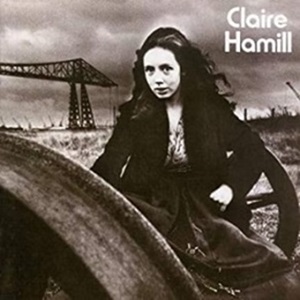
For some strange and inexplicable reason, all my female friends in 1971 (real or imagined) looked like Claire Hamill. Just seventeen years old on the cover of her debut LP, Claire was rightly or wrongly compared to Joni Mitchell, which was probably more of a hindrance than a help. It could’ve been the inclusion of Joni’s “Urge for Going” that brought about the comparisons. Claire was regularly featured in all the music press at the time and as a consequence, caught the attention of at least one sweaty Herbert from Doncaster. The cover shot of One House Left Standing, her debut album, sees out heroine perched upon some railway debris in an industrial part of Middlesbrough with the Tees Transporter Bridge looming large in the background. It was a little like John Everett Millais painting, with his Ophelia just about to step into the puddle at some railway sidings. John Martyn, who she supported on tour just prior to the album’s release, plays on the record as does Terry Reid and David Lindley, good company for this young northern schoolgirl to say the least. The album features one or two memorable songs, “The Man Who Cannot See Tomorrow’s Sunshine”, “Where Are Your Smiles At” and the whimsical “Baseball Blues” that kicks this record off.
131 | Led Zeppelin | Led Zeppelin IV | Atlantic 2401012 | 1971

I don’t recall ever waiting for the release of a record with quite as much anticipation than that of Led Zeppelin’s fourth album, the untitled one. By the time this album was released just before Christmas 1971, the other three records were already showing signs of wear, so often were they played and therefore I made sure I was the first to arrive at Foxes Records on the first floor of the Arndale Centre in Doncaster on the day this LP was released and couldn’t wait to get it in my mit. On the bus home, I took the record out of the bag and was immediately baffled by the sleeve design, a discarded framed picture of an old man with a bunch of sticks on his back, then on the back, a photo of a district that could easily have been one of the more derelict areas of my home town. Words were also conspicuous by their absence. I then pulled out the grey inner sleeve, which revealed the song titles, the lyrics to “Stairway to Heaven” and a few credits including the names Sandy Denny and Peter Grant – Beauty and the Beast perhaps? Most curious of all were the four strange symbols, which no one really understood, apart from the four people they represented. I was confused. Once I got the record home I played it over and over until I fell asleep. Although I quite like “Black Dog”, the opening number, I always thought, and continue to believe today, that the opener on this album should’ve been “Rock and Roll”, John Bonham’s distinctive opening beats trumping many a fanfare that had gone before. Again, considering the track listing, I also felt “Stairway to Heaven” should’ve closed the album, rather than being placed midway through. After seeing one or two publicity photos of the band with Sandy Denny, who I didn’t know at the time, it all became clear on the mandolin-led “Battle For Evermore”, for which the singer duetted with Plant to good effect. It was just over a year later when I got to see the band at Sheffield City Hall on 2 January, 1973, where they performed “Rock and Roll”, “Black Dog”, “Misty Mountain Hop” and “Stairway to Heaven” from this album and had already begun to include material from their follow up Houses of the Holy. Robert Plant had the flu and couldn’t quite reach the high notes, in fact their tour was abruptly cancelled after this gig. We tend to brush aside the importance of Led Zeppelin these days, yet I can’t imagine my youth without them, and certainly not this platter.
130 | Shirley Collins and the Albion Country Band | No Roses | Mooncrest Crest 11 | 1971

The English folk singer Shirley Collins was still married to the ex-Fairport Convention bassist Ashley Hutchings at the time of No Roses, an album the couple collaborated on under the guise of the Albion Country Band. The centre spread of the gatefold sleeve shows the couple strolling along in a field reminiscent of Gainsborough’s Mr and Mrs Andrews, though devoid of the tricorn hat and gun. The LP is perhaps best remembered though for the collaborative nature of the recordings, with various folk luminaries dropping in and out of the studio during the recording sessions, including Fairporters Simon Nicol, Dave Mattacks and Richard Thompson, singers Lal and Mike Waterson, Royston Wood and Maddy Prior and an assortment of other folkies that included John Kirkpatrick, Nic Jones and Barry Dransfield. The title No Roses comes from a verse in “The False Bride”, a song Collins released on an earlier EP Heroes in Love almost ten years earlier. Recorded at both Sound Techniques and Air Studios in London and produced by Sandy Roberton and Ashley Hutchings, No Roses stands as a landmark in folk rock from its early Seventies heyday.
129 | Mott the Hoople | Brain Capers | Island ILPS 9178 | 1971
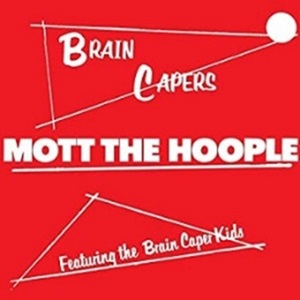
Brain Capers is the fourth album release by Mott the Hoople and according to the back cover, the album is dedicated to James Dean, who had been dead for sixteen years by the time of the album’s release. Guy Stevens was once again at the helm, a strong presence through the band’s early years. With such suggested titles as AC/DC, Brain Damage and Bizarre Capers, the band eventually settled on Brain Capers, with a relatively simple sleeve design in vivid red and a black mask insert, which was printed on the front in some later releases. The band at the time consisted of Ian Hunter, Mick Ralphs, Pete Watts, Dale ‘Buffin’ Griffin and Verden Allen and the LP features a couple of covers, Dion’s “Your Own Backyard” and Jesse Colin Young’s “Darkness, Darkness”, together with its originals that include the sprawling “Journey”, the Rolling Stones influenced “Death May Be Your Santa Claus” and the Dylanesque “Sweet Angeline”. It was probably the poor reception that this album received which inevitably planted the seed of bringing the group to an end, until that is, an unexpected rescue plan courtesy of an unlikely source, but that’s another story.
128 | Joni Mitchell | Court and Spark | Asylum SYLA 8756 | 1974
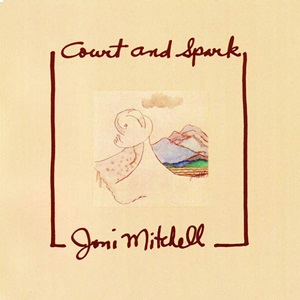
Joni Mitchell’s sixth album was her first foray into jazz, albeit slightly tentatively. A steady transformation from her earlier folk beginnings, through one or two truly remarkable musical statements, notably Ladies of the Canyon and Blue and more recently For the Roses. Court and Spark saw a dramatic change in musical integrity and a much more collaborative approach to her work. Gone was the highly personal confessional writing, which paved the way for a more character focused basis, with the odd poke at the music industry and other social observations. Bringing on board such jazz luminaries as Joe Sample and Larry Carlton of The Crusaders fame, together with Tom Scott, John Guerin and Max Bennett of L.A. Express, Mitchell had the opportunity to stretch out musically, which she took full advantage of on such songs as “Help Me”, “Free Man in Paris” and “Raised on Robbery”, featuring a guest appearance by fellow Canadian Robbie Robertson. Probably the most unexpected surprise on Court and Spark was Mitchell’s reading of the old Annie Ross number “Twisted”, which she handled with some ingenuity, whilst enlisting the inimitable Cheech and Chong to provide the appropriate vibe. Joni’s best album? Could be.
127 | Kevin Coyne | Marjory Razor Blade | Virgin VD251/2 | 1973
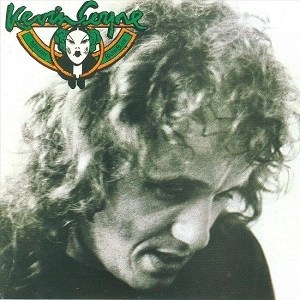
I remember precisely when and where I bought Kevin Coyne’s double LP set Marjory Razor Blade. It was Bradley’s Records in Doncaster, right next to the West Laith Gate entrance of the Arndale Centre, now the Frenchgate Centre and it was the day after John Peel featured the Derby-born singer songwriter live on his late night programme. I’d never encountered such a voice before and part of me knew I would like the album he was promoting on the wireless that night and another part of me was absolutely convinced this would irritate my siblings (it did). There was something primal in Coyne’s performances, almost as if he was making it up as he went along. His acoustic guitar was primitive and his voice was like the sound of a feral cheese grater with an additional sneer. Though I bought the album on the strength of such eccentric songs as “Dog Latin”, “Karate King”, “Good Boy” and “This is Spain”, I soon discovered another side to this extraordinary talent, the heart breaking “House on the Hill”, which still sends a shiver whenever I hear it. In a perfect world, this song should perhaps appear on many ‘top ten songs of all time’ lists. The gatefold sleeve shows the young musician in three poses, a head shot on the front, a guitar player looking perplexed on the reverse and a full length portrait on the inner double spread, making Kevin Coyne’s image just as familiar as his voice and his songs. Love him.
126 | Maria Muldaur | Maria Muldaur | Reprise K44255 | 1973
Perhaps best known for the single “Midnight at the Oasis”, which provided Muldaur with a hit single in both the UK and the USA back in the early 1970s, her self-titled debut boasts a guest musician list that would fill any self-respecting vocalist with pride. Leaving the writing credits to others, notably Dolly Parton, Kate McGarrigle, Mac Rebennack and David Nichtern, Muldaur concentrates on getting the vocals right, with one or two memorable moments. Opening with an old Jimmie Rodgers song, “Any Old Time”, the album traverses Americana before Americana became a thing. Among those guests, Ry Cooder and Clarence White contribute some fine guitar licks, with David Lindley providing the distinctive Hawaiian guitar on the opening song. David Grisman’s mandolin can be heard on the Dolly song “My Tennessee Mountain Home”, along with Richard Greene’s fiddle, with further contributions from the likes of Dr John, Klaus Voorman, Spooner Oldham and others. Produced by Lenny Waronker and Joe Boyd, Maria Muldaur remains one of the singer’s most memorable albums, an album I snapped up as soon as I read the credits. “Midnight at the Oasis” isn’t even the cherry on top, not by a long way.
125 | Blondel | Blondel | Island ILSP9257 | 1973

And then there were two, again. After the departure of founder member John Gladwin, the two remaining musicians Eddie Baird and Terry Wincott found themselves in a tricky position. Not only had their lead voice, a voice that dominated much of the band’s material thus far, but they had also lost their main song writer, the man behind such memorable songs as “Spring Season”, “Dolor Dulcis (Sweet Sorrow)”, “Seascape” and the magnificent “Celestial Light”. Then there was the contractual problem of owing Island another album. All eyes turned to Eddie Baird, who took on the role of song writer for the band’s final Island album Blondel. Dropping the adjective and separating it by one letter in the alphabet, thus taking up residence in the B section of the record shop browsers, Blondel or the Purple Album, shows a surprising departure from the previous albums, with one or two highly melodic moments, which possibly came as more of a surprise to Eddie Baird than the rest of us. The album appears to be a masterclass of song writing created by someone who didn’t know he had it in him. There’s little doubt that the first side’s suite of songs, “The Leaving of the Country Lover”, Young Man’s Fancy” and “Easy Come, Easy Go”, each song linked by orchestral arrangements courtesy of Adrian Hopkins, demonstrates an affinity with the craft of song making. Like England and Fantasia Lindum before it, the first sides of which are made up of cleverly crafted suites, while the second side is a collection of complete separate songs, Blondel follows suit, with a further five songs, from the easily accessible “Sailing”, not to be confused with the Sutherland Brothers/Rod Stewart song, through to the melancholic “Depression”, which brings the album to an end. The album also features contributions from Free’s Paul Rodgers and Simon Kirke, together with Traffic’s Steve Winwood and singers Sue and Sunny, known for their later hit “Doctor’s Orders”.
124 | Rab Noakes | Red Pump Special | Warner Bros K46284 | 1973
Red Pump Special captures a youthful Rab Noakes at his melodic best, with an album of memorable songs. For the most part regarded as a songwriter’s songwriter, Rab injects a sense of the everyman into his songs, whether riding on the top deck of a bus or getting out walking, for a bit of peace and quiet. With his association with such bands as Lindisfarne and Stealers Wheel, Rab has enjoyed a fruitful solo career with collaborations with both Rod Clements and Barbara Dickson, and the release of several albums beginning with the 1970 debut, Do You See the Lights? The lapels on the jacket worn for the cover shot gives away this LP’s vintage, the music however is timeless. The optimistic “Clear Day” reminds us of Rab’s penchant for writing a good pop song, while “Frisco Depot” has a more melancholy feel, ‘when you’re alone, there’s nothing that’s slower than passing time’ – wisdom at an early age. Recorded in Nashville, the album includes contributions by the Memphis Horns, including “Tomorrow is Another Day” and the bluesy “Diamond Ring”, with other contributions by Ray Jackson on harmonica, Kenny Buttrey on drums and old Stealers Wheel muckers Gerry Rafferty and Joe Egan providing backing vocals on a couple of songs.
123 | Beck Bogert Appice | Beck Bogert Appice | Epic SEPC65455 | 1973

Like Blind Faith, Derek and the Dominos, Thunderclap Newman and most notably the Sex Pistols before them, Beck, Bogert and Appice made just the one album, and like the others, it’s possibly best remembered just for that. In places the band, made up of Jeff Beck on guitar, Tim Bogert on bass and Carmine Appice on drums, former members of Vanilla Fudge and Cactus respectively, sound like a Cream tribute band, notably on “Lady” which has shades of “I Feel Free” written all over it. The soulful “Sweet Sweet Surrender” has good intentions, whilst “Lose Myself With You” is possibly over-zealous as an arrangement, which teeters on the fence between genius and shambolic. Perhaps the finest moment is the power trio’s cover of Stevie Wonder’s “Superstition”, which delivers on Beck’s funky guitar licks, who had worked on Wonder’s 1972 album Talking Book. The album closes with a smooth reading of Curtis Mayfield’s “I’m So Proud”, but not quite as smooth as the Impressions original.
122 | Steppenwolf | Steppenwolf 7 | Probe SPBA 6254 | 1970
Most rock aficionados would probably think of “Born to be Wild” at any mention of Steppenwolf, that or the tenth novel by the German/Swiss author Hermann Hesse, published in 1927. Having both “Born to be Wild” and “The Pusher” on the soundtrack to the film Easy Rider did this LA band no harm whatsoever, making it hard to ignore Steppenwolf back in the early 1970s. Add a memorable appearance on the Old Grey Whistle Test to the mix, and it wasn’t long until I had a handful of the band’s records on my shelves, or to be more accurate, the fruit crates that would masquerade as shelves back then. By the time I added this album to my LP collection, I scarcely had three, let along seven, yet this one looked attractive enough to pop on the turntable. It’s actually a pretty good rockin’ album, with plenty of bluesy, boogie and funky guitar riffs throughout, notably on the opening track “Ball Crusher”. Having never caught this band live, I wouldn’t recognise any of these musicians in Tesco’s, even the leader John Kay, who wouldn’t ever be seen without his trademark shades, not even by the canned spuds. The motley crew featured on the inner gatefold sleeve, all dressed as warriors engaging in battle, provided little more to go on. A raggle-taggle hirsute bunch if ever there was one. Their sound however was and remains clear in my mind. The titles alone give the listener clues before the needle hits, “Ball Crusher”, “Foggy Mental Breakdown”, “Who Needs Ya” a single lifted from the record, and “Earschplittenloudenboomer”, which is surprisingly funky despite its heavy metal thunder title. Fortunately, “Renegade” and “Snowblind Friend” offer a little respite from the stomp-fest.
121 | Joni Mitchell | Ladies of the Canyon | Reprise K 44085 | 1970

This is one of those albums where I have no recollection of buying it, or from where, though it seems to have been in my LP collection for more years than I can remember. A best guess would be sometime in the middle of the 1970s, possibly when wall-to-wall Bay City Rollers was endangering my sanity. It was a case of either visiting Bradley’s Records (or Foxes, or Our Price, I really can’t remember) to buy this record or jump off the A1 motorway bridge into the Don. I wisely chose the first option. Ladies of the Canyon was the moment when Joni managed to shrug off her folk priestess credentials and begin to be considered an artist in a field of one. Her songs became increasingly personal, with meditations on her place in the world, or specifically Laurel Canyon, where the sort of friends and neighbours she mixed with would be simultaneously dropping by for tea, while at the same time gracing the cover of Rolling Stone on the coffee table. It was a highly hip time and songs were springing up like chaparral shrubs in the Canyon, songs like “For Free”, “Conversation”, “Willy”, the conservation aware “Big Yellow Taxi”, not to mention the anthem of the era “Woodstock”. This is a Joni Mitchell record I return to again and again and would be under my arm if ever I had to leave a burning building in a hurry.
120 | Stephen Stills | Stephen Stills | Atlantic SD 7202 | 1970

The one obvious next move for David Crosby, Stephen Stills, Neil Young and Graham Nash after leaving their respective 1960s bands (The Byrds, Buffalo Springfield, The Hollies), and forming their so-called supergroup, Crosby, Stills, Nash and Young, was to go solo, though to be fair Neil Young had already released three albums under his own name in the wake of Déjà vu. Around the same time each of the other three musicians released competitive debuts, Crosby with If Only I Could Remember My Name, Nash with Songs for Beginners and this, the debut effort from Stills, each being released within months of one another. Stills had this eponymous album out before the end of November 1970, whilst the other two came out the following year. Stephen Stills starts on a positive note, with the almost anthem-like “Love the One You’re With”, which was also simultaneously released as a single. For this album Stills was able to call upon high profile friends to add spice to an already spicey piece of work, those being Jimi Hendrix, who died just before the album was released, Eric Clapton, Ringo Starr and Booker T Jones amongst others. Photographer Henry Diltz braved the Colorado elements to shoot the cover, which features the musician sitting on a snow covered fence alongside a toy giraffe. The album has one or two fine moments, not least the tender “Do for the Others”, written for Crosby in the wake of the death of his girlfriend Christine Hinton, and the bluesy workout “Black Queen”, which sees Stills at his most comfortable. A good debut, though I feel a little cluttered with far too many instruments, where fewer would’ve done the trick. A good example of this is the album closer, “We are Not Helpless”, which would’ve been fine as a solo acoustic performance, without the strings, horns and heavenly chorus.
119 | Incredible String Band | U | Elektra 7E-2002 | 1970

If the Incredible String Band was considered an acquired taste back in the heady days of the late 1960s, early 1970s, it didn’t stop them putting out album after album in a relatively short space of time, two of them being doubles. Between 1966 and 1974, a dozen albums were released, each as strange and unusual as the last, and with various line-up changes along the way, Robin Williamson and Mike Heron being the constants from the beginning. The double LP U was the band’s seventh release, which came midway through this period, to mixed reviews. Things had become even more strange in the Incredibles’ camp, adding dance to their sphere, with much of the album made up of a song and dance mixed media production. The experimental artist Malcolm Le Maistre had joined the ranks by this time, who was to stick around for the next five albums until the band’s eventual demise in 1974. The eight-minute instrumental opener had all the usual aspects you would expect from an ISB production, a potpourri of eastern influences, Mike Heron’s prominent sitar, Robin Williamson’s wild gimbri, Rose Simpson’s trance tabla, an intriguing title (“El Wool Suite”), an otherworldly feel, bonkers rhythms etc. “The Juggler’s Song” sees Williamson and Liccy McKechnie return to the music hall once again, with another whimsical ditty, before Williamson delivers another unique vocal performance on “Time”. By the time we get to “Bad Sadie Lee”, a new voice emerges as Janet Shankman takes centre stage, an artist who was also responsible for the cover design and who also did the cover for the earlier Changing Horses album. She would eventually become Mrs Robin Williamson. The throw away aspect sometimes associated with the band is evident on Heron’s “Glad to See You” which is a blot on the “Light in Time of Darkness” landscape. The album is described as a surreal parable in song and dance, which probably had more to do with the band’s recent conversion into Scientology than anything else. The Incredible String Band never surprised me; they courted favour with both Joe Boyd and John Wood, they impressed The Beatles, they played Woodstock, they became Scientologists – if we should later discover that they were actually aliens from another galaxy, I wouldn’t be in the least bit surprised.
118 | Colosseum | Daughter of Time | Vertigo 6360 017 | 1970
The opening track on Colosseum’s fourth album sounds biblical, both in terms of its title “Three Score and Ten, Amen”, but also in the wildly over-the-top arrangement. Saxophonist Dick Heckstall-Smith takes to the pulpit midway through to deliver a sermon while the rest of the band try to keep up with Jon Hiseman’s stick work. Daughter of Time is a highly dramatic album, which utilises the band’s rich arsenal of instruments to deliver two sides of powerful originals, with just the one non-original, a convincing reading of the Pete Brown show-stopper “Theme from an Imaginary Western”, which Chris Farlowe handles as well as the original by Jack Bruce on his Songs for a Tailor album. The LP is best remembered perhaps for Hiseman’s extended drum solo during the concluding “The Time Machine”, recorded live at the Royal Albert Hall in the summer of 1970, something that appeared to be an essential part of many a live performance by any contemporary rock band at the time, though something largely frowned upon today. John Bonham got away with it on “Moby Dick” didn’t he?
117 | Elton John | Tumbleweed Connection | DJM DJMLPS 410 | 1970

These days, whenever I pull Elton John’s third album Tumbleweed Connection off the shelf and flick through the generous accompanying twelve-page booklet, I’m always surprised at just how young all these musicians look, especially Elton himself; mind you he was only 23 at the time, possibly even 22 when the photos were taken. Tumbleweed Connection was my first Elton John LP, and it’s still probably my favourite after all these years. The sepia sleeve shot looks very much American, though it’s clearly a British railway station, judging by the products advertised on the walls, from the Daily Telegraph to Rountrees Chocolates, not to mention those all-important Swan Vestas. If a Sussex railway station shows a very English side to Elton John, then the songs themselves lean more towards the Americana of The Band and other such contemporary American bands at the time, each swept up in the new (or should that be old) sounds from over the pond. Comparisons could be made between “Country Comfort” and Robbie Robertson’s later “Twilight” in terms of melody and feel. Caleb Quay’s guitar licks at the beginning of “Ballad of a Well-Known Gun” set the scene as the song takes us through Bernie Taupin’s world, which encompasses much Western imagery, aided in no small part by the soulful chorus of Dusty Springfield, Madelene Bell and Lesley Duncan amongst others. All the lyrics are from the pen of Taupin, except for Lesley Duncan’s “Love Song”, for which Elton is accompanied by her acoustic guitar. I have no problem keeping this album alongside Music from Big Pink, or Stage Fright, not least for the inclusion of “Burn Down the Mission”, which I could imagine either Richard or Levon singing.
116 | The Beatles | Magical Mystery Tour | Parlophone PCTC 255 | 1967

I remember very well, as if it was yesterday, going around to a mate’s house to hear his new pop group rehearse a few songs and seeing on the side, a newly acquired colourful double EP by The Beatles, which I picked up and flicked through the inner pages with great interest, while the band played. The Magical Mystery Tour EP, featured six songs and tunes from the band’s ill-fated film of the same name, which was to be shown on TV later in the month. The title track was followed by “Your Mother Should Know”, “I am the Walrus”, “The Fool on the Hill”, “Flying” and “Blue Jay Way”. A few days prior to the UK release of the EP, an expanded version was released in the US, featuring the same six songs on the first side of the LP, with a further five on the second side, all previously released as singles, including b sides. Though the film fell flat on its face and is now seen as a rare Beatles faux pas, this album couldn’t really fail, certainly due to the inclusion of such remarkable songs as “Strawberry Fields Forever”, “Penny Lane” and “All You Need is Love”. A little late, for some curious reason, the jukebox in the underground Doncaster pub Beethams, seemed to play the instrumental “Flying” every few minutes. It must’ve had something to do with substances.
115 | Roy Harper | Come Out Fighting Ghengis Smith | CBS 63184 | 1967
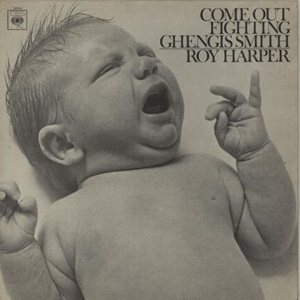
Like most music lovers of my particular generation, the name of this hippy singer, songwriter and folk troubadour first came to us via the sleeve of the third Led Zeppelin LP, where the band tipped their caps to him with the rather bizarre “Hats Off to Roy Harper”. As on many an occasion, I was intrigued enough to go out and discover more. Come Out Fighting Ghengis Smith is Harper’s second outing following the noted debut Sophisticated Beggar of a couple of years earlier. These days some of those early Harper LPs are often embarrassing, not so much the actual songs – the voice is usually good, with some fine acoustic accompaniments – but rather, the man’s penchant for including some of the most dreary hippy-dippy dope-fuelled nonsense between the tracks, or sometimes in them, especially on the later Flat Baroque and Berserk. The ten-minute autobiographical song cycle “Circle” is perhaps the start of this trend, with some almost Pythonesque narration, which may have been amusing in ’67, but falls flat broke and definitely berserk these days. Even Bert Jansch’s sleeve notes are affected by what I warmly describe as ‘hippy shit’ and he’s a real hero. The album was also one of the first in a plethora of LPs to feature a baby on the cover, other notables being albums by Black Sabbath, Paul Kantner & Grace Slick, Paul Simon, Barclay James Harvest, Chumbawamba and not least, Nirvana of course.
114 | Jefferson Airplane | After Bathing at Baxter’s | RCASF7926 | 1970

The opening few seconds of “The Ballad of You and Me and Pooneil” suggests where this trip was likely to take us back in the Summer of Love, a trip that was probably as unsteady a ride as the one aboard the aeronautical contraption shown on the sleeve. Psychedelic, surreal and markedly different from the UK’s then current number one record, “Baby, Now That I’ve Found You” by The Foundations, Jefferson Airplane’s opening song morphs into “A Small Package of Value Will Come to You Shortly”, which wouldn’t be out of place on one of Frank Zappa’s early releases. Though originally released in 1967, my copy is a 1970 re-issue, with a slightly different sleeve, though both feature Ron Cobb’s Heath Robinson triplane. The band’s third album follows the successes of Takes Off (1966) and Surrealistic Pillow (1967), yet After Bathing at Baxter’s was less reliant on the singles market, with just two largely unsuccessful releases, “Pooneil” and “Watch Her Ride”. “Martha”, possibly the finest song on the album, should’ve been released as the single instead. Influenced by the Beatles’ Sgt Pepper album, the band was given more freedom in the studio than previously to experiment, which the musicians were only too happy to run with. Even the octogenarian vicar of the Cotswolds village of Cockadilly couldn’t possibly have missed the drug references here.
113 | Ten Years After | Ten Years After | Deram SML1015 | 1967
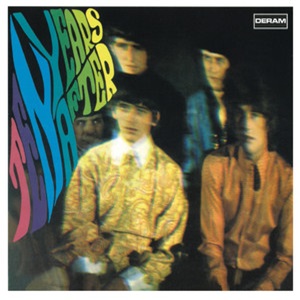
It wasn’t until May 1970 that I first became aware of the Nottingham band Ten Years After, upon the release of their single “Love Like a Man”, which I immediately added to my small but impressive collection of rock 45s, the slightly annoying aspect being the fact that the b side, a live version of the same song, had to be played at 33.1/3, doubly annoying, when later played via Beethams’ richly serviced jukebox. Despite the psychedelic-styled cover shot, Ten Years After’s self-titled debut LP, released in 1967, was a blues album through and through, arriving at the tail end of the British blues boom, an album that would effortlessly rub shoulders with those by such established outfits as John Mayall’s Bluesbreakers, Chicken Shack and the soon to be dominant leaders in the field, Peter Green’s Fleetwood Mac. Rising out of the ashes of Ivan Jay and the Jaycats, Ten Years After was to make its mark not only on the blues scene but also on the burgeoning rock scene, notably with the band’s invitation to play on the bill at the infamous Woodstock Festival a couple of years later. Predominantly made up of songs written by guitarist Alvin Lee, the album dutifully offers a nod towards such legendary bluesmen as Willie Dixon and Sonny Boy Williamson with versions of both “Spoonful” and “Help Me” respectively, together with a pretty convincing take on Al Kooper’s “I Can’t Keep From Crying Sometimes”. Joining Lee are Ric Lee (no relation) on drums, Leo Lyons on bass and Chick Churchill on organ. I could’ve done without the whistling intro to the Stones-influenced “Losing the Dogs”, co-written by co-producer (with Mike Vernon) Gus Dudgeon, but otherwise, a fine blues album.
112 | Love | Forever Changes | Elektra EKS 74013 | 1967
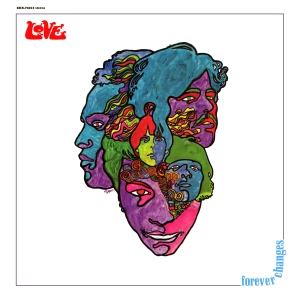
It’s hard to believe nowadays that Love’s third album Forever Changes failed to achieve any significant success upon its initial release back in 1967, at the height of the so called Summer of Love. Co-produced by Bruce Botnick along with the band’s enigmatic leader Arthur Lee, who apparently replaced Neil Young, initially pencilled in as the original producer, the album is sometimes considered one of the greatest albums of all time, depending on current trends. Some believe it to be vastly over-rated. Though I was aware of the band in the early 1970s, I didn’t get around to taking it all in until much later. It’s a strange little album, with equally strange song titles such as “Maybe the People Would Be the Times or Between Clark and Hilldale”, “Andmoreaghain” and “Bummer in the Summer”, not to mention the bewildering lyrics, such as the opening line to “Live and Let Live”, ‘Oh, the snot has caked against my pants’. I’m sure it means something, though exactly what? One things for sure, I never tire of hearing the mariachi trumpet on the album opener “Alone Again Or”.
111 | Traffic | Mr Fantasy | Island ILP961 | 1967
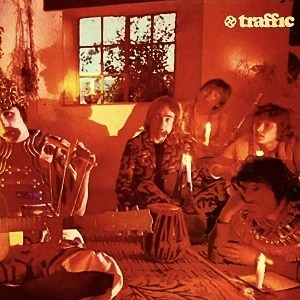
There are definitely one or two moments on Traffic’s debut LP for which you have to accept the passage of time, certainly the decidedly bizarre “Berkshire Poppies”, a strange follow up to the album’s superb opener “Heaven is in Your Mind”. Despite the five figures on the blood red dowsed cover, the band at the time consisted of just four, the original quartet of Steve Winwood, Jim Capaldi, Chris Wood and Dave Mason. Mr Fantasy was recorded at Olympic Studios in London with producer Jimmy Miller at the helm, though Island Records was still in its infancy, Traffic being one of the label’s first rock bands on its roster. Psychedelic Rock was very much in vogue during the so called Summer of Love and Mr Fantasy was loaded with plenty of Sitar and Hammond Organ, plus the sort of whimsical material associated with the genre, certainly “House for Everyone”, with its idiosyncratic opening and for that matter, its conclusion. Winwood comes into his own on the gorgeous “No Face, No Name, No Number”, an album highlight for sure. “Dear Mr Fantasy”, the title song, is perhaps an update of Dylan’s “Mr Tambourine Man”, in much the same way as Lindisfarne’s “Meet Me on the Corner” would go on to be a couple of years later, another call for Mr Dream Seller to lay it on us, whatever it might be.
110 | The Doors | Strange Days | Elektra K42016 | 1967

The Doors was a band that pretty much passed me by when I was in my early teens, during the late stages of my school days, when Led Zeppelin, Deep Purple and Black Sabbath almost exclusively ruled the turntable. The second studio album by the LA-based band, Strange Days, was recorded and released in 1967, hot on the heels of the band’s self-titled debut, recorded earlier the same year. I was already familiar with the band’s “Light My Fire” in both its short and long versions, but it wasn’t enough to spark much interest, that was until I read Jerry Hopkins and Danny Sugarman’s biography of Jim Morrison, No One Here Gets Out Alive, which I read over ham sandwiches and coffee in a cafe along Copley Road, while working as a screen printer in Doncaster. Some of the songs on Strange Days had been written before the release of the band’s debut record, including “Moonlight Drive”, one of Jim Morrison’s earliest songs by all accounts, yet failed to make it onto that initial release. Strange Days is equally remembered for its cover artwork, the only Doors album not to feature the band, but rather, a group of street performers, including a strong man and a juggler among them, photographed in a Manhattan back street. The man playing the trumpet was apparently a random cab driver. Not as good as its predecessor, but worth a listen nonetheless.
109 | Cream | Disraeli Gears | Reaction 593003 | 1966
Although the guitar riff had been around since the earliest of pop songs, it wasn’t until I first heard “Sunshine of Your Love”, performed one night by a local band, The Androolays, at an end of term party at my high school in the late 1960s, that I felt the full impact of such a thing. The iconic ten-note descending riff that opens the song immediately embedded itself in my head, the original earworm, which stayed with me until I eventually discovered who was responsible for it. Another local band whose drummer I was chums with, also played the song, which I often heard at close range, squatted next to the band’s guitarist during their many Sunday afternoon rehearsals. I eventually went out and bought the brightly coloured psychedelic rock album from Foxes Records in Doncaster and discovered other notable tracks such as “Strange Brew”, “Tales of Brave Ulysses” and the abbreviated “SWLABR”, otherwise She Walks Like a Bearded Rainbow. Heady days indeed. As a band, Cream has been derided mercilessly by many a blues fan, throughout the ensuing years, yet their impact on my young ears back then is inestimable.
108 | C.C.S. | C.C.S. | Rak SRKA 6751 | 1971
The first time I heard the name Alexis Korner, he was already 22 years into his career as a British blues musician, having already played in several combos from the Chris Barber Jazz Band, a duo with harmonica player Cyril Davies, which would morph into Blues Incorporated, and from 1970, the Collective Consciousness Society, or more commonly known simply as C.C.S. On 1 May, 1971, Korner appeared on the front cover of Disc and Music Echo holding a kitten, which was the first time I’d heard his name. Around the same time, his band’s single “Tap Turns on the Water” was played relentlessly on the radio, a song with decidedly unappetising lyrics, certainly to a 14 year-old with two sisters. This aside, it was a memorable piece of music. This introduction to a fine jazz, rock, fusion collective, pointed me directly to the band’s self-titled debut album. The album is a mish mash of blues standards and popular covers, including the Rolling Stones’ “(I Can’t Get No) Satisfaction” and Jethro Tull’s “Living in the Past”, though the album is chiefly remembered for their instrumental interpretation of Led Zeppelin’s “Whole Lotta Love”, which bizarrely became the theme tune for Top of the Pops for many years. I was almost put off C.C.S. due to the band being signed to Mickie Most’s Rak label, which would have seen the band inadvertently rubbing shoulders with the likes of Hot Chocolate, New World and Mud. Still, mustn’t be precious.
107 | East of Eden | New leaf | Harvest SHVL 796 | 1971

The opening instrumental “Bradshaw the Bison Hunter”, wouldn’t be out of place on Frank Zappa’s Hot Rats album; it certainly has a similar blending of guitar and electric violin, along the lines of “Willie the Pimp” sans Captain Beefheart. It’s strange to open the album with a lengthy instrumental, which you would normally expect to be placed at the very end. The jigger-wiggery employed on perhaps the band’s best known single, “Jig-a-Jig”, released earlier the same year, was out of character for this Progressive Rock band, though some of the diddly-diddly re-appears on the second track in, the country-inflected “Ain’t Gonna Do You No Harm”, again a little out of place. Released on the Harvest label, as was its eponymous predecessor, New Leaf features an obligatory and memorable Hipgnosis sleeve design, cleverly adopting the well-worn Garden of Eden theme to good effect. Having undertaken easily sixteen different line-ups, even one or two without violinist Dave Arbus oddly enough, East of Eden has been active in one form or another for the last few decades, releasing several albums, this being possibly the most remarkable, though there’s nothing on it that comes anywhere close to the opening instrumental in terms of musicality, in fact one or two of them sound positively throw-away in comparison.
106 | John Martyn | Solid Air | Island ILPS 9226 | 1973

Eighteen months after stepping into the studio to record Bless the Weather, John Martyn’s critically acclaimed third solo album released after his two previous collaborative albums with his then wife Beverley, the singer/guitarist was back in the studio to record the landmark Solid Air, its title track written for his fragile and soon to be departed friend Nick Drake. Once again pretty much an acoustic album not unlike its predecessor, this time aided and abetted by several Fairport friends and crucially Pentangle’s Danny Thompson, who Martyn would later tour with. The Echoplex tape delay effect comes out to play again, an effect initially explored on “Glistening Glyndebourne” from the previous album, but this time used more forcefully on “I’d Rather Be the Devil”, loosely based on the old Skip James number, “Devil Got My Woman”. Solid Air is perhaps best known though for the tender song “May You Never”, one of Martyn’s most engaging songs, covered multiple times over the years, notably by Eric Clapton, Ralph McTell, Linda Lewis and Snow Patrol. Seeing John Martyn and Danny Thompson back in the 1980s remains an enduring memory.
105 | Alice Cooper | Killer | Warner Bros WB56005 | 1971
Produced by Bob Ezrin, Killer was the fourth studio album by Alice Cooper, a band that came to wider prominence in the UK with their next album School’s Out, or at least the lead single from the album. Yet it was the Killer album that initially broke the band after the band’s appearance on the Old Grey Whistle Test performing “Under My Wheels”, the album version featuring additional guitar by Rick Derringer, a song that also featured on the Warner Bros sampler Fruity. There’s an immediately recognisable Punk influence in some of the songs on the album, which is probably one of the reasons Johnny Rotten of the Sex Pistols and Public Image Ltd fame would later claim the album to be the greatest rock album of all time. Despite this, the album memorably contains two lengthy non-Punk pieces, the title song that closes the album and the adventurous “Halo of Flies”, with its ever-changing musical structure and tongue-in-cheek reference to “My Favourite Things”, which keeps the album a little closer to the turntable than anything by the Sex Pistols, Heaven forbid.
104 | Humble Pie | Performance Rocking the Fillmore | A&M AMLH63506 | 1971
How do we judge exactly what a good live album is? There has been many a claim for the best live album of all time, The Who Live at Leeds springs to mind, or perhaps James Brown at the Apollo, yet for my money, it’s this good-rocking double LP from the early 1970s, which sees Humble Pie at their very best. There are moments when you feel like you were actually there, where you could almost taste the sweat. “Alright.. alright.. alright” yells Steve Marriott before launching into Ida Cox’s “Four Day Creep”, immediately handing over vocal duties to band mates Greg Ridley and Peter Frampton, who between them plead “I want you to love me, till the hair stands on my head” and “I want you to love me like a hurricane” respectively. It’s a good start. The band appears to be on fire with Marriott and Frampton’s duelling guitars leading the way, backed by an ace rhythm section of Ridley on bass and Jerry Shirley on drums. Marriott’s sung intros make it feel all the more live, with the former Small Faces singer warbling such lines as “I want to tell you, even you people behind the glass plate at the back of the hall, I’m ready”, delivered in the most soulful of white soul voices. There’s only seven songs here, two of which take up a side each, Dr John’s voodoo classic “I Walk on Gilded Splinters” coming in at a little over 25 minutes, while Muddy Waters’ “Rollin’ Stone” lags behind at just over 16 minutes long. Hendrix’s producer Eddie Kramer was at the desk, ensuring every drop of excitement was captured in this masterful live recording, re-mixing it at the Electric Lady Studios. Sadly, Frampton left the band before the album was released, leaving a lasting statement of just how good Humble Pie was as a live band. Great in the car.
103 | Black Sabbath | Paranoid | Vertigo 6360 011 | 1970

There’s always been someone on Doncaster Market selling records in various different locations over the years and it’s still somewhere I like to pick up certain gems, despite the bartering becoming increasingly irritating. I quite liked it when the stall owner plonked a price at the front of the box, so you could blissfully peruse and calculate your budget steadily decreasing incrementally from your pocket. These days, the stall owner reaches for his/her/their mobile phone to check Discogs, an ‘effin’ irritation to say the very least. I remember in those golden days, picking up several 45s from the bloke on the market, including “Paranoid” by Black Sabbath on the glorious Vertigo label. This eventually led to seeking out the LP for which the single is named, the band’s second album. Before the named track, the album opens with a delightful piece of heavy shit called “War Pigs”, complete with a signature Tony Iommi guitar riff, which goes on for almost eight minutes, before the band’s classic three-minute wonder. Black Sabbath always included the one sensitive number on the band’s albums, which I always looked forward to, “Changes” rings a bell on their fourth album, possibly “Solitude” from their third, and here it’s “Planet Caravan”, a moment of respite from the colour flashin’ thunder crashin’ dynamite machine. Other notables include “Iron Man”, “Electric Funeral” and the memorably entitled closer “Fairies Wear Boots”, which almost put me off my Doc Martens. My memories of Black Sabbath worship are concentrated to Saturday nights at my pal Gary’s house, where we argued until the early hours on the merits of Ozzy’s vocal prowess, Bill Ward’s stick work, Geezer Butler’s bass runs and Iommi’s credentials as a rock god. Then there would be discussions on who wore the most impressive crucifix. This was all years before Kelly was even a gleam in her dad’s eye.
102 | Status Quo | Dog of Two Head | Pye PSPL 18371 | 1971
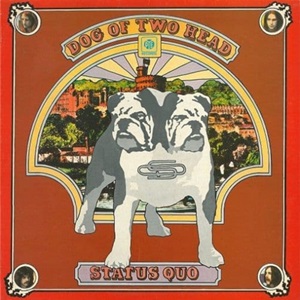
My older sister introduced me to the single “In My Chair” back in the early 1970s, which was rather different from “Pictures of Matchstick Men”, an earlier single release by the band. The single demonstrated a harder edged bluesy side of the former psychedelic band, with shades of John Mayall’s Bluebreakers lurking somewhere between the bars. I headed for the next Status Quo LP release, Dog of Two Head, out of curiosity, which showed some promise, though the single was sadly not included. This was before we all became familiar with the denim-clad, waistcoat-wearin’ boogie brothers led by messes Rossi and Parfit. The hairy geezers pictured in monochrome on the inner gatefold sleeve appeared to what I would describe as ‘my tribe’ at the time and whatever was to come afterwards, couldn’t be further from my mind. I went to see the band at Sheffield City Hall on 12 May 1972, supporting, or at least double-billed with, Slade, who were very much the flavour of the month back then. The concert was very much a good rockin’ night, much of the audience who vacated the premises after Status Quo left the stage, missing what was actually a rather brilliant and exciting concluding set by the decidedly more Glam Wolverhampton band. Dog of Two Head reminds me very much of that time and demonstrated what a tight little outfit Status Quo was at the time, before they became cartoon replicas of themselves, rocking all over the world to the same tune, though a taste of that specific sound was premiered here in the form of “Mean Girl”, a live favourite. The cross over point was perhaps the curious “Gerdundula”, originally released as the b side to “In My Chair”, which included eastern sitar-like influences, fused with the band’s signature boogie sound. The tracks were interspersed with several annoying throwaway interludes under the title “Nanana”, which I could’ve done without. This was my first and last Status Quo LP.
101 | Matthews Southern Comfort | Second Spring | UNI UNLS112 | 1970

When I first heard Matthews Southern Comfort’s version of Joni Michell’s “Woodstock” on the radio in 1970, I had no idea who Ian Matthews was, nor indeed anything about the band he was leading. He was only from up the road from me in Scunthorpe. The fact that he’d recently left a popular folk rock band also passed me by; for all I knew, Fairport Convention was a political gathering in Portland, Oregon. My interest in Matthews Southern Comfort came later, after I’d caught up with all the early Fairport material, discovering Matthews was one of the band’s original members. I came to appreciate much of Matthews’ prolific output, from his Fairport days, his solo material, his MSC LPs and that wonderful debut by Plainsong. Second Spring remains a favourite amongst those records and features one or two memorable performances, not least the a cappella (for the most part) “Blood Red Roses”, the bluegrass stomper “Ballad of Obray Ramsey” and the Byrds-like “D’arcy Farrow”, not to mention the album closer, the sprawling eight-minute “Southern Comfort”, a song written by Sylvia Tyson of Ian and Sylvia fame, interspersed with a nod to the old traditional ballad “Nottamun Town”, and featuring a wild mandolin solo courtesy of Martin Jenkinson. Even James Taylor’s “Something in the Way She Moves” is given some of that special MSC country-inflected treatment, together with those essential and highly impressive vocal harmonies.
100 | James Taylor | Sweet Baby James | Warner Bros K46043 | 1970
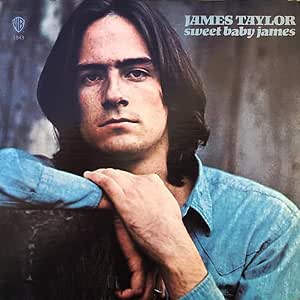
I think it might very well have been Taylor’s reading of Carole King’s “You’ve Got a Friend”, or specifically his performance of the song on Top of the Pops, that first introduced me to the voice of this singer songwriter, way back in the early 1970s. I immediately went out and bought the single, which lived on the turntable of my Dansette for several months thereafter. This, and hearing a female student at the nearby High Melton teacher training college, singing Taylor’s “Sunny Skies”, kind of sealed the deal; I had to investigate further, despite Taylor’s gentle music being a million miles from the heavy rock music I was then very much into, Uriah Heep, Led Zeppelin, Deep Purple and the like. Going out to buy Mud Slide Slim and the Blue Horizon, the album that featured the Carole King song, would’ve been the obvious thing to do, but I headed straight for Sweet Baby James, thinking at the time that it was Taylor’s debut. I discovered the earlier self-titled Apple LP much later. Sweet Baby James would go on to be played relentlessly as I tried in vain to sound like him, knowing full well that I could never in a million years look like him, which was a crying shame. I would probably have had the same girlfriends, but they would’ve shown me off more! Other notably tracks, “Sweet Baby James”, “Country Road” and “Fire and Rain”, possibly his finest song.
099 | Genesis | Trespass | Charisma CAS1020 | 1970
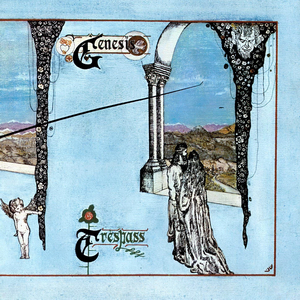
After something of a false start under the supervision of fellow public school luminary Jonathan King, the band Genesis entered London’s Trident Studios in 1970 to record what effectively became the band’s first proper album. The artwork itself pointed very much in the direction the band were to eventually go in the early 1970s as well as the music, which was written by the band as a whole. Trespass was however to be the swansong for both guitarist Anthony Phillips and drummer John Mayhew, who would be replaced by Steve Hackett and Phil Collins respectively. In truth, Genesis didn’t become an obsession until the arrival of Foxtrot a couple of years later, which lingered until The Lamb Lies Down on Broadway in 1974, before evaporating with the departure of charismatic frontman Peter Gabriel around the same time. As in most cases though, I ventured backwards over the band’s catalogue to discover the Trespass and Nursery Crime albums a little after discovering Foxtrot, both of which occasionally re-visit the turntable even today. Notable tracks “Stagnation”, “Visions of Angels” and “The Knife”.
098 | Arlo Guthrie | Washington County | Reprise RSLP 6411 | 1970

Arlo Guthrie appears to be in the process of sharpening an axe on the cover of his third solo album, Washington County, for what purpose, I can only guess. Once again, the singer surrounds himself with the cream of contemporary session players here, including Ry Cooder, Clarence White, Doug Dillard and Richie Haywood, each of whom help to create an eclectic sounding album, with some fine performances throughout. Predominantly self-penned, Guthrie includes one of his dad’s songs on the album, “Lay Down Little Doggies”, complete with a count in that goes up to five, as well as a reading of Bob Dylan’s sing-a-long “Percy’s Song”. I imagine that by October 1970, Arlo Guthrie would have been sick up to the back teeth of reciting the “Alice’s Restaurant Massacree” night after night and Washington Country offers some fine songs to fill out his live set, such as “Gabriel’s Mother’s Hiway Ballad #16 Blues” and “If You Would Just Drop By”, which I feel would be more suited to Closing Time-period Tom Waits. Arlo’s records aren’t the first I reach for after a busy day, though I’m glad that they’re all there in the collection. It feels comforting to have him (and his songs) in my life.
097 | The Amazing Blondel | Evensong | Island ILSP9136 | 1970
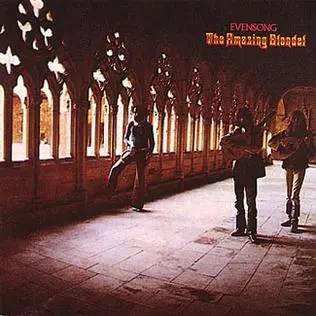
Having already worked their way through three bands during the late 1960s, John Gladwin and Terry Wincott had evolved into a duo for the first Amazing Blondel album, recorded in 1970 and released on the Bell record label. Two major developments followed the release of The Amazing Blondel and a Few Faces, firstly, fellow Scunthorpe musician Eddie Baird joined the band and secondly, they signed to Chris Blackwell’s Island label, a risk at the time, when their label mates included Free, King Crimson, Traffic and Cat Stevens to name but a few. The cover shot of the three musicians posing in the cloisters of Lincoln Cathedral was reflected in the music on the record, even before it reached the turntable, as were some of the song titles, “Old Moot Hall”, “St Crispin’s Day”, “The Ploughman” and “Lady Marion’s Galliard”. The first few notes of the opening song “Pavan” more or less sealed the deal; you were either into it or not. Evensong is made up mainly of songs written by John Gladwin, except for a short instrumental by Eddie Baird, which closes the first side. Much of the album features instrumentation from an entirely different era, from the lute and the cittern to the variety of recorders and the crumhorn, an essential combination for this trio’s completely out of step music at that time.
096 | Fleetwood Mac | Then Play On | Reprise RSLP 9000 | 1969

There has always been the tired old discussion surrounding which version of Fleetwood Mac is the definitive; die-hard Blues buffs maintain that there ain’t no Fleetwood Mac without Peter Green, the band’s brilliant guitar player and main singer, whilst many tend to acknowledge the whirling dervishes of a chiffon-clad Stevie Nicks on stadium stages throughout the world as the Fleetwood Mac, both versions employing the unquestionable credentials of the brilliant rhythm section of namesakes Mick Fleetwood and John McVie. The moment that stands out for me personally, was the the day I first heard the single “Oh Well” on the radio, which I immediately went out to buy. This was the version of the band I took to. It was a strange little single in that the first part, a wild electric blues with spoken interludes, led into the much slower, classical influenced second part, which faded out and then continued on the flip side. It’s the only single I can think of that did this. Then Play On was the band’s third studio album released just prior to the single in late 1969, though neither part of the two part “Oh Well” appeared on the original LP release. Like “Oh Well”, Then Play On showed a different side of the band, with a variety of styles being employed, which effectively closed the first chapter of the band, original band leader Peter Green who left shortly afterwards. There had been nothing quite like “Searching for Madge” on either of its predecessors Fleetwood Mac or Mr Wonderful, both released in 1968, certainly its bizarre orchestral interlude. Then Play On had its fair share of blues numbers included, including the memorable “Rattlesnake Shake” and “Without You”, though it was pretty obvious that the band were in the process of moving on to something new.
095 | Led Zeppelin | Led Zeppelin II | Atlantic K40037 | 1969
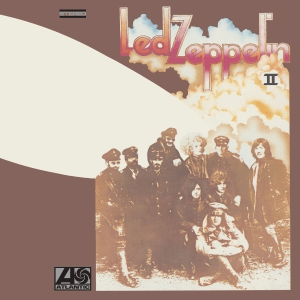
The first Led Zeppelin album I heard and the second LP I ever owned, which soon joined the Jimi Hendrix Experience Smash Hits LP on my bedroom shelf back in the early 1970s. My older sister was a fan of the album and memorably warned me about wailing out some of Plant’s lyrics in earshot of my folks, as I had no idea what they meant as a kid. I was literally thinking of squeezing actual lemons, the citrus fruit. As I gazed at the cover, I couldn’t work out which one was Robert Plant, though I knew it was either the one above the seated man in a hat, or the one with his/her arm around the soldier above. I was frustrated with my ignorance and in those days there was no Wikipedia to consult. I soon became familiar with all the tracks on the album, favourites of which included “Whole Lotta Love”, “Heartbreaker”, “Ramble On” and the relatively commercial “Livin’ Lovin’ Maid (She’s a Woman)”. I wasn’t too keen on “Moby Dick” though after a while, I could tap out the entire drum solo on the arm of the settee, much to mum’s chagrin. Shortly afterwards, I found myself in front of the stage at Sheffield’s City Hall watching my heroes on the 2 January 1973, for the sum of £1 per ticket, a little blue thing not unlike a bus ticket as I recall. The band played just two songs from this LP, “Whole Lotta Love” and “Heartbreaker” for the encore, though the concert was slightly marred by Plant having the start of a flu bug, which would bring the tour to a premature end hours after the gig. I don’t play much Led Zeppelin these days, though I’ll never forget the enthusiasm I once had, and the esteem I held these musicians in.
094 | Free | Free | Island ILPS 9104 | 1969
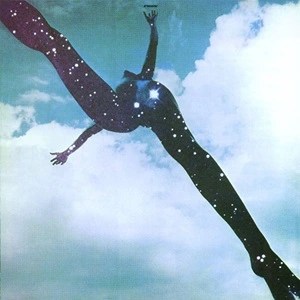
By the time Free had played the Isle of Wight Festival in 1970, which showcased the band’s current hit “All Right Now”, the young band had already released three albums, Tons of Sobs recorded in 1968 but released the following year, the band’s most popular album Fire and Water in 1970 and somewhere in between, their eponymous LP, you know, the one with the leaping lady. The thing that was unusual about the band at the time, was that all the members were so young, Andy Fraser being only fifteen when the band formed, while Paul Kossoff was seventeen, and both lead singer Paul Rodgers and drummer Simon Kirke were just eighteen. The band’s very distinctive sound was becoming more evident by the time this LP arrived, produced by the head of Island Records himself, Chris Blackwell. The songwriting partnership of Rodgers and Fraser had begun to blossom around this time, though the band’s demise just a few years later was largely due to tensions between the two, with the added problems arising from Kossoff’s ongoing drug related problems. Then there’s that cover, designed by Ron Rafaelli, his model silhouetted against stars, leaping through the air, with the band’s name almost too tiny to read at the top. After devouring the single version of “All Right Now”, with the flip side being “Mouthful of Grass”, it was inevitable I would seek out this LP for the collection where it now resides along with all the others and despite the band’s enticing moniker, none of them were actually free.
093 | Pink Floyd | Ummagumma | Harvest SHDW 1 / 2 | 1969

Released as a double LP set with one disc recorded live at two UK venues, Mothers in Birmingham and Manchester College of Commerce, and a second disc made up of studio cuts, Ummagumma isn’t Pink Floyd’s best moment, it has to be said. Their first album on the Harvest label, Ummagumma was released barely two years after the band’s debut The Piper at the Gates of Dawn, the live sides beginning with that album’s opener “Astronomy Domine”, written by the (by then) absent Syd Barrett, yet faithfully rendered by the relatively new line-up of Roger Waters, Nick Mason, Richard Wright and David Gilmour. “Careful with that Axe Eugene”, a b side to “Point Me at the Sky”, a single released the year before is probably the album’s high point, though high point might be a questionable term. If the live sides remain a fairly good example of what the band sounded like back in 1969, the studio sides, evidently divided democratically between each member of the band, presumably so that each member would get an equal share of the royalties, are but a mish-mash of pointless noodling. If Wright’s overblown four-part suite “Sysyphus” reflects the band’s more pretentious side, Roger Waters gets back to nature with the gentle pastoral “Grantchester Meadows”, accompanying himself on acoustic guitar, whilst paying homage to his beloved Cambridge, only to brought to its conclusion with the swatting of fly in glorious stereo. Waters’ musical relationship with avant-garde composer Ron Geesin is evident in the rather strange “Several Species of Small Furry Animals Gathered Together in a Cave and Grooving with a Pict”, which concludes the first side of the studio disc. The acoustic guitar is employed once again in Gilmour’s three-part “The Narrow Way”, which seems pretty throwaway from the start. The remainder of the last side is given over to the drummer of the band with predictable results. The only real positive aspect to this album is the sleeve design, created by those lovely people at Hipgnosis who rarely fail, which shows the band for the last time on a Pink Floyd cover, in several interchanging poses using the Droste effect, complete with the inclusion of the soundtrack LP to the musical Gigi bizarrely enough. Having said all this, Ummagumma is more than a collector’s curiosity, it’s a ‘must have’ despite all its flaws.
092 | Allman Brothers Band | Allman Brothers Band | Atco 228033 | 1969

I first became aware of the Allman Brothers Band when I heard “Black Hearted Woman” on the Age of Atlantic sampler LP back in the early 1970s. Led Zeppelin, Yes and at a push, Delaney & Bonnie, drew me to this LP, the very first sampler I ever bought, though it was the Allman Brothers track that I remember the LP for most of all. It wasn’t long then, before I sought out the band’s debut album, one of many albums I would subsequently seek out. The Allman Brothers Band features the original line-up, with brothers Duane and Gregg fronting their namesake sextet, standing shoulder to shoulder with other notables Berry Oakley and Dick Betts, together with Butch Trucks and Jai Johanny Johanson, who complete the band. Little did we know at the time, that within just three years, two of the key players would be gone, both under almost identical circumstances, meeting their respective ends after coming off their motorbikes, and bizarrely enough, within just a block of one another. This debut covers a lot of ground geographically, the album being conceived in Jacksonville, Florida, then recorded in New York City and with Stephen Paley’s grainy sleeve photos set in and around Macon, Georgia, one of which shows the band returning to nature, completely starkers in a southern river. There’s no mistaking the band’s blues credentials here, certainly on “It’s Not My Cross to Bear”, yet the songs are generally of a rock riff nature, “Every Hungry Woman” and “Trouble No More” for example. Despite the overall length of the album, coming in just over the thirty minute mark, the album is generous in its content, not least in the final track, one of the band’s most enduring numbers, the five-minute (and that’s fairly short when compared to other later recordings) “Whipping Post”, one of Gregg Allman’s best remembered songs.
091 | Johnny Cash | Hello, I’m Johnny Cash | CBS 63796 | 1969

The first time I heard the name Johnny Cash was back in the summer of 1969 when my dad bought the single “A Boy Named Sue”, a song written by Shel Silverstein. I distinctly remember him sitting me down and telling me to listen to the words. I also think it was his way of telling me to ‘man up’ to school bullies (ie. the teachers). I was never what you might refer to as a Johnny Cash fan, though a number of albums have popped up in my collection over the years, this being one of them. Hello, I’m Johnny Cash, is as good a title for an introduction to his work as any, despite it being the Man in Black’s thirty-third album. It features a dozen songs, two of which are duets with his wife June Carter Cash, Cash’s own “‘Cause I Love You” and Tim Hardin’s “If I Were a Carpenter”. Cash provides his signature sound on the album opener “Southwind”, complete with some tasty dobro playing courtesy of Norman Blake, strangely not released as a single, that honour being reserved for “Blistered”, “See Ruby Fall” and the aforementioned “If I Were a Carpenter”, all released in the same year. This album also features the first of many Kris Kristofferson songs to be covered by Cash, a characteristically spoken word performance of “To Beat the Devil”, featuring the Carter Family in the celestial chorus, though I could’ve done without the ‘doo-di-doo’ outro. Jack Clement’s “I’ve Got a Thing About Trains” could very well be my own country anthem, its sentiments echoed throughout the life of this Hexthorpe-born and bred lad. Closing, Cash returns to the subject of carpentry, with a heart-felt reading of Chris Wren’s “Jesus Was a Carpenter”, a gospel coda to this rather fine album. Listening to this LP again makes me wonder why I don’t play Johnny Cash more often than I do.
090 | Colosseum | Colosseum Live | Bronze ICD 1/2 | 1971

I first heard this double live album back in 1971, when a pal down my street added it to his collection of Progressive Rock LPs, which soon found itself rubbing shoulders with all those Third Ear Band, Curved Air and Edgar Broughton records he’d already introduced me to. At the time it was a little too jazzy for my liking, though it seems to have grown on me over the years. My first thought was, is Colosseum akin to a majestic triumph in Roman architecture, or a bit of a dilapidated ruin? The gatefold sleeve was terrible, not so much the cover artwork, which shows the band’s leader either being shot or triumphantly celebrating his Banksy credentials, but rather the construction of the thing, its two records having to be placed in thick pink plastic sleeves with no protective inner sleeves to speak of, which at the time I thought unsafe. There were more clues as to why I might not readily take to this album, namely the inner photos, one of which shows Dick Heckstall-Smith with not one but two saxophones in his gob, which immediately put me off. Nowhere does the jazz element shine through more than on the Michael Gibbs number “Tanglewood ‘63”, a playful workout for Heckstall-Smith (oh he can play the two instruments together, still, Roland Kirke can do three, so no biggie here) and Farlowe’s scat vocal. Despite this, I did eventually become a fan of the band and this album in particular. There’s a vibrancy in the performances, lifted by the extraordinarily versatile guitar work of Clem Clempson, the determined almost theatrical voice of Chris Farlowe, the keyboard prowess of Dave Greenslade and the expert drum work of Jon Hiseman, certainly on such tracks as “Rope Ladder to the Moon”, the frantic “Walking in the Park”, T Bone Walker’s “Stormy Monday Blues” and the memorable “Skelington”, with Farlowe’s yodelling’ Al Jolson routine included. Having said all that about the dodgy pink sleeves, the records still sound good today.
089 | Lindisfarne | Fog on the Tyne | Charisma CAS 1050 | 1971

It was most probably the opening song, “Meet Me on the Corner”, written by Rod Clements, that drew so many to the second album release by the Tyneside five-piece band Lindisfarne back in 1971. The Dylan inspired opening line of Hey Mister Dream Seller, together with its jingle-jangle guitar and harmonica intro, must have been an inviting sound in the early 1970s, especially to those with even a tentative regard for the commercial side of Dylan or indeed folk music in general. The Dylan connection was confirmed further by having Bob Johnson produce it, the producer responsible for several Dylan albums throughout the 1960s. Another part of the band’s appeal around this time might have been the fact that these Geordies had a sense of humour, which shone through, especially on the album’s title song, with such wonderfully alliterative lines as sittin’ in a sleazy snack bar sucking, sickly sausage rolls. An appearance on the Old Grey Whistle Test might have sealed the deal, despite the gratuitous display of garish tank tops and Newcastle United stripes, sales of the album rocketing up the charts eventually reaching number one in the UK, becoming the eighth bestselling album of the following year. Other notable songs on this album include Alan Hull’s melancholic “January Song” and Rab Noakes’ almost throwaway, yet highly joyous and completely accessible “Together Forever”. Trevor Wiles and Franco Polsinelli’s instantly recognisable sleeve design centres around an engraving of a pre-Tyne Bridge Newcastle, complete with a bunch of colour shots of the band on Holy Island making up the inner gatefold sleeve
088 | Steve Tilston | An Acoustic Confusion | The Village Thing VTS 5 | 1971
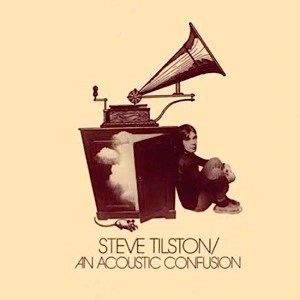
Steve Tilston’s songs take me to a certain place, they always do. His debut LP was first released on Ian A Anderson’s The Village Thing record label back in 1971, one of a handful of such early albums centred around the folk music scenes of both London and Bristol. These days Steve Tilston’s songs are known through his own albums and performances but also through interpretations by others, notably Fairport Convention, but also by Dolores Keane, the House Band, Peter Bellamy, Bob Fox and many others. The Ian Anderson and Gef Lucena-produced album may have been the starting point for what has turned out to be a long and successful career, yet the songs on An Acoustic Confusion remain strong to this day, songs like “I Really Wanted To”, “Time Has Shown Me Your Face” and “It’s Not My Place To Fail”, each . Although essentially a solo album, the record does include a couple of guest musicians, labelmates from the Village Thing stable, notably Dave Evans. Though the album may have been superseded by one or two subsequent mini-masterpieces, An Acoustic Confusion remains the Steve Tilston album I listen to most, that ‘certain place’ calling ever more strongly as time goes by.
087 | Incredible String Band | Liquid Acrobat as Regards the Air | Island ILPS 9172 | 1971

If you were still buying Incredible String Band records in 1971, you would be considered a die-hard fan. The band had been a trio, a duo, a duo with girlfriends and at one point, a sort of theatrical outfit, with eight albums under their belt by the time Liquid Acrobat came along. The opening track on this album “Talking of the End”, wouldn’t be out of place on the soundtrack to The Wicker Man, the original, not that Nic Cage turkey, as Christopher Lee prances about in a wig. The thing that marks their ninth album out from the band’s earlier releases, is that it was their first almost completely electric album, a sort of folk rock excursion, becoming one of the band’s most successful albums of their career. Liquid Acrobat was produced by Stanley Schnier and features original members Mike Heron and Robin Williamson, along with Malcolm Le Maistre and Licorice (Likki) McKechnie, who takes the lead vocal on one of her own songs, the whimsical, almost Music Hall ditty “Cosmic Boy”. The other ‘girlfriend’ Rose Simpson had just left the band to concentrate on rearing a family, while Fotheringay drummer Gerry Conway stepped in to provide the all-important rock beats. The Music Hall aesthetic continued with Williamson’s jaunty “Evolution Rag”, which features no less than three kazoos and a swanee whistle. I can see how desperately you want to hear that! Perhaps the album’s show stopper though, is the sprawling eleven-minute closer “Darling Belle”, though Mike Heron’s “Worlds They Rise and Fall”, later used in the soundtrack to the low budget film Hideous Kinky, Kate Winslet’s next film after the blockbusting Titanic, is another stand out track.
086 | Marvin, Welch & Farrar | Second Opinion | Regal Zonophone SRZA 8504 | 1971

When I first heard the debut album by The Shadows, the only LP in dad’s small collection I had any interest in at all, mainly due to the fact that it featured guitars on its cover, I was more interested in the instrumentals than the songs. The Shadows were never strong in the tonsils department as I recall. It came as a surprise then, when in 1970, the two key pickers in this predominantly instrumental group, formed a Crosby, Stills and Nash-styled acoustic harmony trio with John Farrar, an Australian musician who had been a member of one of the bands that supported the Shads on one of their then recent Antipodean tours. I recall the British music press smothering their respective pages with ads for the trio’s first couple of albums, both of which soon found their way onto my shelves. The most memorable of these was the trio’s second outing Second Opinion, produced by Marvin, Welch and Farrar themselves, which was considered a very well-produced and fabulous sounding album at the time. Made up entirely of originals, written by various combinations of these three writers, Second Opinion was sadly destined never to be popular with the twang-happy Shads fans, nor the weed-happy CSN brigade; too cool for the Palladium, not cool enough for the Troubadour possibly. More for fans of The Hollies than anything else I would say. Visually, the two initial albums should perhaps be remembered at least for their sleeve designs, each photographed in desolate places by those lovely chaps a Hipgnosis.
085 | Pentangle | Reflection | Transatlantic TRAL5240 | 1971

I suppose first became enchanted with the sound of Pentangle a good three years after the release of their debut LP back in the summer of 1968. I would’ve still been whistling along to the Love Affair’s “Rainbow Valley”, whilst swooning at the feet of Doreen Hardy in the back streets of Hexthorpe. The bloke who ran the local youth club handed me two LPs, which he said I could have as long as I took care of them. One was the Velvet Underground’s White Light White Heat, which I thought an insufferable din, though I quite liked the macabre Lou Reed story “The Gift”, narrated by John Cale and the other was Basket of Light by Pentangle, something infinitely more soothing I soon discovered. I became a Pentangle fan immediately. Opening the gatefold sleeve I noticed the name Bert Jansch, a name I’d recently been introduced to in art class by a cool teacher who would play Bert’s first solo album over and over, while we threw paint around. Reflection came later, but was just as vibrant as the earlier album. Wrapped in a gatefold sleeve that includes little in the way of information, but a whole plethora of snaps of the band; I counted 82 but I could be mistaken (I’m not counting them again). The LP contains four originals, including one of the band’s prettiest songs, and a favourite over many years, “So Clear”, featuring a lead vocal courtesy of John Renbourn, and also four traditional songs “Wedding Dress”, “Omie Wise”, “When the Circle be Unbroken” and “Rain and Snow”, all of which are treated to inspiring arrangements. Produced by Bill Leader, Pentangle’s fifth album certainly reflects the talents of these five extraordinary musicians.
084 | Wishbone Ash | Pilgrimage | MCA MDKS 8004 | 1971
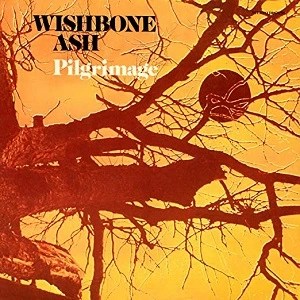
In the words of Greil Marcus, “What is this shit? This colourful phrase was used for an entirely different album, though it immediately came to mind when I first heard the opening track to Wishbone Ash’s second album Pilgrimage. Perhaps I was anticipating something along the lines of “Phoenix” or “Lady Whiskey”, but instead, this album opens with “Vas Dis”, a cover of a Brother Jack McDuff jazz workout, complete with an almost convincing scat vocal, courtesy of Martin Turner, which raised both eyebrow and temperature, after forking out the £2.49 for the album. I would never have considered this track as an album opener, though I’ve warmed to the track over the years. “The Pilgrim” sees the band return to form with Andy Powell and Ted Turner’s familiar twin guitar motifs, though once again, the vocal continues along scat lines, with thirteen minutes gone and not one single lyric delivered. No matter, the third track saved the day, “Jailbait” being a standard Rory Gallagher type blues rocker, which would remain in the band’s set for some years to come. The LP concludes with a live recording of “Where Were You Tomorrow”, recorded at the De Montford Hall in Leicester earlier in the year and gives us a glimpse at what the band could do live, something I was pleased to experience on a few occasions. For those still unfamiliar with precisely what this band looks like, as the first album didn’t give too much away, this album offers no less than sixty-four black and white snaps of the band on the inner gatefold sleeve. Despite the album’s initial jazz leanings, Pilgrimage remains a much played album, with some memorable moments.
083 | Yes | Fragile | Atlantic K50009 | 1971
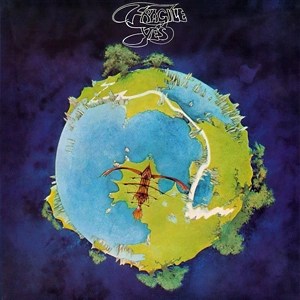
The fourth album by the Progressive Rock band Yes saw one major line-up change, when Rick Wakeman replaced founding member Tony Kaye on keyboards, due in no small part to Kaye’s refusal to move into the adventurous sphere of electronica, maintaining a stubborn allegiance to the standard piano/organ fare. Wakeman brought to the band a whole caboodle of electric pianos, synthesisers and the obligatory Mellotron in order to further the band’s overall Prog sound, together with an unnecessary wardrobe of Batman capes. The LP was also the first to feature a sleeve designed by artist Roger Dean, whose futuristic landscapes would go on to be regularly employed by rock bands for years to come, not least for this particular outfit. Made up of four group efforts and several solo compositions, the album feels slightly fragmented and covers a variety of styles, from Brahmsian classical music to Spanish Flamenco, with one composition lasting just thirty-five seconds, challenging the notion that Prog songs always go on a bit. Despite the album’s diverse approach, Fragile does include one of the band’s most familiar songs, the relatively accessible “Roundabout”, which opens the first side.
082 | Graham Nash David Crosby | Graham Nash David Crosby | Atlantic K50011 | 1972

Graham Nash David Crosby was the first album released by the left over partnership of Crosby and Nash, after the break-up of the hugely successful Crosby, Stills, Nash and Young, a couple of years earlier, released on the Atlantic record label in 1972. Though both musicians had recorded and released solo albums by this time, If I Could Only Remember My Name and Songs for Beginners respectively, this album appeared to be a logical progression. Graham Nash David Crosby appeared as a live album, judging by the sleeve photographs, the cover snap showing the pair on stage, peeking through a die-cut window, though the album was very much a studio album, though it did include the annoying one minute long “Blacknotes” midway through the first side, which was evidently recorded live and received an unfathomable applause at the end of the excruciating fifty-odd seconds. This aside, the album is good, and features several high profile contributors in the form of Jerry Garcia, Phil Lesh and Bill Kreutzmann from the Grateful Dead, former Traffic guitarist Dave Mason and some of the best session musicians working on the West Coast at the time, including Danny Kortchmar, Leland Sklar, and Russ Kunkel, who would all go on to achieve much success working with the likes of James Taylor, Carole King and Jackson Browne. If some of the duo’s later work left a lot to be desired as the 1970s moved into the Punk era, Graham Nash David Crosby remains one of the duo’s most commercially successful albums.
081 | Van Morrison | Tupelo Honey | Warner Bros K46114 | 1971

The songs on Van Morrison’s fifth studio album Tupelo Honey were predominantly written in Woodstock, the sleepy artsy home of Bob Dylan and The Band in upstate New York. This small town was a temporary retreat for Morrison and his then-wife Janet ‘Planet’ Rigsbee, both pictured in dappled light on the cover, Rigsbee on horseback, with a long-haired Morrison walking beside. The music reflects this idyllic setting, notably the title song, the name of which relates to the honey produced from the flowers of the tupelo tree. The centre gatefold sepia photo shows Morrison smiling (honest guv) and looks for all intents and purposes like he might be at home in this rural setting. Shortly afterwards though, Morrison moved to California, where the album was recorded at the Wally Heider Studios in San Francisco and was completed in May 1971 at Columbia Studios. Tupelo Honey provided the singer with three singles, the first being “Wild Night” with “Tupelo Honey” and “(Straight to Your Heart) Like a Cannonball” following shortly afterwards. The catchy country song “I Wanna Roo You” was also featured on the Warner Bros sampler LP Fruity, famed for its circular salad bowl sleeve. I originally bought Tupelo Honey as part of a double Warner Bros set, paired with Morrison’s previous release, His Band and the Street Choir in 1975, but felt duty bound to buy the two LPs separately a little later. It remains an equal favourite alongside both Astral Weeks and Moondance.
080 | The Beatles | Abbey Road | Apple PCS 7088 | 1969

Strangely, the one place that most fans head for to experience that all-important Beatles buzz, is not the Cavern Club in the heart of Liverpool, nor Shea Stadium in New York, not even Candlestick Park in San Francisco, the last place the band played in front of a paying audience, not even any of their respective childhood homes, but rather, an ordinary zebra crossing in leafy St John’s Wood, next to the studio where this and many other records were made. Every day, tourists irritate cabbies as they line up on the crossing for their photo to be taken, which never captures the correct angle shown in this famous photograph. Had this photo never been taken, few tourists would ever visit this otherwise quiet thoroughfare, but that’s the power of an album shot. Abbey Road is the final album by The Beatles, though there was one further edition to the band’s canon, when Let It Be was finally released eight months later, after the official break-up of the band. I bought Abbey Road in the early 1970s, during my heaviest Beatles period, when it became important to know the name of the taxi driver who drove one of them to the studio on a certain day, that sort of detail. There’s lots to like here, certainly the two songs that bookend the first side, “Come Together” and “I Want You (She’s So Heavy)”, both of which immediately placed this band in a different category altogether to that of the former Mop Tops. George Harrison excels with his burgeoning songwriting credentials as he lays down a couple of his finest, the timeless “Something” and the deliriously gorgeous “Here Comes the Sun”. But it’s probably the second side of this platter that takes one’s breath away, a song cycle pieced together in such a manner that if one fraction of a second was removed, you would notice it immediately. I might go as far as to say, a masterpiece and a side I often reference to those people who claim not to like the Beatles. The conversation usually goes something like this: “I don’t like the Beatles”, to which I say “Well who do you like above all others?” (insert any name, Kraftwerk usually), to which I then respond, “Oh dear, so sorry about that”.
079 | Frank Zappa | Hot Rats | Reprise 44078 | 1969

The first time I heard the music of Frank Zappa was in the early 1970s when I picked up the Mothers of Invention’s second LP Absolutely Free (the name of the album, not the price tag!), from Ken’s Swap Shop on St Sepulchre Gate in Doncaster, for the sum of one pound sterling and a couple of discarded records. The concept was simple; take in a couple of unwanted LPs and swap them for a new one, with the smallest exchange of cash. I was one of Ken’s keenest swappers. I was also initially confused as it contained the Sgt. Pepper parody cut-out sheet that usually went with the band’s next LP We’re Only in it for the Money. This purchase/swap would lead to a whole world of Zappa discoveries over the next few decades. Another Zappa LP I picked up at the shop shortly afterwards was Uncle Meat, my first double LP. Hot Rats however, was a different story, an LP I bought new, yet based on my cheapo Zappa experiences thus far. I particularly enjoyed this album because it was more about the music than the ‘humor’ (another irritation right there), one of the things that would frequently irritate me about Zappa over the years. Great guitar solos, shame about the infantile lyrics, and it’s ‘humour’, I would often muse (I was young). This LP is a fine example of jazz/rock fusion with some astonishing guitar solos courtesy of Zappa himself. The only other Mother to appear on the LP was Ian Underwood, who took care of keyboards and woodwind instruments. It was also the first time I heard the names Jean Luc Ponty and Sugar Cane Harris, two outstanding violin soloists. “Willie the Pimp” features the only voice on the record, a cameo by Captain Beefheart, who also appears in a photo holding up a vacuum cleaner on the inner sleeve. The sleeve artwork is another delightful aspect of Hot Rats, which features one of the GTOs (Miss Christine I believe) enjoying a bit of psychedelia, front and back. Hot Rats remains one of the most re-visited of all Zappa’s albums in my collection and it continues to resonate today. “Hot Meat, Hot Rats, Hot Zitz, Hot Wrists, Hot Ritz, Hot Roots, Hot Soots…” What’s not to like?
078 | Neil Young | Everyone Knows This is Nowhere | RS6349 | 1969
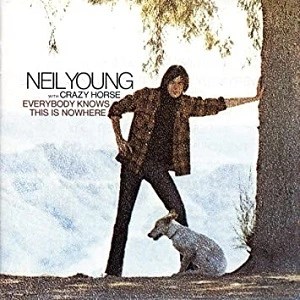
Wrapped in a grainy gatefold sleeve, showing a gangly 23-year-old Young leaning against a tree with his dog Winnipeg at his feet, Everyone Knows This is Nowhere is the Canadian’s second solo album, albeit his first with Crazy Horse, a band made up of key players, Danny Whitten on guitar, Billy Talbot on bass and Ralph Molina on drums. The album appeared in quick succession to his debut self-titled album, which came out just six months after that album’s release, yet it showed improvement on its predecessor, helped in no small part by at least three signature songs that would feature in Young’s live set for many years to come, those being the driving “Cinnamon Girl”, the country inflected title song, the almost anthemic “Down by the River” and the sprawling ten minute opus “Cowgirl in the Sand”, all allegedly written in a single day. The gypsy violin on “Running Dry (Requiem for the Rockets)”, courtesy Bobby Notkoff, was echoed seven years later, when Bob Dylan invited Scarlet Rivera to add embellishment to the songs on his seventeenth album Desire. It’s interesting to find that Young’s vocal on the title song was actually a low quality test take, which the musician liked enough to keep for the finished product. I came to this album a little later, certainly after devouring both subsequent albums After the Goldrush and Harvest. and even the messy Journey Through the Past soundtrack, which I bought in quick succession back in the early Seventies while my contemporaries were all going glam bam thank you man.
077 | Joni Mitchell | Clouds | Reprise K44070 | 1969
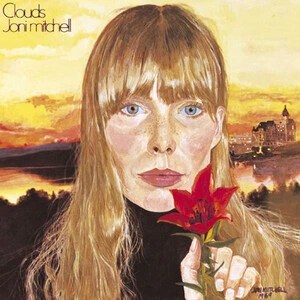
Joni Mitchell’s second album Clouds, was eagerly anticipated at the time, her reputation having gone ahead of her with no less than two of the songs already known through interpretations by both Judy Collins and Fairport Convention prior to the album’s release in 1969. Joni had already uprooted from her native Canada to record her debut album in New York with then current boyfriend David Crosby in 1967 and by this time had moved once again to California, recording Clouds in Hollywood with the help of Stephen Stills. “That Song About the Midway” chronicles the way in which her relationship with Crosby went, in no uncertain terms, though she allegedly had to sing it to him twice to ensure the message sunk in. Once again illustrated by her own sleeve artwork, Clouds features an impressionistic self-portrait, an image of the artist most remembered. “Tin Angel” almost continues where the songs on Song to the Seagull left off, with a similar bleakness. “Chelsea Morning” brings in the mountain dulcimer, a feature of the next few albums, culminating in Joni’s 1970 masterpiece Blue. The multi-tracked vocal on “Song to Aging Children” takes Joni to her most ethereal place, a superb performance, the song borrowed for the snowy cemetery scene in Arthur Penn’s film Alice’s Restaurant, released in the same year, performed in the film by Tigger Outlaw, possibly due to copyright complications. Perhaps the album’s key track is the closer “Both Sides Now”, from which the album title is taken, a song that is peerless in its beauty, and one, along with a much later version, that almost bookends Joni’s rich and varied career as the preeminent singer songwriter.
076 | King Crimson | In the Court of the Crimson King | Island ILPS911 | 1969

With one of the most distinctive and instantly recognisable sleeves in the history of popular music, King Crimson’s debut LP from 1969 is widely regarded as the first progressive rock album, though this might be contested by Sgt. Pepper obsessives. In the Court of the Crimson King, with its slightly pretentious subtitle An Observation by King Crimson, was released on the Island label and often finds its way into the rare issues boxes in second hand record shops, with second mortgage level price tags depending upon the actual label and the general state of the thing. The striking sleeve was designed by Barry Godber, who died shortly after the album’s release, it being his one and only album cover. Album sales were helped along by the band’s high profile appearance at the Rolling Stones’ Hyde Park concert, which drew a crowd of up to half a million people along with a few dead butterflies. As with much of the music that sprang from the deep well of Prog, there’s plenty of mellotron and jazz rock noodling to keep the Prog Rock crowd fully awake, though there’s a chance they might nod off half way through “I Talk to the Wind”. For those who might be wondering what that strange noise is at the beginning of the record, just prior to the opening bars of “21st Century Schizoid Man”, it’s the sound that the Mellotron makes when it’s being switched on. After listening to all those Moody Blues records though, you sometimes wish they’d left it switched off.
075 | Edgar Broughton Band | Wasa Wasa | Harvest SHVL757 | 1969
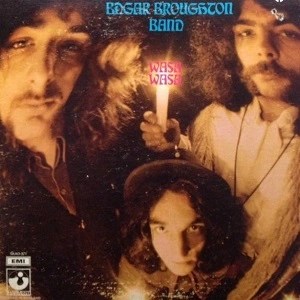
It’s hard to believe looking back, that in 1971/2, the proto-punk Edgar Broughton Band was my favourite and perhaps most played band, having forked out for their debut album Wasa Wasa and their self-titled third studio album, the one with the meat cover. Known for their underground reputation, their radicalism, their frequent appearances at free festivals alongside such outfits as Hawkwind and the Pink Fairies, and their penchant for psychedelic repetitive chants, “Out Demons Out” and “Apache Dropout” spring to mind, the Edgar Broughton Band was best served live, their albums dating almost immediately. Wasa Wasa was the first of five studio albums on EMI’s Harvest label, released in the summer of 1969, at that time the band being a trio comprising Edgar on guitar, brother Steve on drums and Arthur Grant on bass. Steve Broughton also drew some attention as the drummer who appeared on Mike Oldfield’s otherwise solo masterpiece Tubular Bells in 1973. The album’s most memorable tracks are “Evil”, “Death of an Electric Citizen” and the sprawling doom-fest “Dawn Crept Away”, similar in intensity to the Doors’ “The End”, not to mention the corny throw-away, if perhaps conscientious anti-war statement, “American Boy Soldier”.
074 | Delaney & Bonnie | The Original Delaney & Bonnie and Friends | Elektra EKS 74029 | 1969
Here we see the husband and wife combo of Delaney and Bonnie Bramlett together with their kids in a formal colourised portrait for the cover of the duo’s second studio album. The Original Delaney and Bonnie and Friends, also referred to as Accept No Substitute, does indeed feature some of the duo’s friends, in the shape of Leon Russell, Rita Coolidge, Bobby Whitlock, Carl Radle and Bobby Keys among them, also captured in formal sepia portraits on the reverse of the cover. The gospel, country and soul influences are most apparent here, providing the sound Eric Clapton was at the time searching for, something like the sound he would further develop with his later Derek and the Dominoes project, notably on the double album set Layla and Other Assorted Love Songs. Clapton would feature on Delaney and Bonnie’s follow up album On Tour with Delaney and Bonnie, remembered for the song “Coming Home” perhaps the collaboration’s best known song and the opening song to the famed plasticine-adorned Atlantic sampler The Age of Atlantic. The Original Delaney and Bonnie and Friends, also features a fine reading of the Chips Moman and Dan Penn soul standard “Do Right Woman, Do Right Man”, channelling Aretha with no apparent problem.
073 | Seatrain | The Marblehead Messenger | Capitol EA-ST 829 | 1971

When I first discovered the American band Seatrain, they’d already reached their final album, which I found languishing in the bargain bin at Bradley’s Records in the late 1970s. Watch was the band’s fourth album and key members Peter Rowan and Richard Greene had already left the band. My thoughts at the time were along the lines of, if the band is this good without those two musicians, then what would it be like with them? I was left with no option but to investigate further. I was on a mission. The first record I picked up from the band’s back catalogue, was their previous release, The Marblehead Messenger, which as fully expected, sounded pretty much like the band I was already familiar with on Watch, but with the added bonus of Richard Greene’s brilliant violin playing and Peter Rowan’s unmistakable voice. “Protestant Preacher” features a heavy dose of both, even to the extent of including some of Rowan’s authentic sounding, yet playful, Native American yodelling towards the end, something he would later revisit on such songs as “Land of the Navajo” on his self-titled debut in 1978. Produced by George Martin at London’s Air Studios, The Marblehead Messenger features ten songs delivered by a band that should really be better known and more frequently played, which is precisely what I’m going to do now, excuse me.
072 | Creedence Clearwater Revival | Pendulum | Liberty LBG 83400 | 1970
I was still running around the village of Hexthorpe on my bike when Creedence Clearwater Revival’s sixth LP was released, and I distinctly recall humming John Fogerty’s “Have You Ever Seen the Rain” as I pedalled along, precisely at the point where I felt I couldn’t possibly be any wetter, drawing up to my back door after a fairly unsuccessful newspaper round one wet and miserable December morning in 1970. Me and my mate, who lived just up the street, had been eagerly awaiting the release of Pendulum, after being so utterly blown away by the band’s previous LP Cosmo’s Factory, though we’d already worked out that it might be a tough act to follow. Whereas Cosmo’s had “Up Around the Bend”, “Who’ll Stop the Rain”, “Run Through the Jungle” and a fine reading of “I Heard it Through the Grapevine”, Pendulum had little in the way of comparison in terms of quality or indeed excitement, though it was the band’s first to contain all original material. That quality could be measured in the number of singles taken from each of the band’s previous two or three albums, whereas Pendulum has just the one, the aforementioned “Have You Ever Seen the Rain” backed with “Hey Tonight”, both of which appear on this album. It was a bit of a disappointment to be honest, though it still had its moments, certainly the lengthy opener “Pagan Baby”, which bears all the hallmarks of CCR’s familiar sound. The equally lengthy “Rude Awakening #2”, which closes the album, is as different to that sound as was possible, a performance that reveals a more folky psychedelia side of the band. There was only one album left in the band, the highly disappointing Mardi Gras, which brought about the sudden, if not entirely unexpected nail/coffin manoeuvre.
071 | Rod Stewart | Every Picture Tells a Story | Mercury 6338 063 | 1971
In 1971 you couldn’t really move for the sound of Rod Stewart warbling the song “Maggie May” on the radio or TV, notably on Top of the Pops, where the singer appeared to take on something akin to a residency, occasionally kicking a ball around the studio, while John Peel sat on a stool pretending to play the mandolin. The actual mandolin part was provided by Lindisfarne’s Ray Jackson, though credited on the album sleeve simply as “the mandolin player in Lindisfarne”, going on to confess, “the name slips my mind”. In hindsight, it’s hard to get past Rod’s later appearances on the same show, attired in a leopard skin jump suit or worse still, in posh suits while crooning the Great American Songbook, but once we erase these awful diversions from our respective memories, we might just remember that Rod Stewart was once an almost peerless rock and roll maverick. Every Picture Tells a Story is Rod Stewart’s third solo album following hot on the heels of An Old Raincoat Won’t Ever Let You Down (1969) and Gasoline Alley (1970), both worthy albums, yet this one seems to have all the right ingredients for Stewart, which allows him a place in both rock and pop camps. The rockers come over as good time stompers, notably the old Arthur Crudup song “That’s All Right”, whilst “Mandolin Wind” just might be considered one of Rod’s finest moments, before our loyalty was put to the test with such unforgivable awfulness as “Do Ya Think I’m Sexy?” and “Hot Legs”, which in a perfect world should’ve seen the singer banged up for a substantial period, until 2001 at least.
070 | Pink Floyd | Meddle | Harvest SHVL 795 | 1971

The compositions on Pink Floyd’s sixth album Meddle are so diverse that the record appears to contain both their finest and their worst tracks in the band’s canon, which may or may not be true. If the utterly throwaway “Seamus”, a simple twelve bar blues featuring Steve Marriott’s dog of the same name desperately howling along, might be considered the band’s worst recorded song, then the epic “Echoes”, which takes up the entire second side, might well claim the crown of being their finest. Perhaps it’s the steady build and varying themes throughout the twenty-three minute opus that remains just as important today as it was back in 1971. The Hipgnosis cover was typically surreal, with Storm Thorgerson’s photograph of an underwater ear being the best he could come up with at the time and not quite as iconic as the previous album’s Friesian cow. The opening track “One of These Days” was played every week at the Doncaster Top Rank’s Prog night and hearing those twinned bass runs swirling around the nightclub remains an enduring memory, together with drummer Nick Mason’s particularly weird “one of these days I’m going to cut you into little pieces”, being slightly reminiscent of Roger Waters’ whispered “careful with that axe Eugene”, both an indication of the band’s slightly macabre sense of humour. Perhaps the most memorable moment on Meddle though is the field recording of the Liverpool FC Kop singing in unison their claimed anthem “You’ll Never Walk Alone” at the end of “Fearless”, an acoustic song that remains one of the band’s most enduring off the cuff performances.
069 | Curved Air | Second Album | Warner Bros K46092 | 1971

Released at a time when promotional gimmicks were perhaps a dead cert way of selling product, Curved Air’s second LP came wrapped in a complicated sleeve design that once eventually unfolded, revealed not only the actual record, but five black and white photographs of the individual band members, plus a topless group shot, with Sonja Kristina cleverly tucked away at the bottom, revealing nothing but her face, a clever manoeuvre on the part of the photographer. The band’s previous album also came with much hype along with some disappointment, when it was released as an early picture disc, which was almost unplayable, despite its aesthetic value. I have both the picture disc, which is only good for display purposes and the standard LP, which is the one I play. The big hit from this second helping was “Back Street Luv”, which opened with the most convincing fart in popular music and which reached number four in the UK charts, backed by the almost Yoko-esque “Everdance”. Second Album wasn’t the critically acclaimed album the band expected it to be, which was probably due to the band members pulling in different directions with no solid band unity to speak of. I saw the band a few times during this period and though I would like to form some sort of considered musical critique, I was far too involved in my teenage obsession with Sonja Kristina to even comment on what the other hairy geezers were playing!
068 | Sandy Denny | The North Star Grassman and the Ravens | Island ILPS 9165 | 1971

The North Star Grassman and the Ravens was the first of four solo albums Sandy Denny released between 1971 and 1977, and the first recorded after the disbandment of her band Fotheringay, which dissolved half way through the recording of the band’s second album. My attention was first drawn to Sandy after hearing her voice on “Battle of Evermore”, her duet with Robert Plant on the fourth Led Zeppelin LP. I discovered this album, together with all the others, a little later. Produced by Denny herself, together with her former Fairport band mate Richard Thompson along with the noted engineer John Wood, North Star was made up predominantly of self-penned songs, such as “Late November”, “Next Time Round” and “Crazy Lady Blues”, with just one or two non-originals included, namely Bob Dylan’s “Down in the Flood” and the old 1959 Alvin Gaines & the Themes hit “Let’s Jump the Broomstick”, written by Charles Robbins and later covered by Brenda Lee. Sandy’s treatment of traditional material is second to none, something we were already aware of, with her reading of “Blackwaterside” being the sole inclusion here. Sandy was joined on this album by former Fotheringay musicians Trevor Lucas, Jerry Donahue, Pat Donaldson and Gerry Conway, together with appearances by Richard Thompson, Buddy Emmons and brothers Robin and Barry Dransfield among others, with string arrangements by Harry Robinson. Wrapped in a memorable gatefold sleeve, with Sandy pictured on the front apparently weighing seeds in a dimly-lit period apothecary, which brings an additional sense of the archaic. Sad to think that Sandy would be gone less than seven years later.
067 | The Who | Who’s Next | Track 2408 102 | 1971

The Who had pretty much missed my radar save for a couple of singles in the late 1960s, “Substitute” being one of them. Tommy meant nothing to me and A Quick One While He’s Away even less. It was “Won’t Get Fooled Again” that caught my attention when I first heard the single on the radio in 1971, a rock anthem if ever there was one. This led me to the Who’s Next album, which included the song, though a longer version than that of the single release. The album’s notorious cover shot, which features a 2001: A Space Odyssey-style monolith, shows all four members of the band having recently relieved themselves against it, which in itself brings a certain attitude to the record a good six years before the arrival of Punk. Although the album appears to be a fully formed finished product, it was in fact cobbled together from remnants of Pete Townshend’s abandoned Lifehouse project, which included the liberal use of synthesisers, particularly on “Baba O’Riley”, the opening track. All the songs on the album were written by Pete Townshend, with the exception of John Entwistle’s “My Wife”, which doesn’t feel at all out of place. Other notable tracks include “Bargain”, “The Song is Over” and “Behind Blue Eyes”. This LP remains one of the milestones of British rock. I only saw the band once, which was back in 1981 at the Deeside Leisure Centre in North Wales. All I remember is that it was loud, I came away with chest pains and that Townshend was particularly aggressive towards the Welsh crowd. I seem to recall one particular exchange.. “Get on with it” called out one fan, during a sensitive introduction to “Won’t Get Fooled Again”, to which the guitarist responded with the rather succinct “C***!”
066 | Groundhogs | Split | Liberty LBG83401 | 1971
In 1970, as I prepared to embark on my troubled teenage years, my record collection was still very much in its infancy. I was already showing signs of dissatisfaction with the music that was then infiltrating the pop charts, being not in the least bit concerned about where love actually grows, despite Edison Lighthouse’s eagerness to tell me. If a record by Lee Marvin could get to the number one spot, there was no further hope as far as I was concerned, a notion exacerbated further by Clint Eastwood talking to the trees on the b side. The rock world beckoned and with a little help from my older sister, more specifically, the hippie boyfriends she would bring home, my ears began to let in the good stuff. I first heard the sound of the three-piece blues outfit Groundhogs at the Monday Prog Rock night at the Top Rank Suite in Doncaster, where the confused DJs would always manage to slip in the odd blues number. “Split – Part 2” was one of the mainstays on the playlist during these nights and it wasn’t long before the record was added to my collection. Split, the band’s fourth album release, is probably most remembered for the inclusion of the band’s best known track “Cherry Red”. I’m sure neither guitarist Tony McPhee, bassist Peter Cruikshank nor drummer Ken Pustelnik considered themselves to be anything other than a blues band, nevertheless, their music seemed to fit well into the Rank’s progressive oeuvre every Monday night. According to guitarist Tony McPhee, the lyrics for this album were inspired by a panic attack he experienced in 1970, something possibly reflected in the fabulous cover shot.
065 | Blood, Sweat & Tears | Blood, Sweat & Tears 3 | CBS S64024 | 1970
There was always something a little overblown and slightly brash about such bands as Chicago and Blood, Sweat and Tears, mainly due to their heavy use of brass instruments and arrangements. I suppose bands such as these would normally have passed me by, but for being relentlessly represented in the plethora of CBS samplers, which I had to have for their simultaneous inclusion of Dylan, Cohen, the Byrds, Johnny Winter, Santana, Janis Joplin, Laura Nyro and the like. So, the songs and tunes of Blood, Sweat and Tears were effectively forced upon me. It’s only now that I’ve grown to appreciate those arrangements and some of them can be found on this, the band’s third album released back in the summer of 1970. The album is predominantly made up of non-originals, including James Taylor’s “Fire and Rain”, Richard Manuel’s gorgeous “Lonesome Suzie”, Laura Nyro’s “He’s a Runner” and Traffic’s “40,000 Headmen”, together with a rather experimental reading of the Stones’ “Sympathy for the Devil”, in this case retitled “Symphony for the Devil”, which explores the darker side of a dark song; the opening few bars could be used as a soundtrack to a Hitchcock thriller. Possibly the most unexpected song on Blood, Sweat and Tears 3 is “The Battle”, a short harpsichord-led folk ballad, which seems oddly out of place, yet is probably my favourite track on the album.
064 | Jethro Tull | Benefit | Chrysalis CHR1043 | 1970

I think my first encounter with Jethro Tull, the band rather than the eighteenth century agriculturalist that is, came via the front pages of Disc and Music Echo, where the heavily hirsute fizzogs of messes Anderson, Barre, Cornick and Bunker could be seen gurning back at me in rock and roll fashion. I identified with these four musicians immediately and took them to be ‘my tribe’, despite the fact that I myself wasn’t quite ready to attempt a moustache let alone a beard, though my hair was showing potential. “Witches Promise” had been released as a single just prior to the release of the band’s third album Benefit, and was immediately added to my little orange box, though I was slightly disappointed that the track wasn’t included on the album, nor indeed was the b side “Teacher”. Perhaps I should’ve seen this as a bonus, having the two discs in my growing collection. Already partial to the sound of the electric guitar, my ears pricked up immediately upon hearing “To Cry You a Song”, “Nothing to Say” and to a lesser extent, “A Time for Everything” and “Son”, where Martin Barre satisfied my thirst for the all-important ‘guitar riff’. “Inside” was apparently deemed the album’s most commercial song, it being released as a single and the only track from the album to be included on the band’s double retrospective Living in the Past a couple of years later. The bands that I’d discovered up to this point, were predominantly bands I’d been introduced to by my pals, whereas Jethro Tull was a band I discovered all by myself, something I was quite proud of at the time, though my Northern Soul fanatical school pals thought it was just one man; “Wilko’s going on about that Jethro Tool bloke again”.
063 | Deep Purple | Deep Purple in Rock | Harvest SHVL777 | 1970
Having first bought the single “Black Night” backed with the manic “Speed King” released on the Harvest label in June 1970, I was compelled to save a couple of weeks’ paper round money to go out and buy Deep Purple in Rock, an LP I just simply had to have. I thought the sleeve design was clever, and although I couldn’t at the time name all the presidents carved into Mount Rushmore, I could definitely name these five geezers; Ian Gillan, Richie Blackmore, Jon Lord, Roger Glover and Ian Paice. One of my favourite rock bands of the era, Deep Purple ticked all the boxes for me, great riffs, amazing guitar playing, prominent organ sound, excellent rhythm section and a star vocalist, making a wailing sound that would soon become so hackneyed by others, my love of this sort of music waned quicker than you can say boiled asparagus. The aforementioned “Speed King” name checks just about every Little Richard song, indicating precisely the sort of tunes this mob would’ve been listening to when they were still in three-cornered trousers. All the contemporary rock bands at the time supplied their audience with a long and memorable opus, which always required a slowish opening, then a steady build, which then led to an over the top conclusion; Led Zeppelin’s “Stairway to Heaven”, Wishbone Ash’s “Phoenix”, Black Sabbath’s “Black Sabbath” etc., and in the case of Deep Purple, it was “Child in Time”, which should in all fairness be more well known than “Smoke on the Water”. I soon found myself at Sheffield City Hall (28.09.72), with my chin resting on the edge of the stage as Jon Lord handed me his bottle of Guinness, before getting on with the business of being a rock star. My period of interest lasted a couple more albums (Fireball, Machine Head) and a live double (Made in Japan) before the imminent arrival of David Coverdale, and the resulting departure of my commitment.
062 | Fairport Convention | History Of | Island ICD1-4 | 1972
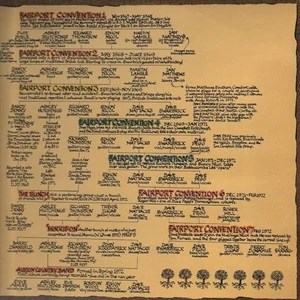
After seeing Fairport Convention at the Top Rank Suite along Silver Street in Doncaster sometime in the early 1970s, certainly before the release of Rosie in February 1973, I picked up this double retrospective LP in an effort to catch up. If I remember correctly, Budgie were playing somewhere else in town and didn’t show up, so we all toddled off to the Rank to experience for the first time, a Folk Rock band, whatever that was supposed to be. I’m pretty sure it was ‘Fairport Convention Mk 6’. Both Sandy Denny and Richard Thompson had left the band by this time, together with Ashley Hutchings, Ian Matthews, Judy Dyble and all. The group photos on the inner gatefold sleeve indicated clearly that there had already been at least six line-up changes before I was ready to swap my electric cricket bat guitar for an electric tennis racquet fiddle and swap the Velvet Underground’s White Light White Heat for Babbacombe Lee, which in hindsight was a mistake. It would be Fairport this and Fairport than for the next few years, culminating in my attendance at the 1980 Cropredy Festival to see my folkie heroes in action once again. Pete Frame’s family tree on the cover, explains how the band had developed, while the songs and tunes within demonstrated how the band’s sound had changed during these formative years, with such songs as “Fotheringay”, “Who Knows Where the Time Goes”, “Crazy Man Michael” and the timeless “Meet on the Ledge”. There was nothing included from the band’s self-titled debut as it was released on a different label (Polydor). Sadly, I tired of Fairport after Swarb left and I’ve never been a die-hard Cropredy goer, though I made the effort in the late 80s, John Martyn & Danny Thompson and Whippersnapper being the main reason for the visit, and once again in 2015 to see Emmylou Harris, but other than that, I’m not interested, certainly not to see four hours of Fairport Mk 375. The magic ended decades ago (for me). History Of remains a superb introduction to the band, and if push comes to shove, if you only have limited space on your shelf, this one alone will probably do. I lost the rosette somewhere along the line, probably while out canvassing for Dave Swarbrick to become an MP, who knows?
061 | Keef Hartley Band | The Time is Near | Deram SML1071 | 1970
I often wondered whether Keef Hartley avoided becoming a household name simply due to the fact that he was the drummer in the band, not the best place for a frontman it has to be said. However, Keef Hartley remains an important figure in the British blues world. Hartley’s band also played at the 1969 Woodstock festival but were not featured in the film, another kiss of death for a band’s potential popularity at the time, in fact Keef’s appearance at the festival is the only one not to appear on any official release. The Time is Near was recorded shortly after their Woodstock ‘experience’ and features none of the songs from their Woodstock set, though some if not most of these songs would have been either written or in the process of being written. The LP came with an LP size sixteen page booklet, which included all the lyrics along with a series of black and white shots of the band in action, either on stage or in the studio. The lengthy title track that closes side one is the album high point, with a strong vocal courtesy of Miller Anderson, along with a fine and fluid guitar solo. Notable for the bands mixture of brass and flute arrangements, the seven selections place the band firmly in the realms of Blood, Sweat and Tears, Chicago and CCS territory, though the album also includes the one sensitive acoustic ballad, “Another Time, Another Place”, which includes Dave Caswell’s D trumpet, reminiscent of David Mason’s famous solo towards the end of “Penny Lane”, a side of the band I would like to have heard more of. It has to be said, it’s the noble Native American imagery on the cover, based on the Appeal to the Great Spirit statue that currently stands before the Museum of Fine Arts in Boston, Massachusetts, set against a yellow prairie sky that caught my attention before the actual music within.
060 | Blodwyn Pig | Getting to This | Chrysalis ILPS 9122 | 1970
The illustration that graces the cover of Blodwyn Pig’s second album could have us thinking they’re a bit of a fun band, The Archies springs to mind, though the familiar Chrysalis butterfly logo probably gives the game away. A quick glance at the reverse of the gatefold sleeve shows the moody quartet in all their hairy intensity; the one in the middle looking very much like what’s his name from Jethro Tull, the other three looking like the Amazing Blondel after a visit to the barbers. The cartoon, apparently created by the band members themselves, suggests the band’s perceived appeal, with an audience made of of a Ted, a couple of greasers, a couple of skinheads, together with a bunch of hippies. I don’t know one single band of the era who could actually pull that off. The musical stylings on the ten selections here are pretty hard driving rocker numbers throughout, the opener “Drive Me” could be Johnny Winter for all intents and purposes, a hard blues complete with a memorable opening riff and jump jiving sax licks, whilst “Variations on Nainos” sounds more like Jethro Tull, possibly due to the flute lippin’, an obvious throwback to earlier days, though the distorted coda seems a little too Captain Beefheart for general consumption. One or two tracks seem a little throw-away, notably the instrumental “The Squirreling Must Go On”, which goes nowhere but noodlesville. The lengthy “San Francisco Sketches”, an opus in four-parts, appears to explore some imaginative jazz territory, with frantic guitar playing courtesy of Mick Abrahams, in several tempos, together with some fine sax courtesy of Jack Lancaster. I think we could have all done without the dreadful “To Rassman”, for obvious reasons.
059 | Tir Na Nog | Tir Na Nog | Chrysalis ILPS 9153 | 1971
I first became aware of the Dublin-based duo Tir na Nogback in 1971 when I heard “Our Love Will Not Decay”, a track included on the double Island sampler LP, which was wittily entitled El Pea, the cover shot featuring a giant garden pea. On this sampler, the duo rubbed shoulders with such diverse acts as Traffic, Jethro Tull, Quintessence, Free, Cat Stevens, Incredible String Band and Jimmy Cliff, which went a long way to emphasise the diversity of the label’s then steadily growing roster. Tir na Nog, whose name translates from the Gaelic as Land of Eternal Youth was made up of Sonny Condell and Leo O’Kelly, who between them created a gentle acoustic sound that might’ve been compared to that of Nick Drake or indeed Pentangle. Produced by Bill Leader, the duo’s self-titled debut was the first of three LPs to be released between 1971 and 1973, each remembered as much for their sleeves as their music, all three featuring close up portraits of the occasionally hirsute duo. Whimsical in places, “Daisy Lady” and “Aberdeen Angus” for example, but also haunting in others, notably on the title song “Tir na Nog”, which features a guest appearance by contemporary folk musician Barry Dransfield on fiddle. Like Incredible String Band, the duo also borrowed from eastern influences, especially on the explorative “Looking Up”, the Tabla guiding the drone-like melody home. The aforementioned “Our Love Will Not Decay” has an Amazing Blondel feel, yet it’s the album opener “Time is Like a Promise” that captures sound of Tir na Noglike no other.
058 | Genesis | Selling England by the Pound | Chrysalis CAS 1074 | 1973

Can you tell me where my country lies? Now there’s a question. Peter Gabriel was throwing out such queries dressed as Britannia long before it was fashionable to do so. The fifth album release by Genesis was probably the most eagerly anticipated at the time as I had just discovered the band through their previous album Foxtrot. Someone (I can’t remember who) suggested I check out “Supper’s Ready”, which I did, becoming a fan overnight. In between going to work and sleeping, Foxtrot dominated my crummy Fidelity Music Master stereo system, the speakers of which I placed two inches away from each ear until I was struck with an epiphany; I purchased a set of headphones. Selling England by the Pound was to follow some months later and I was first in the queue at Bradley’s Records in Doncaster. I don’t want to compare this album with the band’s previous one, as I was besotted with them both for different reasons. “Dancing with the Moonlit Knight” was for my money just as good as “Watcher of the Skies”, though “The Battle of Epping Forest” wasn’t a patch on “Supper’s Ready”. I suppose “You Know What I Like (In Your Wardrobe)” was the album’s most heard record at the time, possibly due to the fact that it was released as a single, which became the band’s first and only chart entry with Gabriel at the helm, but also that a film circulated showing Gabriel mowing a stage with a straw hanging from his gob, while the rest of the band looked on in mild bemusement. Did I mention “Firth of Fifth” or “The Cinema Show”? Outstanding, both. Selling England by the Pound was the penultimate album by the classic line-up of Gabriel, Banks, Rutherford, Hackett and Collins, just one more to go before the band became a different animal. I stuck around for The Lamb Lies Down on Broadway and Trick of the Tail, before giving up and returning to a tunnel-visioned five-year obsession with the Blues.
057 | Man | Back into the Future | United Artists UAD60053 | 1973
Hardly ever talked about these days, the Welsh band Man became a major fixture on the underground rock scene from the late 1960s through the early 1970s, making appearances at all the main underground gatherings and events, whilst rubbing shoulders with the likes of Hawkwind, Edgar Broughton Band and an early incarnation of Brinsley Schwarz, possibly due to their penchant for long extended jam sessions on stage. They liked to play, that’s for sure. Known as a fine live band, popping up on various bootlegs and event albums such as Greasy Truckers Party for instance, their lengthy and unfortunately named “Spunk Rock” taking up the entire first side of the double LP set, with similar jams here on the live sides. The band’s liberal use of synths added to their appeal, certainly on “Just for You” and “Never Say Nups to Nepalese”. Perhaps the most bizarre moment on this double set is the completely out of place “Sospan Fach”, which brings out the unexpected Welsh Voice Choir credentials in the band. “We’ll finish it off in Russian” announces a member of the band, “now join in the oy-oys”. The band return to their lengthy jam mode in the closing “Jam Up Jelly Tight/Oh No Not Again”, recorded at the Roundhouse in London, which takes up the final side, which you may fall asleep to. The gatefold sleeve shows the members of the band suitably attired in Victorian outfits with their gals and kids apparently waiting for a train, whilst the inner photo shows the same railway station, this time deserted and very much in a state of decay. Nice album.
056 | Gram Parsons | GP | Reprise K4422 | 1973
The first time I heard Gram Parsons was probably while he was still with The Byrds, way back in the days when I would pop by Doncaster market to browse the stall that sold ex-jukebox 45s in the late 1960s. I distinctly recall sifting through piles of singles and coming across “You Ain’t Going Nowhere” by The Byrds on the CBS label. As with many bands of the era, my understanding of them developed once I obtained my 1971 copy of Lillian Roxon’s Rock Encyclopaedia, which became my own personal music bible. This led me to the further discovery of the Flying Burrito Bros, though Gram Parsons as a solo artist hadn’t yet been listed. Once I’d absorbed the Flying Burrito back catalogue, I became more impressed with Parsons not only as a singer, but also as an artist responsible for making Country Music cool once again. The Nudie suits worn by the likes of Hank Williams and Porter Waggoner, were redesigned to include Marijuana leaves rather than Wagon Trains and Cactus plants. GP was Gram’s debut solo LP, recorded in Hollywood and released in 1973, for which he surrounded himself with some major players on the country music scene such as James Burton, Byron Berline, Al Perkins and of course, Emmylou Harris. You only have to listen to “Streets of Baltimore”, “She” and “We’ll Sweep Out the Ashes in the Morning”, to become immediately hooked, then realise that mum, with her Hank Locklins and Eddie Arnolds, was listening to the wrong stuff all those years.
055 | Little Feat | Dixie Chicken | Warner Bros K46200 | 1973
Like many UK fans, my introduction to Little Feat came via the Old Grey Whistle Test, where the band performed one of the tracks from this album, “Fat Man in the Bathtub”, together with “Rock and Roll Doctor” from the band’s next album Feats Don’t Fail Me Now. Shortly afterwards, Warner Bros released a cheap sampler LP called The Warner Bros Music Show, featuring a cool Bugs Bunny on the cover, the two Little Feat selections effortlessly stealing the show. Failing to catch the band at the Rainbow around that time remains one of life’s little regrets, though seeing them on the box late one night in the early to mid-1970s, was somehow almost as good. I still have to smile at the thought of this band opening for the Doobie Brothers! The Dixie Chicken-era Little Feat was still very much led by Lowell George and therefore having within their ranks one of the finest and most soulful voices of the 1970s, if not the entire history of rock and roll, as well as one of the hottest slide players around, much of this confirmed throughout Dixie Chicken (or are we expected to just call it ‘Chicken’ these days?). This was another record I discovered in Paul’s box by the Dansette, sitting right next to the band’s previous LP Sailin’ Shoes. Once again the sleeve artwork was produced by Neon Park, an artist the band would use time and again. This third album also saw the departure of original bassist Roy Estrada, who was replaced by Kenny Gradney as well as the addition of Paul Barrere, who would become a key player in the band for years to come. The album also featured contributions by both Bonnie Bramlett and Linda Ronstadt as well as Malcolm Cecil, the synth pioneer responsible for Tonto’s Expanding Head Band and his work on some of Stevie Wonder’s finest albums. Essential listening.
054 | Uriah Heep | Sweet Freedom | Bronze ILPS 9245 | 1973
The first time I heard the name Uriah Heep was at school, whilst flicking through the pages of David Copperfield in class, when all I really wanted to do was to get back to my well-thumbed copy of Hell’s Angels by Hunter S Thompson. Sometime in 1969, when Dickens was becoming popular again, it being the one hundredth anniversary of the writer’s death, a bunch of reprobates from Brentford, Essex chose to name their band after this character, whilst creating a din that would soon be labelled Heavy Rock. The opening song on their debut album Very ‘Eavy, Very ‘Umble (I see what they did there), “Gypsy” was a staple at the Top Rank prog night, with its memorable organ intro, which would then inevitably lead into one of the most iconic guitar riffs in the whole of Rock, which went something like, duh duh duh du-duuh. It was a good start. Sweet Freedom came out a little later of course, in fact just three years later, even though it was their sixth album release, which I imagine would’ve rendered the band ‘prolific’. This album opens with the frantic “Dreamer”, which hits the listener with some urgency, yet it has to said, it ain’t no “Gypsy”. In a way, after six album releases in just three years, it began to look like the band were just chucking albums out and quality probably became less of a concern. After the hard rock guitar riffs courtesy of Mick Box and the squealing vocals of David Byron, both original members, “Circus” comes as a surprise, a rare acoustic-based ballad, which pointed towards a new direction for the band to take, though it was followed later on by the album closer “Pilgrim”, which is operatic in its drama. Each of the band’s previous album releases were wrapped in arty sleeves, one of which was in the form of an actual mirror, inviting the listener to look at themselves. Sweet Freedom is dull in comparison.
053 | Eric Clapton | Rainbow Concert | RSO 2394 116 | 1973
It was Pete Townshend who coaxed Eric Clapton back to the stage after a couple of years away, Clapton last seen holding a guitar on stage at George Harrison’s Concert for Bangladesh in 1971. Heroin had taken over the guitarist’s life and ultimately his stage appearances, which had become impossible, despite Clapton’s popularity on record, with one or two compilations having been released in that period of inactivity. The two concerts were staged at the famous Rainbow Theatre in Finsbury Park on 13 January 1973, and one or two guests had been invited along to help their old friend return to the spotlight, including Ronnie Wood, Steve Winwood, Rick Gretch and Jim Capaldi. The original LP featured just six tracks, “Badge”, “Roll it Over”, “Presence of the Lord”, “Pearly Queen”, “After Midnight” and “Little Wing”, which were perfectly representative of the much larger concert, though a later remastered edition was released on CD, with several more songs from the two concerts, including “Layla”, “Bell Bottom Blues” and “Crossroads” amongst others. It seems a little strange now to listen to this LP, knowing that the concert originally opened with an introduction to Eric Clapton and the Palpitations, followed immediately by the full version of “Layla”. Clapton would go on to enjoy a successful solo career almost immediately after his return to the stage. On a negative note to an otherwise superb live album, the sleeve design is poor, not even trying.
052 | Allman Brothers | Brothers and Sisters | Capricorn CAP 47 507 | 1973

I pledged to play the sprawling instrumental “Jessica” on repeat until the end of time after first hearing it in 1973, which in reality lasted for no more than a few days before I broke this pledge by returning to my Steve Miller records. Having the tune later associated with the Top Gear TV show did little to rekindle my initial love of this Dickie Betts tune, which is said to be a tribute to the guitar genius Django Reinhardt. The album from which “Jessica” comes, is the band’s fourth album release and the first album without the late Duane Allman who was killed a couple years earlier. With a memorable sleeve, featuring a couple of kids, presumably a brother on the front and a sister on the back, with what looks like the entire family, or several families, on the inner gatefold, Brothers and Sisters remains a favourite in the Southern Rock genre. Dedicated to a brother, not Duane in this case but in fact Berry Oakley, who died in similar circumstances as Duane, both involving motorcycles in roughly the same location, the album also features the easily accessible country influenced “Ramblin’ Man” and a fine country blues “Pony Boy”, which closes the album, the only track to feature neither of the Allman siblings. I first discovered this album in Paul’s cardboard box, by the Dansette, circa 1974, after a theatre group rehearsal. I associate it with sunshine, amateur dramatics and one of Ian’s wife’s curries.
051 | Syd Barrett | Syd Barrett | Harvest SHSP 4041/2 | 1974
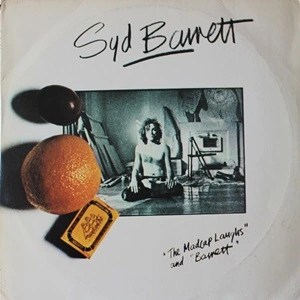
Syd Barrett is a double LP set made up of straight re-issues of the former Pink Floyd guitarist’s two previous solo albums, both initially released in 1970. Unlike other reissues of the period, notably those released on the Fly record label (Tyrannosaurus Rex, Joe Cocker, Procol Harum), The Madcap Laughs and Barrett have been repackaged rather than stitched together, the result being a newly designed Hipgnosis gatefold that features several snaps of the man himself and a few press clippings, scattered on a wooden floor, not unlike the one featured on the original Madcap sleeve, albeit unpainted. The orange, plum and matchbox had some acid significance to the singer, so it seemed appropriate to include them. When Harvest released the two original albums, no one was quite sure what direction the unpredictable Barrett was likely to take, though by 1974, it was looking like these recordings would be his lasting legacy, the artist being pretty much unfit for purpose by then. The songs on Madcap are essentially demos, in that some of the false starts, between-song dialogue and various cock-ups are left in, in fact on one song we hear the singer turning the page mid-song, that sort of thing. The guitar strumming on the opening song “Terrapin” is pedestrian, though the voice carries the song nicely to the end, whilst some of the numbers are helped along by members of Soft Machine, whilst ex-bandmates Gilmour and Waters were on hand to help the production along (that’s when the two were speaking of course). There are one or two whimsical moments, notably “Love You” and “Here I Go”, but the standout has to be “Octopus”, with its surrealistic lyricism and sharp offbeat melody. The second disc, originally titled Barrett appears a little more together, though the songs are not quite as strong as those on its predecessor.
050 | Jess Roden | Jess Roden | Island ILPS 9286 | 1974
Jess Roden might be going places, or so the sleeve photo suggests, with the singer making himself comfortable on a suitcase, albeit barefoot, so probably not. The British singer songwriter’s debut solo album, released after stints with the Alan Bown Set, Bronco and the Butts Band, reveals a soulful voice and a spirit for adventure. It’s easy to enter Roden’s world, with nothing here to tax the system, his confident voice equally at home with falsetto as it is straight up, not least on the drifting “Feelin’ Easy”, or indeed “Ferry Cross”. The horns add texture throughout the album, courtesy of the New Orleans Horns conducted by co-producer Allen Toussaint (the other producer being Island boss Chris Blackwell). One or two Island label mates even come out to play, Free’s Simon Kirke and Rabbit Bundrick for example. With some strong vocal performances, “Sad Story” for instance, reminiscent of where Robert Palmer would take his solo career after leaving Vinegar Joe, Roden fully investigates his musical chops throughout. Even the seven-minute Leiber/Stoller classic “On Broadway” is treated to a funky arrangement, complete with lush strings, again confirmed by Toussaint’s highly capable credentials. “Trouble in Mind” has another full-on New Orleans arrangement, reminiscent of one or two tracks included on Lowell George’s solo album released a few years later. A fine debut.
049 | Sassafras | Expecting Company | Polydor Super 2383 245 | 1973
From the first note of “Electric Chair”, we find ourselves in 1970s rock guitar riff territory, and as far as 1970s rock guitar riffs go, this ain’t a bad one. Named after a North American tree, Sassafras was a five-piece band from South Wales, whose guitarists Dai Shell and Ralph Evans, did what Andy Powell and Ted Turner set out to do in the original line-up of Wishbone Ash, with their sparring twin guitars being the band’s signature sound. Formed in 1970, Sassafras was actually slightly different to Wishbone Ash in that they moved slightly more towards a Country sensibility, notably on “Busted Country Blues”, the lead guitars adopting something of an Albert Lee flavour, evidence of which can be found in archive footage of the band performing the song on the popular music show, the Old Grey Whistle Test, around the time of the album’s release. Likewise, the slightly dodgy “School Days”, the track that opens side two, is fronted by a tambourine-totin’ Terry Bennett, whose frontman status is brushed aside toward the end in favour of some of Dai Shell’s more Camel-esque guitar noodling. The album has one or two tender moments, with fine vocal arrangements that interweave with the noodling to good effect, notably on “Across the Seas of Stars”. The album is dressed in a sleeve with a strange Miss Havisham feel, her wedding cake untouched and cobwebbed, and the expected company running slightly late.
048 | Supertramp | Crime of the Century | A&M AMLS68258 | 1974
Considered by many to be Supertramp’s breakthrough album, helped along in no small part by the release of the single “Dreamer”, the band’s most commercially successful song up to this point, only surpassed later in the UK by “The Logical Song” and “Breakfast in America” in terms of sales and chart positions. The single also included another album highlight “Bloody Well Right” on the flip side, which would’ve made a good follow-up single had it not been for the multiple utterance of the word “bloody” which might have given Simon Bates a nose bleed. The band had already been around for four years by the time of the release of Crime of the Century and had failed in terms of album sales and ticket sales. They needed a break and this was it, a successful album that would lead to bigger venues, bigger audiences and worldwide success. Going through several personnel changes along the way, it was Rick Davies and Roger Hodgson who managed to transform the band’s fortunes, coming up with eight memorable songs in the process, including the album’s opener “School”, its high lonesome harmonica signalling immediate change. It was back to school, back to the drawing board, the result being to transform the band into a key outfit in the pre-Punk, Post-Prog generation. It was Prog for the pop generation of the early 1970s, later brought to full fruition with the release of the following album releases Crisis? What Crisis? (1975) and Even in the Quietest Moments (1977) before landing the big one Breakfast in America before the end of the decade. The album also contains such memorable songs as “Hide in Your Shell” and the climactic title song closer.
047 | Steve Ashley | Stroll On | Gull GULP 1003 | 1974

It’s a wonder that Steve Ashley isn’t so much better known on the general music scene; perhaps there were too many musicians at the Folk Rock game in the early 1970s to stand a chance. Linked to the ever-diminishing Fairport crowd, with several appearances on that drizzly Oxfordshire stage over the years, Ashley’s potential was obvious upon the release of this, his debut album, released in the spring of 1974, though recorded three years earlier. Predominantly self-penned, with a couple of non-originals, the traditional “Lord Bateman” and a song from the pen of poet John Donne, Stroll On maintains an atmospheric feel throughout, largely due to Robert Kirby’s string arrangements, the bloke who did Nick Drake’s orchestrations around the same time. Members of the London Symphony Orchestra can be heard, notably on such songs as “Spring Song”, “Follow On” and the aforementioned “John Donne Song”. The album is worth investigating if only for the superb “Silly Summer Games”, one of the album highlights. Even Anne Briggs included the opening song “Fire and Wine” on her seminal LP The Time Has Come, recorded around the same time. Wrapped in a sleeve reminiscent of a Rousseau, with foliage-a-plenty and several furry friends, the painting also sees our hero dressed in all the then current hippie garb, notably the Afghan coat and patchwork loons, with a list of key figures from the Folk Rock world, notably Hutchings, Mattacks, Nicol, Pegg, Dransfield and Danny Thompson. Stroll On captures a moment in time and makes a fine addition to any record collection, certainly this one!
046 | Traffic | When the Eagle Flies | Island ILPS 9273 | 1974

As a viable band, Traffic was perhaps reaching its sell-by date by the time this, their seventh album, was released. This doesn’t mean it’s a bad album, perhaps meandering in places, but still essentially Traffic. The core of the band being Steve Winwood, Jim Capaldi and Chris Wood, with Rosko Gee coming in on bass and Rebob Kwaku Baah adding percussion, as he had on the band’s previous couple of albums, The Low Spark of High Heeled Boys and Shoot Out at the Fantasy Factory. All the songs are jointly written by Winwood and Capaldi, except for the eleven-minute “Dream Gerrard”, which has the feel of a sprawling Fela Kuti opus, albeit with surreal lyrics courtesy of Viv Stanshall, you know, ‘Hippos don’t wear hats, lobsters shriek if provoked’ sort of stuff. The synthesiser is prominent throughout the album, notably on “Graveyard People”, a new addition to Winwood’s musical arsenal. One or two of the songs sound a little throwaway, though the autobiographical “Memories of a Rock & Rolla” has its moments. Despite the band’s move into jazz territory, it was probably too late for any further ventures and each of the musicians went their separate ways before the year was out.
045 | Crosby Stills Nash & Young | Déjà vu | Atlantic 2401001 | 1970
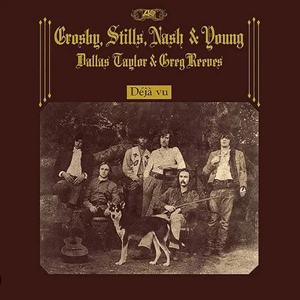
By the time they got to Woodstock, they were half a million fans richer, their memorable set at the festival indelibly marked on the collective hippie consciousness, with acoustic guitars a-plenty, not to mention an abundance of weed, the odd South American poncho and a new word, “shitless” being the order of the day. After such an impressive self-titled debut, created by what everyone agreed to be the perfectly formed unit, with three of the most in-tune, dove-tailed and utterly suited harmony voices on the scene, some might have questioned why they should even consider bringing in a fourth member. Enter Neil Young, genius of this parish, an artist anyone in their right mind would want in their band, not least for the standard of his songs. On this album though, there are but two, one on each side, “Helpless” being the most memorable. With Young around for only half of the album, it feels like it was perhaps the perfectly-formed trio of CSN with a special guest, rather than it being a new and complete band. With the album being prepared and recorded and ultimately released during the turbulent atmosphere of the late Sixties and early Seventies, the ‘scene’ was already beginning to sour. The peace and love of Woodstock landed in-between the horrors of the Tate-LaBianca murders and Altamont killing, with Stephen Stills even losing his temper on camera at the Big Sur Festival for all to see, all within a few months of one another. These small socio-political details aside, Déjà vu remains a superb album and a valuable record of its time, not a time when it was really cool to even consider almost cutting your hair.

044 | Steeleye Span | Below the Salt | Chrysalis CHR 1008 | 1972
By the time of their fourth album, Steeleye Span had already shed two line-ups, recruiting both Rick Kemp and Bob Johnson to serve as the new rhythm section of bass and drums respectively. Original founder member Ashley Hutchings was probably the most noticeable absentee on Below the Salt, closely followed by Martin Carthy, who had both gone off to do other folky things, something the two had been doing for quite a while already. The album has the usual complement of traditional songs and tunes, collected from this, that and the other over the last few centuries, treating them all to some good ol’ rock ‘n’ roll instrumentation. For the cover, the band members of Maddy Prior, Tim Hart and Peter Knight, together with the aforementioned Kemp and Johnson and an assortment of friends and kids enjoy a candle-lit medieval banquet, which effectively mirrors the music within. Below the Salt is quite a listenable album when all’s said and done and perhaps it ought to come out more often, especially at Christmas, where the a cappella “Gaudete” can come out and play, albeit rather annoyingly mixed as a fade in, fade out affair rather than the much more user friendly single version, which bizarrely made it to number 14 on the British singles chart. The album also includes a reading of “John Barleycorn”, but if you’ve heard Traffic’s version of the song, then it soon becomes very much forgotten, or should I say, it does in our house.
043 | Stone the Crows | Ontinuous Performance | Polydor | 1972

Maggie Bell was pretty much accepted as the Scots answer to Janis Joplin, her forceful and determined vocal prowess dominating just about everything Stone the Crows touched in their short existence as a band, between their formation in late 1969 to their break-up in the summer of 1973, a year after the death of their guitar player Les Harvey, brother of the legendary Alex Harvey, who was electrocuted on stage during one of their shows in Swansea. Fellow Scot Jimmy McCullough stepped in to take over from where Harvey left off, and appears on a couple of the songs here. Produced by Peter Grant, yes that one, Ontinuous Performance was the band’s fourth album release and indeed their swansong. I remember seeing the band at the Sheffield City Hall on what would become their farewell tour, though they probably didn’t know it at the time, where much of this album was performed. The songs on this album were largely originals, though there is the one notable non-original, the band’s reworking of the old Sonny Terry and Brownie McGhee favourite “Penicillin Blues”, which brings out the best in Bell’s tormented soulful bluesy voice. If Janis’s voice could strip paint, then Maggie’s could grate cheese. “Niagra” is a bit of a letdown, a bog standard rock and roller that should have stopped after three minutes but persisted for another six. As would be expected, the album was dedicated to Les Harvey and included a heart-felt tribute in the final song “Sunset Cowboy”, a piano-led ballad that effectively served as the band’s actual swansong.
042 | Hawkwind | In Search of Space | United Artists UAG 29202 | 1971

Released in the so-called year of the rock album, In Search of Space, sometimes referred to as X in Search of Space, the ‘X’ often missed due to a rainbowed ear wing getting in the way in Barney Bubbles’ cover artwork, fits in perfectly alongside other such gems released in 1971, a legendary year in music. I must have bought this album shortly after its release, possibly in early 1972, as I remember waxing lyrical about it to largely disinterested revellers at the Silver Link pub along Bradford Row, which was my choice watering hole in the town, years before my age would legally allow me to be in such an establishment. I confess, the first time I heard the opening track, the fifteen-minute “You Shouldn’t Do That”, via a new set of headphones I’d bought to go with the record, it almost scared me to death. I don’t recall being aware of the term Space Rock at the time, though I’m sure it had already been coined, possibly during the early Pink Floyd days, yet on this album, the word Space pops up in the title of the LP and in the space age effects that dominates each of the tracks, though any reference to actual space is absent, save for it being suggested in “Master of the Universe”. “Silver Machine” was yet to hit our screens via Top of the Pops, this was all to come shortly afterwards, but I was still basking in the starlight haze of “Master of the Universe” and “You Know You’re Only Dreaming”, not to mention the strangely appealing and largely improvised “Adjust Me”, a world that only seemed to exist between the two yellow padded headphone speakers. I don’t think dad would’ve approved had I introduced this sort of sound to the household and all of its inhabitants at the time. Sadly, like many bands of the era, it all ended in chaos, calamity and court rooms.
041 | Joan Baez | Come from the Shadows | A&M AMLH 64339 | 1972

The noted American folk singer shifts gear here, by moving from her long-serving label Vanguard to the more mainstream A&M, for this her thirteenth studio album. Made up primarily of her own self-penned material, Joan ventures into the work of such contemporary writers as John Lennon, with her reading of “Imagine” and her own sister Mimi Fariña, whose “In the Quiet of Morning” was written for the late Janis Joplin, who left the world a couple of years earlier. Reflected by the cover image of an elderly couple in the process of being arrested by police during a street protest, politics continues to be a strong contributing factor behind Joan’s work, most notably with the inclusion of “The Partisan”, based on a French anti-fascist anthem. The second side opens with a song written for Bob Dylan, in which Joan sends an open invitation to her old pal, for him to return to the cause; “.. we’re still marching on the streets, with little victories and big defeats, but there is joy, and there is hope, and there’s a place for you”. All these years on and I still don’t think Dylan feels any regret for abandoning the ranting activism of the protest movement. In the sleeve notes, she warns us all “If you don’t fight against a rotten thing you become a part of it.” Recorded in Nashville, Come from the Shadows met with critical disdain, though I feel there are one or two agreeable moments here, certainly the opening “Prison Trilogy” and the hymnal torch song “All the Weary Mothers of the Earth”.
040 | Wishbone Ash | Argus | MCA MDKS 8006 | 1972

Rock journalists seem to frown upon any mention of Wishbone Ash, yet I make no apologies for admiring the band greatly, a band I first heard on John Peel’s late night radio show back in 1970, when the noted arbiter of taste played the memorable guitar riff to “Lady Whiskey”, a track from the band’s 1970 eponymous debut. A couple of years later, this admiration grew exponentially after hearing the band’s third album Argus, which soon became something of a ‘must have’ item back in the early 1970s for any self-respecting rock fan, an album chock full of highly melodic rock classics that would continue to make up the bulk of any Wishbone Ash set list for many years to come, some of those gigs I was only too pleased to attend, which ever Wishbone Ash happened to be operating at the time. Fall-outs, punch-ups, lawsuits aside, there’s still no sound quite like the sound of Wishbone Ash, though my personal preference will always be for the band’s first line-up and their first four albums, this one being perhaps the band’s crowning achievement. The steady build that takes us into “The King Will Come” is worth the price of the album itself, though we mustn’t forget the mighty “Throw Down the Sword”, the bold “Warrior” or the infectious rock riffery of “Blowin’ Free”. Furthermore, those clever Hipgnosis chaps were at it again with the memorable sleeve design which shows the aforementioned warrior standing guard over a misty landscape as a flying saucer hovered above. I was young, when this sort of thing mattered.
039 | Genesis | Foxtrot | Charisma CAS 1058 | 1972
I always thought that I might have come a little late to the Genesis party, Foxtrot being the first record by the band to be added to my burgeoning LP collection back in 1972. The band’s fourth studio album, recorded by the classic line-up of Peter Gabriel, Tony Banks, Mike Rutherford, Steve Hackett and Phil Collins, contained one of the band’s most ambitious pieces, the sprawling twenty-three minute “Supper’s Ready”, which appeared in seven parts on the second side, each part linked with intriguing key changes, sound effects and at one point a station master’s whistle. All change indeed. Gabriel was already used to the quick change of costume, yet his most daring and confusing was the red evening dress and a fox head, which is depicted on the front cover of this album, one of Paul Whitehead’s pictorial creations, in fact his last for the band. The lyrical and musical complexity of this piece alone would no doubt have had student fans writing their dissertations on its meaning, had there been such a course back then, whereas I was happy to just let the experience flood over me as an impressionable 14 year-old. Curiously, despite the extravagance of “Supper’s Ready” or indeed the opening track, “Watcher of the Skies”, for which Gabriel wore a pair of bat wings on his head, I always seem to head straight for the largely dismissed “Time Table”, a rare Genesis ballad, written by Tony Banks, which effortlessly takes me to another time, another place.
038 | Jonathan Kelly | Twice Around the Houses | RCA Victor SF8262 | 1972
Twice Around the Houses is one of those records in my collection, that I have no recollection at all of when, where or upon which piece of record playing equipment I first heard it. All I know is that it seems to have been there forever, bringing with it a sense of sheer joy. Jonathan Ledingham set out on his musical journey from his home in Drogheda, County Louth, way back in the 1960s, whilst changing his name to Kelly and first playing in a folk rock outfit under the unlikely moniker of Humpy Bong. He then went on to enjoy a fruitful career travelling up and down the country on the British folk circuit, becoming a popular and engaging performer, whilst releasing five albums in just over five years, from his 1970 self-titled debut to the 1975 swansong LP Two Days in Winter. His second album release Twice Around the Houses is considered by many to be his finest, not least for the inclusion of such outstanding songs as the haunting “Ballad of Cursed Anna”, the enchanting “Sligo Fair” and the beautifully melodic pop opener “Madeleine”. Though I don’t remember the circumstances of how I came upon this record, all those memories lost in the mists of time, I do remember very much wanting to look like the man on the cover and soon took to wearing a black overcoat, a tartan scarf around my neck and a copy of the Yorkshire Post stuffed in my pocket. Unfortunately, this had the same result as my fruitless endeavours to look like Al Pacino in Serpico, which was essentially, to fail miserably.
037 | Amazing Blondel | England | Island ILPS9205 | 1972
I first became aware of the Amazing Blondel’s England LP when I saw it languishing in the window of Ken’s Swap Shop on St Sepulchre Gate in Doncaster back in 1972 and I decided there and then that it would have to be mine, and that’s before I’d even heard what they sounded like. After climbing over various junk shop debris in order to reach this item, unsuccessfully I hasten to add, I troubled the proprietor to negotiate the hazardous window area himself, in order to salvage this LP from the sun’s rays, whilst simultaneously holding my breath (who says men can’t multitask?). The place stank of pee. I held the LP close as I offered him a one pound note in exchange for the record. I then ran the short distance home, lifted the lid of my crummy Fidelity twin speaker affair, placed the needle on the grooves, laid back on my bed and read every single word printed on the inner gatefold sleeve; simultaneously, I entered an entirely different world. This album features such notables as “Dolor Dulcis (Sweet Sorrow)”, “A Spring Air” and the “The Paintings” suite. They remain one of my favourite bands, despite having been lumbered with the wildly inaccurate supposition, that they were the worst band ever to play Glastonbury (the first), but there again, they do have a crumhorn in their musical arsenal, so it probably serves them right.
036 | Jack Bruce | Songs for a Tailor | Polydor 583 058 | 1969
After the break-up of the short-lived so-called supergroup Cream, and the formation of Blind Faith, in which his erstwhile bandmates Clapton and Baker found themselves, bassist Jack Bruce had time on his hands to record two solo albums, this being the second, though curiously the first to actually be released. Songs for a Tailor continues Bruce’s collaboration with lyricist Pete Brown and is named for the designer of Cream’s trendy clobber, one Jeannie Franklyn, who had recently been killed in the fateful road accident that also took the life of Fairport Convention’s drummer Martin Lamble; Jeannie was at the time of the crash, the girlfriend of Lamble’s bandmate Richard Thompson. Here, Bruce returns to his jazz roots in places, notably on the opening song “Never Tell Your Mother She’s Out of Tune”, a song allegedly about guitarist Chris Spedding’s mum, which features a strong brass element, courtesy of Harry Becket and Henry Lowther on trumpets, Dick Heckstall-Smith on tenor sax and Art Themen on soprano sax, whilst noted jazz drummer Jon Hiseman keeps the beat. The quiet Beatle apparently plays guitar somewhere on this particular song and then disappears for the rest of the album, presumably to do ‘end of the Beatles’ stuff. Some of the songs seem a little over-fussy, certainly “Weird of Hermiston”, which starts well enough, though becomes more laboured as the two minutes plod along. The same could possibly be said for “Rope Ladder to the Sun”, which struggles to find a recognisable melody, or perhaps it’s just jazz? Neither one of these numbers is “White Room” exactly. The album is possibly best remembered though, for “Theme for an Imaginary Western”, a beautifully melodic song, for which Bruce adds both piano and organ to his familiar bass and delivers a brilliantly soulful vocal performance
035 | Frank Zappa | Chunga’s Revenge | Bizarre 2030 | 1970
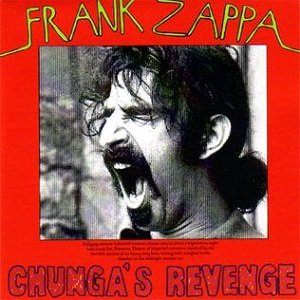
Frank Zappa’s third solo album was released in October, 1970, and was the first to feature both Mark Volman and Howard Kaylan of The Turtles fame, otherwise the ‘Phlorescent Leech and Eddie’, who make their appearance on “Road Ladies”, after a reasonably satisfying opener, “Transylvania Boogie”, which even at five minutes long, seems far too short. The bluesy “Road Ladies” sounds live enough, with some blistering blues licks and vocals shared between Zappa and Kaylan and Volman, though whereas this song sounds live, “The Nancy and Mary Music” is in fact a live performance, recorded at Tyrone Guthrie Theatre in Minneapolis, and features some of Zappa’s most inventive guitar playing thus far, interspersed with some of Flo and Eddie’s highly irritating vocal shenanigans. You tend to want them to just zip it. “Would You Go All the Way” indicates the direction Zappa’s music was heading at the time, which would soon change from the brilliant satire of the Mothers to bawdy nonsense of Flo and Eddie. There are some fine moments here though, not least the title track, which features Zappa at his best, with some sneering sax wah-wah courtesy of Ian Underwood. Wrapped in a vivid red cover with Zappa either screaming or yawning (I’m undecided), Chunga’s Revenge demonstrates a change in direction from Zappa’s earlier Mothers albums and indeed his two previous solo albums Lumpy Gravy (1967) and Hot Rats (1969).
034 | Led Zeppelin | Led Zeppelin III | Atlantic 2401 002 | 1970
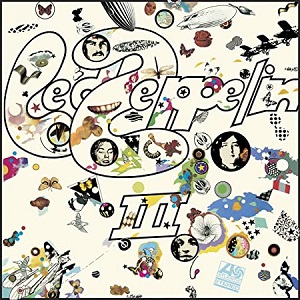
Led Zeppelin’s second album was in fact the second LP I bought while still at school, a record that swiftly joined my prized Jimi Hendrix Experience Smash Hits, which was up until this point, sitting alone on the shelf above my Dansette. For a period, Led Zeppelin II became my favourite LP and marked the beginning of a long standing love affair with rock music. I immediately became aware that there must be a predecessor, simply due to the number in the title, and I was at the time, eagerly anticipating the release of their untitled fourth album, which was just around the corner, in fact I had it on order. Sandwiched in between these two albums was the band’s curious third, which few fans at the time loved, liked, cared for or indeed understood. The hard driving rock of “Whole Lotta Love” and “Heartbreaker” had been replaced by folk influenced acoustics, even at one point name-checking Roy Harper in one of the songs. Jimmy Page was known to have ‘borrowed’ from folk music, notably Bert Jansch on the band’s first album (“Black Mountain Side”) and was at it again on this LP too, looking towards Leadbelly to borrow and rework “Gallows Pole”, whilst Robert Plant supplied some sensitive childhood memories on “That’s the Way”. Perhaps the most memorable aspect of Led Zeppelin III, was the clever psychedelic artwork, which consisted of a revolving disc concealed within the sleeve, with ever changing figures and motifs peeking through small circular windows, giving us all something to play with as we listened.
033 | Mott the Hoople | Mad Shadows | Island Records ILPS 9119 | 1970

Mott the Hoople’s ‘difficult’ second LP turned out to be possibly the band’s best album in retrospect. Legend has it that its original title was going to be Sticky Fingers but messes Jagger and Richards beat them to it with their own album release, which the Rolling Stones were working on in the studio next door. Mad Shadows was their second choice of title, a term borrowed from a poem by Baudelaire, which was perfectly matched by the monochrome artwork. Like most of the albums that were discovered around this time, it was through the sampler format that I first became aware of both the album and the band, in this case the double Island compilation Bumpers. I first saw the band in the early 1970s, when they were riding high on the success of their hit single “All the Young Dudes” and I couldn’t help noticing that things were rapidly changing in rock music. I distinctly recall Ian Hunter’s on-stage proclamation, “There’s only two rock and roll bands in the world, the Rolling Stones.. and us!”, which was probably not actually the case. During that gig at the Top Rank in Doncaster, I called for the song “Thunderbuck Ram” in a sort of squeaky teenage pleading voice, the song being the opening song to this album, and also the song that appeared on the Bumpers compilation, whereupon the bloke standing next to me, dressed from head to foot in Bacofoil, leaned over and said “Oh they won’t be playing that honey, they’ve definitely moved on”. He was right of course, the band had already adopted all the traits of Glam Rock and the Mad Shadows era was over.
032 | Country Joe & the Fish | Together | Vanguard VSD 79277 | 1968

The first seven minutes of Country Joe and the Fish’s third album release, Together, is taken up with a tribute to Soul legend James Brown, a lengthy tempo-changing number, dressed as a sweaty mock-live performance, complete with screaming girls, as if it were performed at the Apollo back in 1963. Towards the end of the track, “Rock and Soul Music”, the band conclude with the now familiar song that they later played at the Woodstock Festival, albeit a shortened version, which in turn appeared on the triple LP set, coming in just prior to Jerry Garcia’s sardonic announcement, “Marijuana, exhibit A”. The sound remains pretty much the sound of San Francisco, with elements of the Dead and the Airplane throughout, plus the twangy lead guitar, courtesy of David Cohen. Notably, the album, produced by Samuel Charters, known for his extensive writing on early jazz and blues music, focuses more on the band as a collaborative unit, rather than concentrating predominantly on Country Joe, as was the case in the band’s previous two releases, Electric Music for the Mind and Body and I-Feel-Like-I’m-Fixin’-to-Die, both released the previous year, with the largely instrumental “Cetacean” encapsulating the sound of ’68 in just under four minutes. Together is marginally powerful, sometimes political and often playful, “The Harlem Song” being a fine example of this. Despite its title, Together was anything but, the band fragmenting even before the album’s release, though a version of the band managed to take to the stage in Bethel the following summer.
031 | Fleetwood Mac | Mr Wonderful | Blue Horizon 7-63205 | 1968

Once you get over the tired old debate of which was the best version of Fleetwood Mac and accept that each era stands up on its own merits, then you can enjoy the outfit that effectively led the way during the British blues boom of the mid 1960s, the stadium rock of Rumours and those bits in between, throughout the early to mid-1970s. There’s no debate really, they are three entirely different bands save for the rhythm section for which each band was named, Mick Fleetwood and John McVie. I quite enjoy popping on Rumours from time to time, but my heart remains faithful to those blues rascals led by the quite brilliant guitar player Peter Green, who provided us with some of the most memorable songs and tunes of the late 1960s, including “Oh Well” (both parts), “Albatross” and the gorgeous “Man of the World”. Their second LP release Mr Wonderful, sees the band steeped in their blues roots, entrenched in the sounds of 1950s Chicago, with such raw originals as “Stop Messin’ Around”, “Rolling Man” and the Elmore James inspired “Need Your Love Tonight”, not to be confused with the later “Need You Love So Bad”. Though slightly slower, but basically the same tune, Elmore James’ classic “Dust My Broom” makes an appearance mid-way through the first side, which provides further authenticity. The same could be said for “Doctor Brown”, once again making good use of Jeremy Spencer’s busy bottleneck guitar, whilst Green’s superb lead perfectly complements the overall sound. Perhaps the most memorable aspect of this release though, is not specifically the music, but the sleeve, the sort of thing you might get away with in the more permissive late Sixties, a full frontal Mick Fleetwood, all six foot six of him, wearing just a hat, some leaves, and a look of apparent bewilderment, or could that be a stray thorn?
030 | The Hour Glass | The Power of Love | Liberty LBL83129E | 1968
The distinctive voice of Gregg Allman permeates the dozen songs included on this, the band’s second and final studio album, released in the spring of 1968. Produced by Dallas Smith, The Power of Love perhaps points in the general direction that the soon to be established Allman Brothers Band would take, with the release of their own self-titled debut almost two years later in November 1969. The Hour Glass, which also featured Gregg’s brother Duane on guitar, rubbed shoulders with such bands as The Doors and Buffalo Springfield on the LA scene, Neil Young even providing the sleeve notes on this album. “I first saw the Hour Glass at the Whisky a Go-Go in Hollywood. They were together then too” wrote Young, while a succinct Stephen Stills added “Witnessed and approved”. With White Soul written all over this album, Gregg provides a convincing vocal delivery, whilst brother Gregg demonstrates his chops, certainly on “Down in Texas” and “I’m Not Afraid”, each solo signalling what was to come. Perhaps the most unusual track on the album is the band’s instrumental reworking of Lennon McCartney’s “Norwegian Wood”, featuring Duane’s electric sitar, a moment of pleasant psychedelia. With a random order track listing printed on the reverse of the sleeve, together with a rough sketch of the five band members, which suggests Gregg as the leader, The Power of Love is a must for those who went on to collect all the subsequent Allman Brothers records over the next couple of decades.
029 | Aretha Franklin | Aretha Now | Atlantic SD8186 | 1968
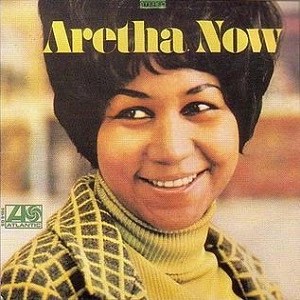
The first time I heard the voice of Aretha Franklin, it was probably the song “I Say a Little Prayer”, which reached number four in the UK charts back in 1968, though the first Aretha single I actually bought was “Spanish Harlem”, from a stall on Doncaster Market around 1971, when I was still doing my best to avoid school. Aretha Now was released in 1968 and still stands up to this day. The opening song “Think”, despite its short two and a bit minutes, demonstrates precisely why some of us think of Aretha as the greatest of all female soul singers, in fact the greatest soul singer period. Aretha Now sounded good when I first bought it back then, and it sounded just as good when I popped it on the turntable yesterday. If “Think” gets the LP off to a good start, the song is swiftly followed by the aforementioned “Say a Little Prayer”, written by Bacharach and David, a staggering performance, which could be seen as Aretha exercising her Gospel chops, in a brand new way. It’s a fine mixture of Gospel, Soul and bedsit cool. The bluesy “Night Time is the Right Time”, the longest cut on the album at almost five minutes long, allows the band to stretch out a little, with some fine keyboard fingering courtesy of Aretha herself, rather than Spooner Oldham who takes care of that department for most of the album. Produced by Jerry Wexler with Tom Dowd at the desk, Aretha Now finds itself out of the sleeve and on the turntable quite a lot lately, and so it should.
028 | Dusty Springfield | Dusty in Memphis | Mercury 5707137 | 1969

Dusty’s voice was one of the first female voices I ever heard emitting from the old teak radiogram back in 1962, when I was just 5 years-old. “Island of Dreams” was one of mum’s most played 45s around the house at the time and one that resonated with me, especially the optimistic chorus, “high in the sky is a bird on a wing, please carry me with you, far far away from the mad rushing crowd, please carry me with you”, which was pure escapism for a kid who had no inclination of washing his neck or eating onions, or indeed sticking around Hexthorpe for too long. I desperately wanted to be on that bird’s wings. If the Springfields’ folky song filled my childhood dreams with hope, then hearing that same voice eventually mature into what we were to hear just six years later was nothing short of staggering. Dusty in Memphis is one of those albums largely ignored at the time of its release, only to be picked up on much later, though “Son of a Preacher Man” had long been a favourite. It’s with little surprise that many still consider Dusty to be the greatest British female vocalist of all time and some of the proof of that is captured on this record.
027 | The Byrds | Sweetheart of the Rodeo | Columbia CS9670 | 1968

By August 1968, after the Byrds had upset almost the entire folk community with their jangly treatment of Bob Dylan songs and a host of traditional folk ballads, the band had begun to move on, turning their attention to Country music, releasing their sixth album Sweetheart of the Rodeo with more than a little help from Gram Parsons, whose influence was crucial to this transition. The album was recorded in both Nashville and Hollywood and is widely regarded as a forerunner of the Country Rock genre. Although never considered a fully paid up member of the Byrds, Parsons joined original members Roger McGuinn and Chris Hillman, together with drummer Kevin Kelley, to pull off this venture, contributing a couple of his own songs to boot, “Hickory Wind” and “One Hundred Years From Now”, and also taking the lead vocal on a couple of others, Merle Haggard’s “Life in Prison” and Luke McDaniels’ “You’re Still on My Mind”. At the time, the rock fraternity was probably not quite ready for what Sweetheart of the Rodeo had to offer, but it’s now considered an influential album, one that paved the way for some of the bands that would follow shortly afterwards, chief among them the Flying Burrito Bros and possibly even The Band.
026 | The Kinks | The Kinks Are The Village Green Preservation Society | Pye NPL 18233 | 1968

Ever since the Kinks dominated the British singles charts with one superb hit record after another, Ray Davies took on the role of the quintessential English pop poet laureate, producing a prolific repertoire of songs that capture the very spirit of Englishness, with songs that talk about leaky kitchen sinks, Sunday joints of bread and honey and rent collectors knocking at the door trying to get in. The Kinks Are The Village Green Preservation Society captures the essence of these perceived lifestyles with a series of vignettes that not only celebrate all things English, but also lament the passing of time and the destruction of traditions. Nostalgic to its core, the album not only marks the passing of an era but also the end of the original band, this LP being the last album to feature all four original members of Ray Davies, Dave Davies, Pete Quaife and Mick Avory. “Do You Remember Walter?”, “Picture Book”, “Last of the Steam Powered Trains” and the title song remain stand outs. The contemporary song “Days” also appeared on some early pressings.
025 | Canned Heat | Boogie With Canned Heat | Liberty LBS83103 | 1968

This is my choice boogie record, which comes out whenever I have the rare urge to boogie (whatever that constitutes). Named after Tommy Johnson’s “Canned Heat Blues”, first released in 1929, this Los Angeles blues band enjoyed some success in the late Sixties and early Seventies with a handful of albums and a list of singles released between 1967 and 1974, including “Going Up the Country”, “Let’s Work Together” and from this album, “On the Road Again”. Boogie With Canned Heat was the band’s second album release and features mostly original material. One of the featured numbers on the album is the eleven minute “Fried Hockey Boogie”, a live favourite, written by the band’s bass player Larry ‘The Mole’ Taylor, which would be the first of many such boogie numbers to form the band’s signature sound. The track features a spoken introduction to each member of the band and their respective nicknames. Canned Heat appeared at the Monterey Pop Festival in 1967 and then again at the Woodstock Festival two years later, each event providing the band with some exposure, though the band was not included in the film of the latter, appearing much later in the director’s cut. The band on both occasions was fronted by the mountainous Bob ‘The Bear’ Hite, who gave the upstate New York stage a good pounding as the sun went down. Guitarist Al ‘Blind Owl’ Wilson, who was the featured singer on “On the Road Again”, committed suicide in 1970, his death being overshadowed by those of Jimi Hendrix and Janis Joplin, all three at the age of 27.
024 | Big Brother and the Holding Company | Cheap Thrills | CBS 32004 | 1968
There’s a moment in the film Monterey Pop where Cass Elliot is seen to mouth the word “wow” after witnessing Janis Joplin in action, which could’ve been a reaction to any of the acts who performed during the daylight hours, one never knows with clever film editing, but I rather like to think it was specifically a response to Janis’s performance. Whenever I hear Janis sing, either on film, on TV or on record, my response is similar to the Mama’s, though when I first heard the singer, I recoiled in abject terror. This is a voice that could strip paint, was my first impression. After a while though, returning to that very distinctive voice again and again, I would become eternally hooked. It was all over for Janis before I’d even heard Cheap Thrills, the second Big Brother album, released just over two years earlier, and the last to feature Janis in the band. At first I thought I’d inadvertently purchased a live album, with all the between song crowd noise, but in fact it was a studio album with just the one song, the album closer, Big Mama Thornton’s “Ball and Chain”, actually recorded live, in this case at the Winterland Ballroom in San Francisco. With such fabulous performances of Gershwin’s “Summertime”, the startling “Piece of My Heart”, the aforementioned “Ball and Chain” and Janis’s own bar room “Turtle Blues”, it’s odd that most of us remember the LP mostly for Robert Crumb’s striking cartoon artwork, whose underground ‘comix’ I picked up once I’d grown out of Sparky. It was a rite of passage, as was first hearing this album. Rest easy Janis.
023 | Santana | Santana | CBS 63815 | 1969

Remarkably, the sun was out when Santana took to the stage at the legendary Woodstock Festival in August 1969, both aspects taking the audience a little by surprise and each bringing smiles to the almost half a million strong crowd. Santana was a little known, and to some, a completely unknown band at the time. Named for its leader, guitarist Carlos Santana, born and raised in Mexico, whose Latin American roots were very much embedded in his vibrant playing, the band did pretty much for the daylight hours what Sly and the Family Stone did for the night, and that was to bring the Woodstock audience to its feet. The footage of the band performing “Soul Sacrifice”, this album’s closer, not only showcased Carlos Santana’s incendiary guitar playing, but also highlighted the band’s percussive qualities, not least the drumming of Michael Shrieve, who could’ve visually been mistaken for Johnny Rotten’s kid brother, though his playing defied his seemingly young age (he was 19 at the time). Santana’s debut album, the one featuring Lee Conklin’s ambiguous lion/woman artwork, provided the rock culture of the late Sixties, with something deliciously improvisational, fifty percent of the album being instrumental, giving one or two critics of the day room for derision, “no meaning” wrote Langdon Winner, while the Dean of rock criticism Robert Christgau simply concluded “a lot of noise”. I rather liked the noise this band made, a band that would go on to produce Abraxis, one of the finest records in the field of American Latin rock.
022 | Cream | Goodbye Cream | Polydor 583053 | 1969
The first time I heard the opening riff of Cream’s “Sunshine of Your Love”, I knew my life would never be quite the same again. I was at a school dance watching a local trio play the pop and rock hits of the day. The band, I think they were called The Androolays, played the opening bars of “Sunshine of Your Love” and I was immediately struck by the power of those ten descending notes, unbeknownst to me at the time, originally played by one Eric Clapton, aka God. What I didn’t realise was that the band I’d just fallen in love with, was just in the process of calling it a day after just three years into their astonishingly successful career. Possibly rock’s first supergroup, Clapton along with Ginger Baker and Jack Bruce recorded their farewell album in 1968 and by the time the album was released, the band was no more, with each of the musicians going their separate ways. This swansong was made up of both live and studio tracks, including re-workings of blues classics such as Robert Johnson’s “Crossroads Blues”, Skip James’ “I’m So Glad” and Willie Dixon’s “Spoonful”, performed by a band that had pretty much established its hard blues-based rock credentials over and over. Now and then though, the band would surprise us, with such seemingly whimsical songs as the Jack Bruce and Pete Brown composition “Doing That Scrapyard Thing” and the more radio friendly “Badge”, co-written by George Harrison and released as a single in early 1969. Suitably dressed for the occasion, Cream throw in their lot as they bid us farewell in good old fashion showbiz style, complete with top hat and tails.
021 | Crosby Stills & Nash | Crosby Stills & Nash | Atlantic ATL 40022 | 1969
Though the first meeting place of these three musicians is uncertain, each of them seems pretty sure that it was at either Joni Mitchell’s house or Cass Elliot’s, both then living in Laurel Canyon, however they do agree that the song that brought them all together was “You Don’t Have to Cry”, written by Stephen Stills. Many such stories surrounded the group during their formative years, with vague memories and conflicting accounts, which was probably due to the liberal use of substances in the heady days of the late Sixties. What is known for certain, is that these three musicians were in possession of three perfectly compatible singing voices, even if they were hardly compatible playmates. Stephen Stills had the strength of a lead rock singer, whilst Graham Nash utilised the high range that had already successfully stamped its indelible mark on all those Hollies hits from the sublime “Bus Stop” to the ridiculous “Jennifer Eccles”. Crosby’s voice is not so in your face, his subliminal tones are almost hard to pick out in the mix. Take it out though and you are left with nothing. His is the crucial catalyst that makes the glue work. I bought this album after seeing the Woodstock film, and their brilliant split-screen performance within it, just one song actually “Suite: Judy Blue Eyes”, written by Stills and named for his former girlfriend Judy Collins, with its constantly changing rhythms and styles, culminating in a Latin American sing-a-long. A couple of other songs taken directly from this album were also used in the film, “Wooden Ships” and “Long Time Gone”, together with the band’s ‘rocked up’ version of Joni Mitchell’s anthem to the festival, which would appear on the band’s later second release Déjà Vu. Once again, it was the look of the band on the cover that drew me in. How cool to look like that in the pre-Glam days of 1970, though I wouldn’t be seen dead in the furs worn for the centre spread.
020 | Blind Faith | Blind Faith | Polydor 583 059 | 1969

I have to confess, I think I dislike the cover of this LP possibly more than I dislike Hendrix’s Electric Ladyland sleeve. I never quite saw the point. Despite this minor irritation, I quite enjoyed this short-lived band. The late 1960s had no apparent shortage of super groups, defined as any band made up of musicians from other previously successful groups. Cream’s Eric Clapton, Ginger Baker and the late Jack Bruce formed a trio that possibly defined the term, each musician having already played in successful bands, namely The Yardbirds, John Mayall’s Bluesbreakers, The Graham Bond Organisation and Alexis Korner’s Blues Incorporated. After the break-up of Cream in 1968, Clapton and Baker reconvened with Blind Faith, along with Steve Winwood from The Spencer Davis Group and Traffic, together with Ric Gretch fresh from his stint with Family. The only problem with super groups though, is the fact that they’re usually made up of several leading players with strong personalities and giant egos, therefore are usually short-lived ventures. The Blind Faith band came to an end virtually as soon as it formed, after recording just the one LP, the one with the aforementioned shot of a naked girl holding a metal airplane on the cover. The album featured at least two classic performances, Winwood’s “Can’t Find My Way Home” and Clapton’s “Presence of the Lord”, together with the extended Cream-riffery of the opening song “Had To Cry Today”. Some say it might have been easier had Winwood just joined Cream instead.
019 | Third Ear Band | Alchemy | Harvest SHVL 756 | 1969
Perhaps one of the most unusual of all the outfits on the Harvest roster was the Third Ear Band, whose trance-like acoustic medieval music was immediately at odds with everything else that was going on at the time. The instruments alone would bring a nose bleed to those very much accustomed to the more electric sounds of Ummagumma, Deep Purple in Rock and Wasa Wasa for instance, with the oboe, recorder, cello, violin and hand drums being the order of a Third Ear Band day. I picked up a second hand copy of this album shortly after its original release in 1969, which I found languishing in the window of Ken’s Swap Shop on St Sepulchre Gate West in Doncaster, which could have been an unwanted gift or a Michael Chapman fan’s error of judgement. But it’s on the Harvest label? They would cry. During their tenure as a regular outfit on the underground scene, the band would garner some wider attention after appearing at one of the famed Hyde Park concerts, playing on the same bill as Blind Faith, Edgar Broughton Band, Richie Havens and Donovan. The band would find further success, albeit limited, when they scored the soundtrack to Roman Polanski’s blood curdling Macbeth in 1971, who actually also appeared in the film as minstrels in the gallery. Jethro Tull were probably too busy. It was the cover artwork that drew my initial attention, which seemed to fit in with my then obsession with Dennis Wheatley novels and adolescent curiosity of all things Aleister Crowley, something I was pleased to grow out of by the time I reached seventeen. “Stone Circle” is probably my favourite track from this completely unusual instrumental album. I have two copies of this album, the original one I bought on the Harvest label which crackles and another on a reissue label which doesn’t.
018 | Various Artists | Easy Rider Original Soundtrack | Stateside SSL5018 | 1969

Easy Rider was almost like a modern western, featuring hippie bikers on their Harleys, criss-crossing the country, effectively mirroring cowboys on their horses. Who could forget the opening sequence of this cult 1969 movie, with Steppenwolf’s performance of Hoyt Axton’s atmospheric “The Pusher”, as the camera gracefully navigates the contours of a bike’s gleaming polished chrome curves? Without the film’s soundtrack though, there’s not really an awful lot to write home about, unless you really do have a thing for motorbikes, long straight roads and the occasional iron bridge. The Band’s classic song “The Weight” was used in the film, but due to licensing issues, their recording of the song, which originally appeared on their debut LP Music From Big Pink, couldn’t be used for this release, the song being replaced by a specially recorded version by an obscure band called Smith (it wasn’t Johnny Marr, or indeed Morrissey). Other artists included on the LP were the Byrds, the Jimi Hendrix Experience, the Electric Prunes and the Fraternity of Man. Bob Dylan was asked to contribute a couple of recordings but refused; however he did write the opening line to “Ballad of Easy Rider” and then advised the filmmakers to give the song to Roger McGuinn, saying “he’ll know what to do with it”. This British LP included all the songs from the American soundtrack but thankfully omitted the sprinkling of sound effects, including the rumbling of motorbikes. The most memorable songs are “The Pusher”, which segues perfectly into “Born to be Wild”, both courtesy of Steppenwolf, “If Six Was Nine” by Hendrix and “Wasn’t Born to Follow” by The Byrds. The end result had a similar effect on me to that of the sampler LPs around at the time, in that it encouraged me go out and buy the albums these tracks were taken from.
017 | Creedence Clearwater Revival | Green River | Liberty LBS83273 | 1969
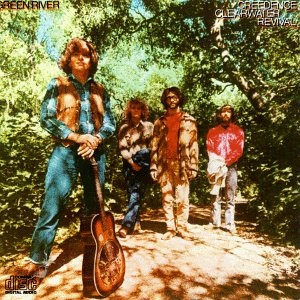
I’m not sure when I first heard the band Creedence Clearwater Revival, probably on the radio back in 1969. Neither can I remember which was the first of the small collection of CCR singles I bought, probably “Bad Moon Rising”, the band’s only chart topper in the UK, in the same year. With a steady newspaper round and its weekly wage of one pound sterling, I was able to expand upon my small LP record collection, then currently standing at just a handful. Of the records I would buy around this time, most of which would be the affordable sampler LPs that I didn’t have to save for. Having to save up for records was a little like the difference these days between binge watching a box set or having to wait a week for the next instalment of your favourite TV series. I often had to wait. One of my regular haunts was Foxes Records in the Arndale Centre, a place I would visit even if my pockets were empty, which was more often than not. Flicking through the browsers became a regular pastime, carefully pulling each record sleeve out to read everything printed on it. If ever I had sufficient coinage in my pocket, I would read more intently and spend a great deal more time deciding which record to buy. Creedence Clearwater Revival’s third LP Green River, with its soothing mottled sleeve showing a seemingly carefree sun-drenched California, was a bit of a no brainer at the time. CCR was briefly my favourite band in the late Sixties and I’d had my eyes in this record for some time. I remember taking the record out of the plastic carrier bag on the bus home and gazing at the picture on the cover, which was dominated by the figure of John Fogerty. I had an insatiable desire to look just like that. Some great tunes here, including “Bad Moon Rising”, “Lodi” and the title song of course.
016 | Byrds | Byrdmaniax | CBS 64389 | 1971

This is the tenth studio album by the Byrds and the second album to feature the line-up of Roger McGuinn, Clarence White, Gene Parsons and Skip Battin, the other one being the previous year’s Untitled. Not as critically or indeed commercially successful as the band’s two previous albums, nor particularly appreciated by the band itself, the blame being placed squarely on producer Terry Melcher’s shoulders, not least for overdubbing strings and horns without the band’s knowledge. The old story really. “Kathleen’s Song” might have been considered an otherwise pleasant song but for the strings, which turns the song into something utterly bland. There are one or two memorable moments though, not least the album closer, a cover of Jackson Browne’s yet to be released “Jamaica Say You Will”, a song that went on to open Browne’s own acclaimed debut album, and in the case of the Byrds’ reading, helped along with a fine vocal performance courtesy of Clarence White, a superb musician who was sadly killed a couple of years later by a drunk driver. Not my favourite Byrds album by any stretch, but it does include “Pale Blue”, which I quite enjoy hearing occasionally. I later heard a version of this song minus the strings and it’s infinitely better. What was Doris Day’s son thinking? Que Sera Sera!
015 | Stephen Stills | Stephen Stills 2 | Atlantic 2401013 | 1971

The second album by Stephen Stills was released just seven months after his eponymous debut, both albums released on the Atlantic label. Highly prolific at the time as a songwriter, Stills had easily enough material accumulated for a double album, which had been the original plan, but was talked out of it by label boss Ahmet Ertegun. Gathering together a number of notable musicians, including Nils Lofgren, Eric Clapton, Billy Preston, Dr. John, David Crosby and Jerry Garcia, the latter notable for his pedal steel guitar on the album opener “Change Partners”, the album was recorded in Miami, some of the sessions taking place well into the early hours of the morning. The LP is also remembered for the presence of the Memphis Horns, which effectively brought an entirely different sound to Stills’ work, though there were one or two Crosby Stills Nash moments, including “Fishes and Scorpions”. One of the songs on this record was re-recorded for inclusion on the later album, the tender “Singin’ Call”, written for his then love interest Rita Coolidge, appearing on Stills Alone (1991). The one song left over from his previous tour with Crosby, Stills, Nash, & Young was the soulful “Bluebird Revisited”, one of the songs from the band’s famous Woodstock appearance a couple of years earlier. Aesthetically speaking, I always wanted sideburns like that, but alas, I had to settle for the receding hairline instead.
014 | Joni Mitchell | Blue | Reprise K44128 | 1971
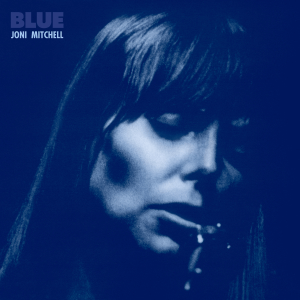
It appears to be rather cool these days, though ‘cool’ is probably not the coolest of words to use anymore, to cite any one of Joni Mitchell’s studio albums, as one’s all-time favourite. Some say Court and Spark, many say The Hissing of Summer Lawns, others choose Hejira, and more recently, even the more recent Night Ride Home pops up on certain ‘favourites’ lists, but I guess it all comes down to personal taste in the end. I’ve lived through dozens of end-of-year polls where the best album of all time has alternated between Revolver and Pet Sounds, depending on the era, whilst during previous years, it had always been Sgt Pepper and nobody ever batted an eyelid. I try not to be too snobbish about these things, though I have no qualms in placing Blue right up there amongst the best of them any day of the week. I don’t know why I adore this album so much, it certainly came along at a time when heavy guitar riffs and licks were ‘my thing’, not your common or garden mountain dulcimer, that’s for sure. In fact, at first, some of Joni’s vocal affectations, you know, that vibrato warbling thing she used to do, could be a little irritating at times, but I suppose, in the end, it’s the quality of those brilliant songs that really seals the deal; “A Case of You”, “Little Green”, “Carey”, “All I Want”, “River”, “California” etc. Most songwriters would give their right arm to have written any one of ‘em. After hundreds of listens, over many years, I don’t think I could be more grateful of the fact that I was lucky enough to have been born in an era that produced Joni Mitchell.
013 | Paul and Linda McCartney | Ram | Apple PAS 10003 | 1971

This has always been my own particular favourite Paul McCartney album, even when it was unpopular to admit such a thing, from the time I first bought it in the early 1970s to the present day. Paul and Linda McCartney’s collaborative album was released just over a year after the official break-up of the Beatles, and was very much derided by both critics and fans alike, not least for the alleged digs at Paul’s former writing partner on such songs as “Too Many People”, “Dear Boy” and “3 Legs”, the latter identified as a jibe against all three ex-band mates, though much of it was denied by the McCartneys at the time. There again, didn’t Lennon write “How Do You Sleep?” It was all in-fighting at the time, with pictures of fornicating beetles and Lennon’s legendary pig response, so all’s fair in love and war I suppose. To me, Ram is just a great album, a record packed with highly melodic, if at times whimsical songs, and an album that might have benefitted from the inclusion of “Another Day”, which was recorded at the same sessions in New York, but released as a single instead and kept off the final album, as were many of the Beatles singles before it. Ram was the first post Beatles record I bought, while George Harrison’s possibly superior All Things Must Pass had to come a little later, due to it being a more expensive triple album. Ram is certainly more highly regarded these days, as it should be.
012 | Mott the Hoople | Wildlife | Atlantic SD8284 | 1971
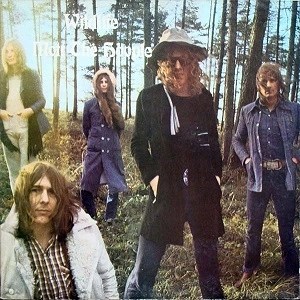
Recorded in February 1970, Mott the Hoople’s third studio album Wildlife was released in the UK back in May 1971 on the Island label and on Atlantic in the US. The classic band line-up at the time was still Ian Hunter, Mick Ralphs, Verden Allen, Pete ‘Overend’ Watts and Dale ‘Buffin’ Griffin, each of who were represented by their own symbols on the cover artwork, a good six months before Led Zeppelin came out with theirs, albeit in the case of Mott, merely generic astrological symbols with Hunter and Allen sharing the same one. The album opens with Mick Ralphs’ “Whisky Woman”, a mixture of a straightforward, almost pedestrian rock riff, together with a pop chorus, Ralphs taking the lead vocal, as he also does on “Wrong Side of the River”, “Home is Where I Want To Be” and the country flavoured “It Must Be Love”, for which the band bizarrely turn into the Flying Burrito Bros for a brief moment. Ian Hunter could always do sensitive when he turned his mind to it, notably “Angel of Eighth Avenue” with its delicate gypsy violin and Dylan-esque vocal delivery, not to mention Ralph’s distinctive guitar solo towards the end. The album was mostly produced by the band, though Guy Stevens was around to produce the opening track and co-produce a couple of others, but remained suspicious by his absence for the rest. He was back to produce the band’s next album Brain Capers later in the year, before standing aside for David Bowie to take care of things on All the Young Dudes in 1972. The album also features a reworking of a Melanie gospel song, “Lay Down” which appeared on her own Candles in the Rain album around the same time. After seeing the band on this album cover, and then catching them live at the Top Rank in Doncaster, to me, a young school kid at the time, it wasn’t the hair, it wasn’t the shades, it wasn’t the jackets nor indeed the floppy hat, it was those weird shaped guitars, all the way.
011 | Black Sabbath | Master of Reality | Vertigo 6350-050 | 1971
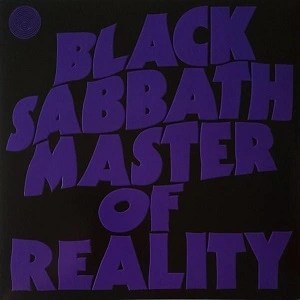
The third album by Black Sabbath originally came in an embossed envelope sleeve and was released on the iconic swirling Vertigo label, a more than suitable image for this Midlands heavy rock outfit. The silver metal crucifix, ten times larger than the ones worn by devoted Christians up and down the country soon became part of this fifteen year-old’s daily attire. Master of Reality was at first slightly disappointing, especially after the band’s self-titled debut and its popular follow up Paranoid, which featured the surprising hit single of the same name. Despite the album’s initial negative critical response, the album is now considered one of the best heavy metal albums of all time. The initial sound we hear at the beginning of the opening song “Sweet Leaf” is guitarist Tony Iommi coughing after taking a drag on a particularly potent spliff. I never did get to see the band live, though I had a ticket for one of their early Seventies shows at the City Hall in Sheffield. I dutifully turned up at the venue only to be told that the gig had been cancelled due to ill health. It was the first time I was unable to see, let alone climb the stone steps of the venue, for the mass of denim and leather, a whole crowd of disappointed fans spread out in front of the hall, each wearing unfeasibly large crucifixes and bemoaning the fact that they wouldn’t be able to bang their heads to the opening riff of “Children of the Grave” or indeed “Into the Void” until next time. There would not be a next time for me personally as I gave up on the band after the fourth album and moved on to Mott the Hoople.
010 | Jethro Tull | Living in the Past | Chrysalis CJT 1 | 1972
Released between Thick as a Brick and A Passion Play, in July 1972, the Living in the Past double album set is a kind of ‘the story so far’ compilation release, not so much a greatest hits, but a hotchpotch of singles, outtakes, live cuts and obscurities. Lavishly packaged for its time, the album was dressed in a fabulous gatefold sleeve complete with colour booklet, presented like a photograph album, with a variety of band shots either on stage, at play or at ease. Some of the most memorable singles are included on the album, including “Witches Promise”, “Life’s a Long Song” and the title track, memorable for its “Take Five” time signature and infectious bass line. Among the singles, there’s a representative track from each of the band’s first four albums, notably “Locomotion Breath” from Aqualung and “Song for Jeffrey” from the band’s 1968 debut This Was. Two extended live tracks are also included, recorded at a charity concert at New York’s Carnegie Hall. Jethro Tull may have been ridiculed mercilessly by the likes of Lester Bangs and other rock critics, dismissed by John Peel after their first album and occasionally mocked by yours truly, especially when it comes to one-legged poses and cod pieces, but I have to confess that I admire some of the band’s albums to death.
009 | George Harrison | Concert for Bangladesh | Apple STCX3385 | 1971

When I first added this three disc box set to my burgeoning collection back in the early 1970s, it was probably the most expensive record I’d bought up until that point. It also marked the beginning of the benefit rock concert, a good few years prior to Live Aid. Reports from Bangladesh appeared regularly on the news at the time, but was largely ignored by this 14 year-old, until a Beatle got involved. George Harrison set out the situation clearly and concisely in the opening lines of the title song “Bangla Desh”, a message even the hardest of cynics couldn’t ignore. His friend was in trouble and he needed some help. I was first of all bewildered at the sheer volume of the applause throughout the recording, not least following George’s introduction to Bob Dylan’s short set. It seemed to me that the engineer had increased the volume directly after the ‘quiet one’ brought on this ‘friend of us all’. Dylan wasn’t a friend of mine, though this introduction and the five songs that followed helped me on the way to becoming a faithful follower a little later. The Dylan side wasn’t my least played side, even back then, that particular honour being reserved for the Ravi Shankar side, whose request for no smoking during the set I took quite literally, waiting until the middle of “Wah Wah”, which opened side two, to light up my Camel. I was drawn to the album after seeing the film of the concert at a local Doncaster cinema, which at the time featured all the key session players, plus Eric Clapton, Billy Preston, Leon Russell, Ringo Starr and Badfinger to name but a few. Curiously, over half a century on, the Dylan side is perhaps the only one of the sides that I regularly play. These three records seem to have stood the test of time, though the box they came in hasn’t.
008 | Stomu Yamash’ta East Wind | Freedom is Frightening | Island ILPS 9242 | 1973

In the early 1970s, I was drawn to certain bands and artists, not so much for what they sounded like or even looked like, though these would be crucial factors when choosing records, but rather, the label they were released on. The important labels to watch out for in those days were Harvest, Atlantic, Liberty, Reprise, CBS, Vertigo and not least, Island. A quick flick through the sampler albums released on those labels at the time revealed a whole bunch of artists whose LPs made up the bulk of my burgeoning record collection. The Island roster itself boasted such acts as King Crimson, Fairport Convention, Traffic, Spooky Tooth, Amazing Blondel, John Martyn and Sandy Denny, whose albums I quickly snapped up as if they were going out of fashion. One of the more obscure artists on Island was the Japanese percussionist Stomu Yamash’ta, who first came to my attention with the release of the album Floating Music, the sleeve design of which I soon transferred to a mural painted above the family bath in our first house, which may still be there for all I know, a beautiful harbour scene complete with sunrise, boats and Japanese hiragana. The LP was released as part of the budget priced HELP series, which I began collecting with its first release, Myrrh by Robin Williamson, swiftly followed by Pictures at an Exhibition by Emerson, Lake and Palmer, Earthbound by King Crimson (oh dear), and Morris On by Ashley Hutchings and Co. Once I became attracted to the instrumental work of Yamash’ta, I sought out more, including this little gem, Freedom is Frightening, released on the Island label in 1973. No matter how many listens, how many play throughs, how much flipping the record over, I will never get past the sheer beauty of one track in particular, the haunting final track (of four lengthy pieces), “Wind Words”, a delicate tune that I instantly fell in love with and a tune later featured in the Nic Roeg film The Man Who Fell to Earth, featuring Hisako Yamash’ta haunting and highly memorable violin solo.
007 | Arlo Guthrie | Hobo’s Lullaby | Reprise MS2060 | 1972

Completely accessible country-inflected fourth album by Arlo Guthrie. Only a couple of years earlier, a stoned Guthrie got up on a dodgy looking stage in Bethel, upstate New York, to tell the audience that everything was ‘far out’ and that he had been rapping to the fuzz who told him that “New York Thruway is closed – man”. Woody Guthrie’s hippy son was always a charismatic counter culture figure, largely due to his starring role in Arthur Penn’s screen adaptation of Guthrie’s engaging Alice’s Restaurant story, despite his almost unintelligible rapport with the masses at the most iconic of all festivals. For Hobo’s Lullaby, Guthrie surrounds himself with the cream of session men, including Byron Berline, Ry Cooder, Doug Dillard, Richie Hayward, Jim Keltner, Spooner Oldham and Clarence White amongst them, together with Linda Ronstadt adding vocals. Predominantly covers, the songs include material from the pens of Bob Dylan “When My Ship Comes In”, Hoyt Axton “Somebody Turned the Light On”, Guthrie Snr “1913 Massacre” and most notably Steve Goodman’s “City of New Orleans”, Guthrie’s one and only hit record, presumably due to Goodman’s radio friendly feel good lyric “Good morning, America, how are ya?”
006 | Emerson Lake and Palmer | Trilogy | Island ILPS 9186 | 1972

Although considered a so-called supergroup at the time of the trio’s initial formation in 1970, Emerson, Lake and Palmer soon became the stick to bash all Progressive Rock bands with, mainly due to their penchant for showing off, over indulgence and excessive touring shenanigans. Who could forget the three articulated trucks with each of the individual musicians’ surnames painted on top, purposefully transporting far too much equipment, including Persian carpets and gongs? Trilogy, the band’s third studio album, which was sandwiched somewhere between Tarkus and Brain Salad Surgery, with a live album Pictures at an Exhibition also released around the same time, became a firm favourite with both fans and the trio alike. The former King Crimson singer, Greg Lake, considered the album his favourite among the band’s ten albums, all released between 1970 and 1994. Once again the trio’s Classical influence can be found in such pieces as “Hoedown”, based on an Aaron Copeland ballet and “Abaddon’s Bolero”, a nod towards Ravel no doubt. “From the Beginning” is possibly the album’s most straightforward soft rock composition, an acoustic guitar-led song, with some fine guitar by Lake and an interesting synthesiser solo, courtesy of Emerson, so commercial in fact, that it was released as a single. Salvador Dalí was apparently approached to design the sleeve, though the famed artist’s fee turned the band’s attention to the more affordable Hipgnosis, who came up with a somewhat half-hearted end result. More interesting is the inner gatefold photograph, which shows a multitude of Emersons, Lakes and Palmers posing deep within Epping Forest on a fine autumn day.
005 | Family | Bandstand | Reprise K54006 | 1972

The penultimate Family album, before the band called it a day with the following year’s It’s Only a Movie. Bandstand was the sixth album release by the Leicester-based band, presented in a lavish sleeve in the style of a Bush TV22 television set, with a photo of the band in the studio behind the ‘window’. The album was possibly the band’s most accessible album, opening with “Burlesque”, one of the band’s best remembered songs. The song was also released as a single and went on to reach number 13 in the UK charts, which fared better than it’s follow up single, “My Friend the Sun”, the McCartney-like song that opens side two of the album, later covered by Linda Lewis, who also appears on Bandstand as a backing singer. John Wetton, who had contributed much to the band, especially on their previous album Fearless, left the band shortly afterwards to join King Crimson. I don’t suppose Family was everyone’s cup of tea, possibly due to Chapman’s challenging rasping vocal, though personally, the band got me through many a smoke-filled, whiskey-fuelled night in the early 70s.
004 | Loudon Wainwright III | Album II | Atlantic 2400 142 | 1971
A young Doncaster hippie called Stu introduced me to the songs of Loudon Wainwright III at a late night party sometime in the early 1970s. I became an instant fan. The songs were completely different from anything I was listening to at the time and they gave me something to think about. I didn’t realise that it was possible to put an album out with just a mug shot on the cover, no smiles, no glamour, just the bloke next door really. It could have had something to do with the mixture of humour, irreverence and that inimitable sneer that first attracted me to this performer, something I would become more and more familiar with over time. While “Me and My Friend the Cat” provided the sneer, “Motel Blues” provided the beauty, despite what would now be considered dodgy subject matter. Teenage groupies, motel rooms, soap and towels etc., just doesn’t sit well these days, though it doesn’t bother me in the least. In the early 1970s I used to make a note of the date of purchase on the inner sleeve, certainly for the first couple of dozen LPs that I bought and this one clearly states ‘73. I first heard the album earlier, but had to wait until I got a job before I could buy my own copy, which would have been two years later. The LP also led to the discovery of Kate and Anna McGarrigle, John Prine, Steve Forbert and a host of others.
003 | Dave Mason | Alone Together | Blue Thumb BTS19 | 1970
After a series of disputes, Dave Mason left Traffic to pursue a solo career releasing his debut album in the summer of 1970, Alone Together being a bold debut with no expense spared on the actual product itself. Was there really any real sense in having a fold-out die-cut sleeve, presumably designed to hang up somewhere in your bedsit. Why the tux and top hat? These were the questions I asked myself as I listened intently to the eight songs back in the early 1970s. Some of the earlier pressings were made with a marble effect vinyl, which was an aesthetic decision to make the actual record look better when hung up in said bedsit. Mason surrounds himself with one or two key players, Leon Russell, Jim Capaldi, Carl Radle and Jim Gordon, together with singers Bonnie Bramlett and Rita Coolidge. My favourite track is the album closer “Look at You, Look at Me”, with its extended guitar solo. A few years passed and the record disappeared from my shelves for some inexplicable reason. I’d either sold it, swapped it, lost it or eaten it in leaner times. Nice to have it back though.
002 | Jimi Hendrix Experience | Smash Hits | Polydor ACB 00219 | 1968
If The Shadows was the first album I ever heard, then this album was the first one I ever bought with my own hard earned pocket money (£1), an LP I obtained second-hand from an older boy from up the street, who had allegedly ‘moved on’ from such things. I still haven’t moved on from Jimi Hendrix. Up to this point, my record collection had been made up exclusively of 45rpm singles, some of which I kept in a plastic wallet which I referred to as an album. Others were kept in what I described as the Little Orange Box, a standard singles box that I received as a present. Owning an LP though, was a most exciting progression, a real long playing gramophone record that crackled with static when removed from its inner sleeve. I distinctly remember placing the cover on my bedroom shelf, as I listened to the record, then standing back to admire my LP collection (of one), eagerly anticipating future additions, the first of which would follow a week later, once again from the money I received for shoving newspapers in letterboxes around Hexthorpe village. Jimi Hendrix Experience Smash Hits was the first Hendrix compilation and featured some of the band’s best known singles and B sides, together with four tracks from the band’s debut album Are You Experienced released the year before. Though the band’s second album Axis: Bold As Love was released five months before Smash Hits, the compilation featured none of the songs from that album. It’s worth noting that neither Noel Redding nor Mitch Mitchell appear on the cover shot, the focus being on the guitarist himself. Favourite songs are “The Wind Cries Mary”, “Foxy Lady” and “Purple Haze”.
001 | The Shadows | The Shadows | Columbia SX1374 | 1961
The Shadows was the very first LP record I took out of its sleeve and played on my dad’s radiogram player back in the early 1960s. I would’ve been around five or six at the time, though possibly slightly older, too young to be handling grown up records. It was the only record in my dad’s small collection that could be described as a contemporary pop album and crucially, the only one to feature guitars on the cover. Most of the records stored under the gramophone lid were by the Big Bands or Swing Bands, records by the likes of Glenn Miller and Benny Goodman, but this was noticeably different, the four musicians, Hank Marvin, Bruce Welch, Jet Harris and Tony Meehan posing in a relaxed fashion, each one of them sporting their very best Cashmere sweaters fresh from the Freemans catalogue and each trying their best to look fantastically cool, with varying degrees of success. Recorded at the EMI Studios between the autumn of 1960 and the summer of 1961, the recordings were made on analogue equipment and in real time, with each track recorded on a one-track-per-day basis and with no apparent overdubs. If the take should be cocked up for any reason, then it was straight on to take 2 and so on. Though the LP now sounds a little dated, especially the vocal performances, some of the instrumentals still sound fresh, notably “Blue Star”, “Sleepwalk” and “Nivram”, which the observant among us will have already twigged is ‘Marvin’ spelled backwards.

